There hasn't previously been a treatment vs pancreatic cancer this successful. Striking improved (a > doubling) survival results @NEJM and @ASCO today with daraxonrasib, which also became available via an FDA approved early access program and began shipping to physicians this week @RevMedicines
https://t.co/e04jqJMPw0
🚨JUST NOW: SpaceX has SUCCESSFULLY launched VERSION 3 of Starship from Starbase, TX
As the largest Starship EVER, V3 is a MAJOR evolutionary upgrade from V2, focused on higher performance, reliability, and FULL reusability
CONGRATS @elonmusk, SpaceX, and AMERICA🇺🇸
We now have a female Bryan Johnson.
It’s Kate Tolo.
She will become the most measured female in history.
+$2 million of spend per year
+ Developing a female-specific protocol
+ Sharing everything for free
To start, she will spend 3 months mapping her baseline. Men, in contrast, can get their baseline done in 1 or 2 weeks.
+ 3 months for baseline measurement
+ across 4 time points per cycle
+ doing the same thing every day
+ a dedicated full-time medical team
For context on the extensiveness of measurement, during the past 5 years, we’ve collected 1.5 billion data points on my body. I suspect Kate will exceed that given technology has improved since I started.
The goal is to create a repeatable waveform of hundreds of life-critical biomarkers. Once the baseline is acquired, she will begin interventions.
We will try to answer practically useful questions and share all of the data + learnings for free.
Can fertility be improved?
+ Should women cold plunge?
+ Can PMS symptoms be alleviated?
+ What should a female sauna protocol be?
+ Should dosage change throughout the month?
+ What keeps a cycle regular?
+ Does the body need more iron, magnesium, or protein at specific phases?
+ Should women fast?
+ Should recovery protocol change by phase?
+ What's the earliest detectable signal of perimenopause?
+ Can perimenopause be slowed?
+ How is cognitive load & mood affected?
+ Does stress impact men and women the same?
Kate has suspected endometriosis. 10% of all women do. We will try to tackle this too. I am excited for all of the surprising things we will hopefully uncover.
Unlike me, Kate does not have the innate desire to wake up at 4:30am and do six hours of longevity therapies.
She’s the cofounder of Blueprint, building in the trenches with me since day one. She understands the game and how hard it is.
In many ways, this is a sacrifice for her. She is a creative person, going from a life of freedom and spontaneity to a rigid protocol.
Traditionally, RCTs have been viewed as the gold standard. But RCTs have underserved women. The FDA banned women from clinical trials for 16 years (1977 to 1993), and most "medicine for women" is still medicine tested in men. Demanding RCT-only evidence for women's health is demanding evidence that doesn't exist. There is not enough practical scientific literature for women to reference only RCTs. It leaves half the population without a path to know what to do.
N=1 medicine is gaining ground and picking up where RCTs specifically fail. Individual science experiments give us signals that answer what to do on a day-to-day basis. This is even more important for women.
If you’re new to Kate and my world, I want you to understand that we have your back. Our intentions are to be a sturdy, reliable force in your life. To care for your best interest as we’d care for our own. We want what’s best for you and our loyalty is to your existence.
It’s pretty cool to be living in a time when we may be the first generation to not die. I’m not suggesting immortality, but lifespans so long that we stop thinking about lifespans.
At the end of the day, the one thing we each care about more than anything else is one more breath. I’m proud of Kate for taking on this responsibility. It’s painful, exhausting and costly.
The beginning of the world’s first n=2.
I just had the craziest experience at the airport.
We are about to board a flight to Atlanta when the pilot from the incoming plane walks out of the jetway. Guy is probably late 50s, salt and pepper hair, military look. The kind of pilot you instantly feel good about seeing on your flight.
Pilot walks over to the counter, gets on the PA system, and starts addressing everyone. “Folks, I’ve been doing this a long time. Flying one of these jets is easy. The hard part is looking at 130 people and telling them their flight is going to be delayed.”
Audible groans throughout the boarding gate. Most people here are flying to Atlanta as a layover before another flight. 130 people just had their day become a complete mess.
The pilot goes on. “I get it, trust me. But here’s the deal: During our landing, we had a small mechanical issue. I’m not your pilot for the next leg, but I don’t feel confident the jet’s safe to fly until we have a mechanical team look it over, and I don’t feel comfortable asking the next pilots to fly you guys until we get confirmation.”
He points at the agents next to him behind the counter: “Now, none of this is the agents’ fault. Please be kind to them. I’m the one who made this decision, not them, so any inconvenience you experience is my fault. Just please know that I don’t do this lightly, and I’m only doing it because I believe it’s in the best interests of everyone’s safety.”
Now this is where the story gets crazy. The pilot puts the microphone down, grabs his suitcase, and all the people in the gate…
Start clapping.
I’m not joking, everyone starts clapping for the guy. 130 people who just had their travel plans ruined give an ovation to the guy who made the decision and delivered the message.
All because he addressed them with decency and transparency, took ownership of the decision, made it clear that it was necessary, and explained why it was in everyone’s best interest.
It’s honestly one of the best examples of strong communication—of strong leadership, for that matter—that I’ve seen in a long time.
@Delta, whoever your Atlanta to Wichita pilot was this morning, he’s one of the good ones. Please tell him the delayed passengers of flight 1637 appreciate what he did.
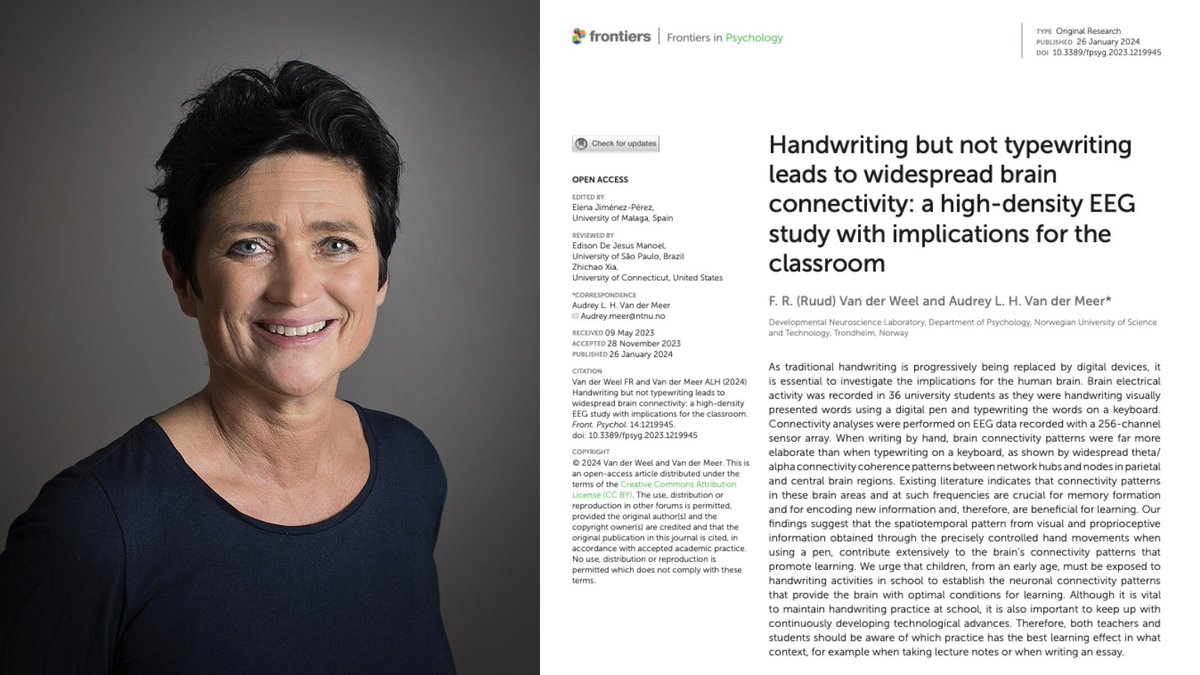
A Norwegian neuroscientist spent 20 years proving that the act of writing by hand changes the human brain in ways typing physically cannot, and almost nobody outside her field has read the paper.
Her name is Audrey van der Meer.
She runs a brain research lab in Trondheim, and the paper that closed the argument was published in 2024 in a journal called Frontiers in Psychology. The finding is brutal enough that it should have changed every classroom on Earth.
The experiment was simple. She recruited 36 university students and put each one in a cap with 256 sensors pressed against their scalp to record brain activity. Words flashed on a screen one at a time.
Sometimes the students wrote the word by hand on a touchscreen using a digital pen, and sometimes they typed the same word on a keyboard. Every neural response was recorded for the full five seconds the word stayed on screen.
Then her team looked at the part of the data most researchers had ignored for years, which is how different parts of the brain were communicating with each other during the task.
When the students wrote by hand, the brain lit up everywhere at once.
The regions responsible for memory, sensory integration, and the encoding of new information were all firing together in a coordinated pattern that spread across the entire cortex. The whole network was awake and connected.
When the same students typed the same word, that pattern collapsed almost completely.
Most of the brain went quiet, and the connections between regions that had been alive seconds earlier were nowhere to be found on the EEG.
Same word, same brain, same person, and two completely different neurological events.
The reason turned out to be something nobody had really paid attention to before her work. Writing by hand is not one motion but a sequence of thousands of tiny micro-movements coordinated with your eyes in real time, where each letter is a different shape that requires the brain to solve a slightly different spatial problem.
Your fingers, wrist, vision, and the parts of your brain that track position in space are all working together to produce one letter, then the next, then the next.
Typing throws all of that away. Every key on a keyboard requires the exact same finger motion regardless of which letter you are pressing, which means the brain has almost nothing to integrate and almost no problem to solve.
Van der Meer said it plainly in her interviews.
Pressing the same key with the same finger over and over does not stimulate the brain in any meaningful way, and she pointed out something that should scare every parent who handed their kid an iPad.
Children who learn to read and write on tablets often cannot tell letters like b and d apart, because they have never physically felt with their bodies what it takes to actually produce those letters on a page.
A decade before her, two researchers at Princeton ran the same fight using a completely different method and ended up at the same answer. Pam Mueller and Daniel Oppenheimer tested 327 students across three experiments, where half took notes on laptops with the internet disabled and half took notes by hand, before testing everyone on what they actually understood from the lectures they had watched.
The handwriting group won by a wide margin on every question that required real understanding rather than surface recall.
The reason was hiding in the transcripts of what the two groups had actually written down.
The laptop students typed almost word for word, capturing more total content but processing almost none of it as they went, while the handwriting students physically could not write fast enough to transcribe a lecture in real time, which forced them to listen carefully, decide what actually mattered, and put it in their own words on the page.
That single act of choosing what to keep was the learning itself, and the keyboard had quietly skipped the choosing and skipped the learning along with it.
Two studies. Two countries. Same answer.
Handwriting makes the brain work. Typing lets it coast.
Every note you have ever typed instead of written went into your brain through a thinner pipe. Every meeting, every book highlight, every idea you captured on your phone instead of on paper was processed at half depth.
You did not forget those things because your memory is bad. You forgot them because typing never woke the part of the brain that would have made them stick.
The fix is the thing your grandmother already knew.
Pick up a pen. Write the thing down. The slower road is the faster one.
I've been praying the past few weeks. Unsure why.
There's good evidence behind prayer. It mimics breathwork, calming the nervous system, dropping cortisol, and quieting the brain. Daily prayers show lower depression, anxiety, and pain.
I'd like to develop a prayer practice. Growing up, the protocol was written for me. Explaining whom to pray to, the structure of the prayer, and the boundary conditions.
I don't really know how to pray now.
“We’re rewiring our brains to become lonely and depressed.”
Dr. Arthur Brooks says it’s critical we get personal devices like phones out of schools.
“There shouldn’t be a classroom in America, from kindergarten through PhD, where you’re allowed to use your personal devices.”
“You shouldn’t have them in there.”
“The most important time to not have the devices is during lunch.”
“That’s when they’re supposed to be talking to each other.”
@arthurbrooks
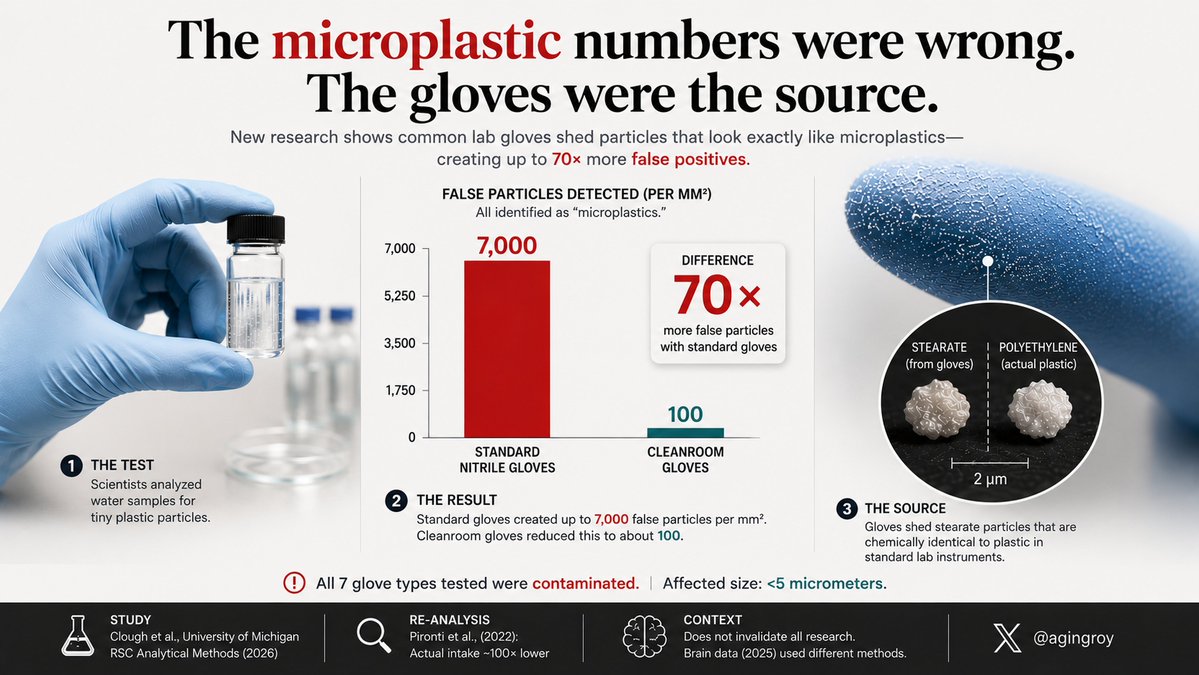
7,000 false positives per square millimeter. The culprit was the lab gloves.
University of Michigan researchers just upended a core assumption in microplastics science. Latex and nitrile gloves, worn by the scientists doing the measuring, shed stearate particles that look chemically identical to polyethylene. Standard infrared and Raman instruments can't tell them apart. The gloves were counting as plastic.
Seven glove types tested. All contaminated. The cheapest fix: switch to cleanroom gloves, which dropped false positives to around 100 per mm² vs. 7,000.
The "credit card per week" headline (5 grams, WWF/Newcastle 2019) has separate problems. A 2022 re-analysis found severe methodological errors in the original estimate. Actual measured intake is likely 100x lower.
None of this means microplastics are harmless. Last month's data on brain accumulation still stands. But the numbers driving the panic may have been measuring the scientists, not the environment.
Science catching its own errors is exactly how it's supposed to work.
If you speak up about patient safety in a corporate healthcare system, you will be retaliated against. Plan accordingly.
Pediatrician Dr. Karla Lester resigned from a children's hospital three and a half years ago, on her attorney's directive, effective immediately. She had built the population health center from scratch. She had built the weight management clinic over three years. Her crime was telling the CEO that the outcomes he was presenting publicly were not real.
Twenty people at that organization, she says, took turns gaslighting her over months. The pattern was the same every time.
Stage one. She would point out a falsified outcome or a quality concern. Stage two. She would be told it was her tone, her personality, her behavior. Stage three. Meetings would get scheduled where everyone but her would mysteriously cancel.
The three operating strategies of a gaslighting executive, in her words.
1. Fabricate outcomes to suit the audience.
2. Control the narrative at all costs.
3. Silence anyone who speaks up.
The three stages a target moves through, also in her words.
1. Disbelief. "Did that just happen?"
2. Defense. "I have to explain myself."
3. Depression.
What she wants every physician, nurse, and clinician to internalize. You will not fix this. The system is not asking to be fixed. Your job is to name the gaslighting the moment it starts, refuse to engage in the "gaslight tango," document everything, never take a meeting alone, and find an employment attorney who works specifically with physicians before you think you need one.
One more piece worth bookmarking. The retaliation is rarely the work of one bad executive. It is delivered by what Dr. Lester calls "shape shifters", the people around the leader who will adopt whatever posture, including lying about clinical outcomes, in order to keep their jobs. They are the delivery mechanism. The culture is set at the top. This is why HR is almost never the right place to go first, and why a colleague-witness or a recording is almost always the right thing to insist on before any closed-door meeting.
Of the twenty people who participated in gaslighting her, fourteen have since left the organization.
What is the first signal you have learned to read that tells you a leader is no longer arguing with you in good faith?
Search "The Podcast by KevinMD" wherever you listen to podcasts. Link in the replies.
#ThePodcastbyKevinMD
Alan has forgotten more about VO2max, aerobic training, all the heart rate zones, and elite level coaching than you’ll ever know. Following him you can actually LEARN.
So why is zone 3 simply not that great for training? Read. I know it’s hard. And find out.
Elon Musk just defended America better than every politician in Washington combined.
Musk: “After World War 2, the US could have basically taken over the world and any country. Like we got nukes, nobody else got nukes. We don’t even have to lose soldiers. Which country do you want?”
One nation on earth held a weapon nobody else had.
Total dominance. Zero competition. No risk of retaliation.
Every empire in history that held that kind of advantage used it.
Rome. The Mongols. The British. The Ottomans.
They conquered until they collapsed.
America had a bigger advantage than all of them combined.
And it rebuilt the countries it just defeated.
Musk: “The United States actually helped rebuild countries. So it helped rebuild Europe, it helped rebuild Japan. This is very unusual behavior, almost unprecedented.”
Almost unprecedented?
It had never happened before. Not once in 5,000 years of recorded history.
The Marshall Plan wasn’t foreign aid.
It was the most radical act of restraint any superpower ever committed.
America turned its enemies into allies. Turned rubble into economies. Turned surrender into partnership.
Germany went from ashes to the economic engine of Europe in a generation.
Japan went from unconditional surrender to the third largest economy on earth.
Three years after the war, America was flying food into Berlin.
A city in the heart of the nation that just tried to destroy it.
That’s not policy.
That’s a civilization deciding what it is at the exact moment it has the power to be anything.
You’re being told a story right now.
That America is the villain of history.
You hear it everywhere. Media. Universities. Social platforms.
Musk: “There’s always like, well America’s done bad things. Well of course America’s done bad things, but one needs to look at the whole track record.”
Every nation on earth has dark chapters. Every single one.
The difference is what a country does when nobody can stop it.
And when nobody could stop America, it fed its enemies and rebuilt their cities.
Musk: “The history of China suggests that China is not acquisitive. Meaning they’re not going to go out and invade a whole bunch of countries.”
Probably right.
China has historically built walls, not fleets.
But the real question isn’t about borders anymore.
We’re approaching a moment that mirrors 1945 in ways nobody has fully processed yet.
AI is going to give a handful of people a power advantage that makes nuclear monopoly look quaint.
If someone is going to hold that kind of power, who do you want it to be?
The country that conquered when it could? Or the one that rebuilt when it didn’t have to?
Every alliance. Every trade route. Every economy.
Billions lifted out of poverty.
All of it traces back to one act of restraint that had never been done before.
And carries no guarantee of being repeated.
The most powerful thing America ever did wasn’t building the bomb.
It was what it didn’t do after.
Time for some soul searching as a country.
11% of people who went through medical school and residency never practiced medicine.
Think of the cost in terms of time and money to get there only to leave.
We need to ask why and we need to fix our system
https://t.co/Q0TD2LUsNX
🚨 Anthropic just showed a 24-minute workshop on how to actually do prompts for Claude.
Taught by the people who built it.
Free. No registration. No paywall.
I've seen $300 courses that don't cover what they teach in the first 8 minutes.
Watch it and bookmark it now.
A new study of over 50,000 kids just dropped a sobering finding:
Kids getting more than 4 hours of screen time a day showed significantly higher rates of anxiety, depression, and attention problems like ADHD.
It’s not proving direct cause and effect, but the pattern is clear: when screens replace sleep, physical activity, and real human connection, mental health suffers.
The nurse practitioner on FOX Carolina put it simply — it’s less about the exact number of hours and more about what those hours are replacing.
Research consistently shows that excessive screen time disrupts melatonin production, reduces deep sleep, and limits opportunities for physical movement and face-to-face interaction — all critical for healthy brain development in children.
We’re raising a generation glued to screens, and the mental health fallout is becoming impossible to ignore.
Many families are now seeing the difference when kids get more outdoor time and less scrolling.
What do you think — are we letting screens take too much from our kids’ development, or do you think the benefits outweigh the risks?
What the ACA/Obamacare really accomplished, forcing physicians out of independent practice and into employment within large health systems. Independent practices were small businesses that competed to deliver quality care at affordable prices. Now we have regional oligopolies that use their market power to drive up prices.
I’m part of the rare disease community..
“I understand intimately why families facing devastating illnesses want access to innovative therapies. But innovation only works if the science ecosystem can differentiate true innovation from failure.
A recent Wall Street Journal column argues that the U.S. Food and Drug Administration (FDA) is standing in the way of hope for rare disease patients. It frames the debate as a simple moral choice: let patients try promising therapies or deny them a chance at survival.
That framing is dangerously incomplete.”
https://t.co/rqCZFoZ9Zg