@doomslide I mean, we can extrapolate the tech, or we can try to extrapolate the politics within existing capabilities. Total automation still needs breakthroughs, whereas mass labor suppression, enclosure of the intellectual commons, surveillance, manipulation, etc. are already feasible.
@doomslide imo "maturation of the tech" is the wrong framing. AI is a ruling class political project. The question is what the people behind the twelve figure investment decisions are trying to achieve and whether they can pull it off.
@cordeliers iiiinteresting. PBS had a documentary critical of AI recently. Credits rolled and the Ford and MacArthur Foundations were among the funders.
@KamStaszewski@doomslide It's been bubbling under the surface in the machine learning world for a long time. See, esp. Chomsky's disagreement with Peter Norvig over a decade ago. Is better and better prediction with statistical models science? Or does science require understanding?
@awildbread@FinitePhysicist Yes! I had the same reaction. It's a great parable for making sense of what we mean by 'knowledge'.
https://t.co/CwXrMCte5c
When we talk about AI writing code, one thing we should talk about is how this qualitatively changes this tradeoff space. Currently, writing code is very hard but we are pretty good at it. What if it was trivial to produce new programs but most of them were poor?
@burkov IP isn't the only problem. Existing sites of knowledge production (academic publishing, Stack Overflow, etc.) aren't just 'data', they're -systems- with feedback mechanisms for correcting, incentivizing and validating intellectual work. No attribution means those processes break.
there is an argument (which I've made privately until now) that one of the principal innovations of the large language model labs is a *legal* innovation, not a technical one
by building a system that hoovers up mind-bogglingly large volumes of human information and feeds it into a recombinatorial association machine, the companies have bulldozed the existing IP regime and made the contents of ~all human IP (including the most mundane) searchable, reconfigurable, and usable while also obscuring any trace of origin and eliminating a need to provide credit or attribution. much of the perceived benefit is therefore access and exposure to IP people would not otherwise have had access to, presented behind a system that abstracts the IP from its context and history and presents it as net-new information.
I imagine we would have seen ~similar productivity outcomes had Google actually been allowed to make productive use of the Google Books database over a decade ago.
@molly0xFFF My point is that it's not necessarily against the interests of the big players to destroy the commons. Obviously it's bad for us, but they may even *want* to degrade public sources of information. Among other things, it pulls the ladder up on potential competitors.
The incentive for AI companies is to make everything proprietary. All knowledge must be held internally. New knowledge can only be created internally. External sources of knowledge must be destroyed.
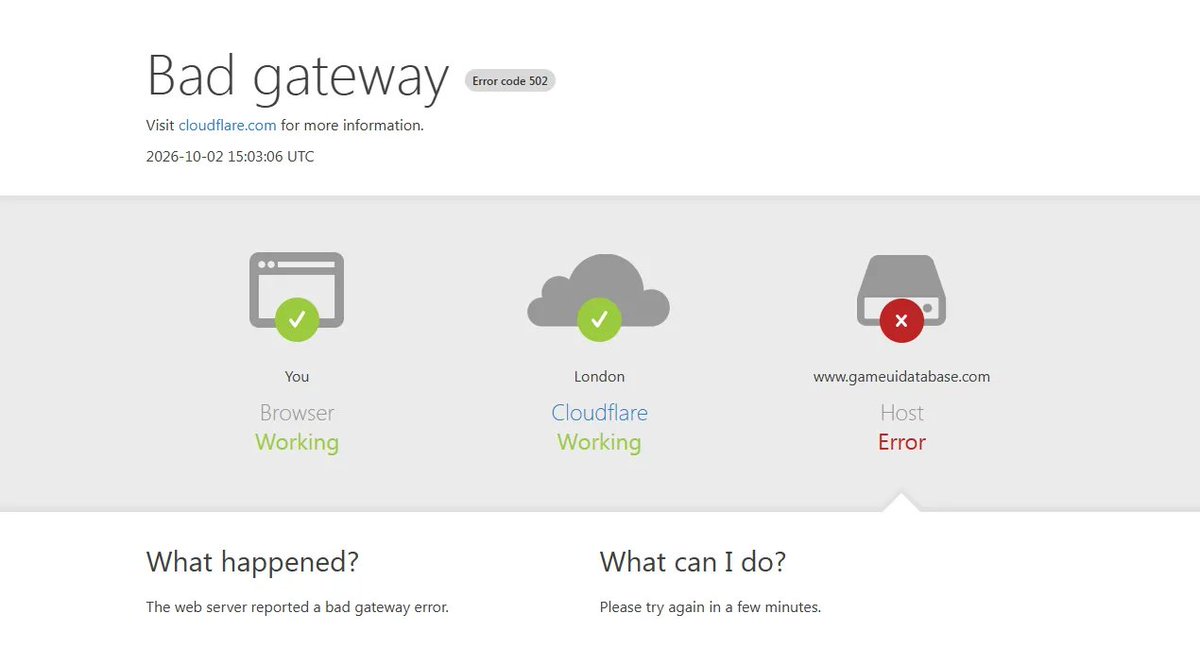
Yet again, the Game UI Database is being scraped to the point that it's getting knocked offline. Even Cloudflare's "I'm under attack" mode isn't working.
I just wanted to create a resource for real designers. I'm getting so fucking sick of this.
Why didn't OpenAI make the AI clean up the math papers before publishing them? Because it can't. The AI messes around doing random stuff at an unbelievable rate until it comes across a result. Its level of understanding and quality of guidance is still minimal.