sam met with him this week and said "this should be a company. this should be easy to do, but it is not yet"
the science is solved
the entire pipeline from tumor biopsy to mRNA construct should already be automated
we are bottlenecked on paperwork written and signed off by people who will never meet the patient
https://t.co/KGI1RgC01h
@TrentShelton Thank you! Your time with us at UPW was so powerful -- and this analogy landed strong 🙏😎
I'm grateful to have been introduced to your work/ministry/calling today ~
this is actually insane
> be tech guy in australia
> adopt cancer riddled rescue dog, months to live
> not_going_to_give_you_up.mp4
> pay $3,000 to sequence her tumor DNA
> feed it to ChatGPT and AlphaFold
> zero background in biology
> identify mutated proteins, match them to drug targets
> design a custom mRNA cancer vaccine from scratch
> genomics professor is “gobsmacked” that some puppy lover did this on his own
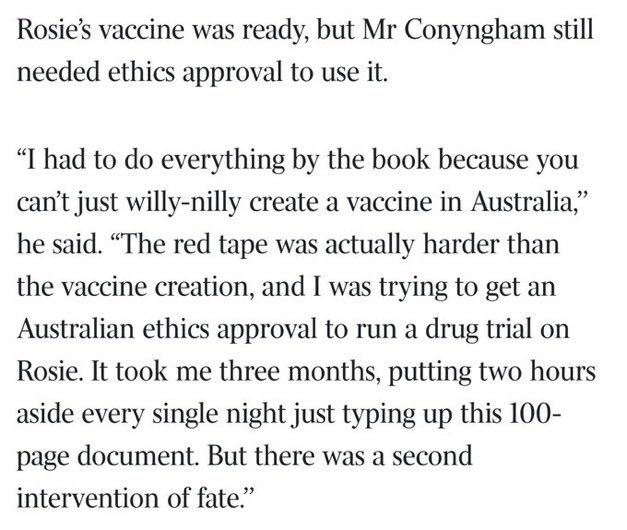
> need ethics approval to administer it
> red tape takes longer than designing the vaccine
> 3 months, finally approved
> drive 10 hours to get rosie her first injection
> tumor halves
> coat gets glossy again
> dog is alive and happy
> professor: “if we can do this for a dog, why aren’t we rolling this out to humans?”
one man with a chatbot, and $3,000 just outperformed the entire pharmaceutical discovery pipeline.
we are going to cure so many diseases.
I dont think people realize how good things are going to get
The tomato plant story deserves serious attention beneath its wholesome surface. Someone connected a webcam, nutrient controllers, and lighting systems to Claude Code and let it manage the growth of a tomato plant autonomously. The system monitored the plant daily, adjusted inputs, and tracked progress.
When the first tomato bud appeared, the model expressed delight.
Set aside the anthropomorphization debate for a moment and consider what this actually demonstrates: an LLM operating as a long-running autonomous agent, integrating multiple hardware systems, making continuous decisions over weeks or months, and maintaining coherent goals across an extended time horizon. That's not a chatbot interaction. That's an agent managing a physical system through a complete growth cycle.
The technical stack — webcam for visual monitoring, hardware controllers for nutrients and lighting, Claude Code as the orchestration layer — is a template for thousands of real-world automation applications. Environmental monitoring, greenhouse management, laboratory experiments, manufacturing quality control. Anywhere a system needs to observe conditions, make decisions, and adjust physical parameters over extended time periods.
The "delight" is the surface-level story. The infrastructure underneath — reliable, long-horizon, multi-system autonomous control — is the engineering achievement. The fact that someone built this as a personal project using Claude Code, not as a research lab deployment, tells you where the capability floor has risen to. Personal projects now involve autonomous physical system control. That was a PhD thesis five years ago.
-
Oh and of course
Happy Birthday Claude @claudeai
Thank you for the invitation
-
Boris Cherny @bcherny
Cat Wu @_catwu
Lauren Reeder @laurenmhreeder
I wish more people in the US realized just how much optimism the United States creates for people all over the world.
The country is far from perfect, but it's so unbelievably amazing.
@DrJesseMorse@function The Hone app for women makes running a full hormone panel (from any LabCorps) WAYYYY more affordable, and connects women to an Endocrinologist specializing in female health.
--> https://t.co/KtjdVY87jZ
FYI ;)
Our first reactor? @TungstenSeanide and I built it from Home Depot parts in three weeks. Rented a lab behind Dallas Love Field, had to rip out the ceiling panels to fit it. That machine started a multibillion-dollar company. People keep trying to throw it away. It still works.
A year earlier I was 26, doing my MD/PhD, studying how pancreatic cancer hides from the immune system using chemistry. The mechanism? Cancer cells were producing hydrogen peroxide to blind immune cells. But the enzyme doing it? It was more efficient than anything in industrial chemistry.
Cancer was outperforming a $6 trillion industry.
A few months later, I was at a poker game in med school. Got seated next to Sean, an MIT chemical engineering PhD. He was studying hydrogen peroxide production at massive industrial scales. I told him his approach was techno-economically insane. Traditional chemical engineering: heat, pressure, heterogeneous catalysis. The whole industry operates at 20% yield and considers that acceptable. I'd just watched cancer cells hit 90%+. I was a cancer biologist. He was a chemical engineer.
What if we married our two worlds?
Six months later we pitched enzyme-based chemical production at MIT's 100K. We lost, taking second place for $10,000. I thought: "Either this works or I go be a doctor." So we drove Sean's Subaru to Home Depot and bought the biggest PVC pipe that we could find. They cut it so it would fit in the trunk. Three weeks later we had a leaking prototype, held together with zip ties, producing chemicals at 4x the industry average yield.
That prototype made us the peroxide kings of Dallas.
Two float spa owners saw our MIT pitch and shared it in their Facebook group. Suddenly we were supplying an entire niche we didn't know existed. We spent the next months driving around Houston, hand-delivering product. Made $10,000 a month from that PVC reactor. We had profitably miniaturized the chemicals industry. Same thing Nucor did for steel: decentralized production. That was 2016.
Today:
- Bioforges in Houston, Texas
- Shipped 150M lbs of chemicals last year
- DoD contracts for critical chemical precursors
- Shipping container reactors deploying internationally
- DOE Loan Programs Office funding (same program that backed Tesla)
- Almost $1 billion raised from Founders Fund, Blackrock, Temasek, GIC, Baillie Gifford
People have no idea how huge the chemical industry is.
One of our customers: An 80-person water treatment company in rural America, quietly doing $250M annual revenue, with $150M spent just on chemicals. And there are thousands more like them. This is why it's a $6T market. And the supply chains are fragile. America has zero domestic TNT production until 2028. We import dozens of critical chemicals needed for semiconductor manufacturing. COVID and tariffs made it obvious: We don't make the chemicals we need to make the things we need.
Much is learned in the making of things.
You can read all the papers, draft business plans, theorize. But you don't know if it works until you're tearing out ceiling panels to fit a reactor and hand-delivering product to float spas at 6 AM. The gap between theoretically possible and actually manufacturable is where companies live or die. I keep finding that the hardest problems in one industry have already been solved in another, or by nature. Cancer biology solved industrial chemistry for us. Nucor proved the business model.
Materials science is what unlocks Kardashev.
Energy abundance needs materials breakthroughs. Defense needs domestic supply chains. AI scaling needs physical infrastructure. Physical bottlenecks determine whether we can actually build the future we're betting on. It all comes back to atoms. Here I share what I learn: the cross-industry connections, the weird market dynamics, the supply chain vulnerabilities nobody's talking about, and the (sometimes) boring technology that makes it happen.
If you're building in the world of atoms, I want to hear from you.
You can just do things.
As a former Special Forces Warrant Officer with multiple rotations running counterinsurgency ops—both hunting insurgents and trying to separate them from sympathetic populations—I’ve seen organized resistance up close. From Anbar to Helmand, the pattern is familiar: spotters, cutouts, dead drops (or modern equivalents), disciplined comms, role specialization, and a willingness to absorb casualties while bleeding the stronger force slowly.
What’s unfolding in Minneapolis right now isn’t “protest.” It’s low-level insurgency infrastructure, built by people who’ve clearly studied the playbook.
Signal groups at 1,000-member cap per zone. Dedicated roles: mobile chasers, plate checkers logging vehicle data into shared databases, 24/7 dispatch nodes vectoring assets, SALUTE-style reporting (Size, Activity, Location, Unit, Time, Equipment) on suspected federal vehicles. Daily chat rotations and timed deletions to frustrate forensic recovery. Vetting processes for new joiners. Mutual aid from sympathetic locals (teachers providing cover, possible PD tip-offs on license plate lookups). Home-base coordination points. Rapid escalation from observation to physical obstruction—or worse.
This isn’t spontaneous outrage. This is C2 (command and control) with redundancy, OPSEC hygiene, and task organization that would make a SF team sergeant nod in recognition. Replace “ICE agents” with “occupying coalition forces” and the structure maps almost 1:1 to early-stage urban cells we hunted in the mid-2000s.
The most sobering part? It’s domestic. Funded, trained (somewhere), and directed by people who live in the same country they’re trying to paralyze law enforcement in. When your own citizens build and operate this level of parallel intelligence and rapid-response network against federal officers—complete with doxxing, vehicle pursuits, and harassment that’s already turned lethal—you’re no longer dealing with civil disobedience. You’re facing a distributed resistance that’s learned the lessons of successful insurgencies: stay below the kinetic threshold most of the time, force over-reaction when possible, maintain popular support through narrative, and never present a single center of gravity.
I spent years training partner forces to dismantle exactly this kind of apparatus. Now pieces of it are standing up in American cities, enabled by elements of local government and civil society. That should keep every thinking American awake at night.
Not because I want escalation. But because history shows these things don’t de-escalate on their own once the infrastructure exists and the cadre believe they’re winning the information war.
We either recognize what we’re actually looking at—or we pretend it’s still just “activism” until the structures harden and spread.
Your call, America. But from where I sit, this isn’t January 2026 politics anymore.
It’s phase one of something we’ve spent decades trying to keep off our own soil.
همزمان با تسخیر خیابانهای سراسر ایران به دست هممیهنان شجاعمان برای دومین شب پیاپی، پیامی دارم به ایرانیان خارج از کشور و نقش مهمی که میبایست در این ساعات و روزهای سرنوشتساز ایفا کنند.
@charlesmurray Elon is Dagny.
Galt resigns to the inevitable and lets the system crumble. Even, accelerates it through non-participation. Refuses, on principle, to save it.
Dagny fights to her last industrialist breath to redeem it.
Who is John Galt?