Whenever $ADA drops and Cardano FUD picks up, people attack @IOHK_Charles and the FEs.
They've never attended a global blockchain event, never experienced the networking and opportunities those rooms create, yet they dismiss @CardanoSummit as trivial.
They've never run a project or built real industry experience, yet they criticize their work and attack the people themselves rather than the message. Like a witch hunt.
It feels like the community is cannibalizing itself. The reality of Cardano governance is moving away from the ideal of decentralized governance.
Realistically, no DRep and no team can replace what Charles and the FEs do. Plainly speaking, if Charles or the FEs ever leaves Cardano, this network has no future.
I wish people would respect the individuals and organizations that built Cardano, defined its vision, and carry real influence in this market.
Bluntly: there is no one in this ecosystem, no team, capable enough to replace them.
"AI agents will hold more crypto than humans within a decade."
Charles Hoskinson (@IOHK_Charles) studied math, dropped out, built one of the only blockchains designed by peer-reviewed research. He co-founded Ethereum, walked away over how it was run, and built Cardano to do it differently.
The man who has argued with everyone in this industry now thinks the biggest user of crypto won't be people at all.
"Humans are a rounding error in the system we're building. AI agents don't sleep, don't panic-sell, and don't care about price. They transact in tokens because that's the only thing they can actually use."
We cover:
- Why AI agents (not humans) become the dominant on-chain actors, and what that does to every token model
- The infrastructure that has to exist before agents can transact safely at scale
- Why most current blockchains can't handle machine-speed transactions
- Where Cardano's research-first approach fits in a world of autonomous agents
- The identity problem: how do you tell a human from an agent on-chain, and why it matters
- Why he's bullish on the technology but blunt about the timeline
- What he thinks the rest of the industry is getting wrong about AI + crypto
- The one thing that has to happen for any of this to be real
Thanks to Charles for coming on @new_era_finance.
TIMESTAMPS:
00:00 - Intro
01:30 - Why AI Agents Change Everything
06:30 - Humans as a Rounding Error
12:00 - The Infrastructure Gap
18:30 - Identity: Human vs Agent On-Chain
24:30 - Where Cardano Fits
30:00 - What The Industry Gets Wrong
34:00 - The Timeline Nobody Wants To Hear
I've begun a comprehensive governance review of over 11,000 DAOs and a decade of literature in and out of our space to study executive function, roadmap, and strategy setting. The goal will be to propose some ideas to add new features to Cardano's governance via the constitution and new technology that will resolve much of the conflict we are facing.
I'm considering if it is prudent at this point to become a Drep and to host a new mini-convention to get it done in time for the 2027 process. More on this later. #CardanoUnityAndClarity
If you're a Cardano holder, please repost this immediately.
We've come to an absolute defining moment for ADA.
In the next 48 hours, the proposals that fund Cardano development are being decided.
While the #2 chain in crypto loses their builders or researchers, Cardano can keep theirs, at one of the most critical times of the altcoin cycle.
Cardano has come this far. It can not stop here.
DReps, think about the impact here.
Holders, make your voice heard.
DReps, let’s push Leios over the threshold and get it funded.
I’ve followed the team’s work closely over the last year. The level of transparency, technical communication, and visible progress has been exactly what Cardano governance should reward.
Leios is focused on a real constraint. Throughput, parallelisation, and better utilisation of blockchain capacity are fundamental if Cardano wants to support larger scale usage without compromising decentralisation.
What gives me confidence here is that this has not been built behind closed doors. We’ve seen ongoing research updates, public discussion, prototype demonstrations, benchmark data, and open tracking of progress. That matters when treasury funds are involved.
From my perspective, the value delivered and the long term impact on Cardano exceeds the spend being requested.
We do not have long left before this expires. Let’s get this across the line.
https://t.co/PNydszLTpL
JUST IN: Charles Hoskinson on #Cardano $ADA's Ouroboro Leios, says "testnet is coming out next month. It will solve all of our throughput problems, and scale over time."
Cardano needs more than just protocol upgrades.
APIs, SDKs, explorers, analytics, and open-source tooling are critical infrastructure for the ecosystem.
The proposed Cardano Tooling DAO aims to help sustain them long term.
Full breakdown: https://t.co/i1jXyKD69x
We can't handle high traffic. That's why CF wants to market to low traffic but consistent transaction enterprise adoption. It's what we can handle. Anytime we brought in hype, it was brutally murdered by our current technical capabilities. We take a black eye every time. Cardano is not ready. We cannot reach sustainable revenue with the current capabilities. The network costs more than it makes. The tree cannot bear fruit if the trunk dies. We're too focused on short term prices and bad feelings to understand that we cannot win if we don't fix these problems. It doesn't matter what anyone thinks about prior spending. That's done. Gone. Over. We need to collectively stop trying to wag fingers and be right and start working. Price is down for everyone. Capabilities keep moving forward. If we want to win, we need to spend and complete the roadmap. The arguments against this are based on emotional pain and not assessment of our capacity and how to improve it until we can fill the bucket where transaction fees cover the rewards output. We cannot handle a huge influx of transactions with an acceptable user experience. We need to fix this. We *must* be ready for the next surge, or the treasury will be worth zero anyway.
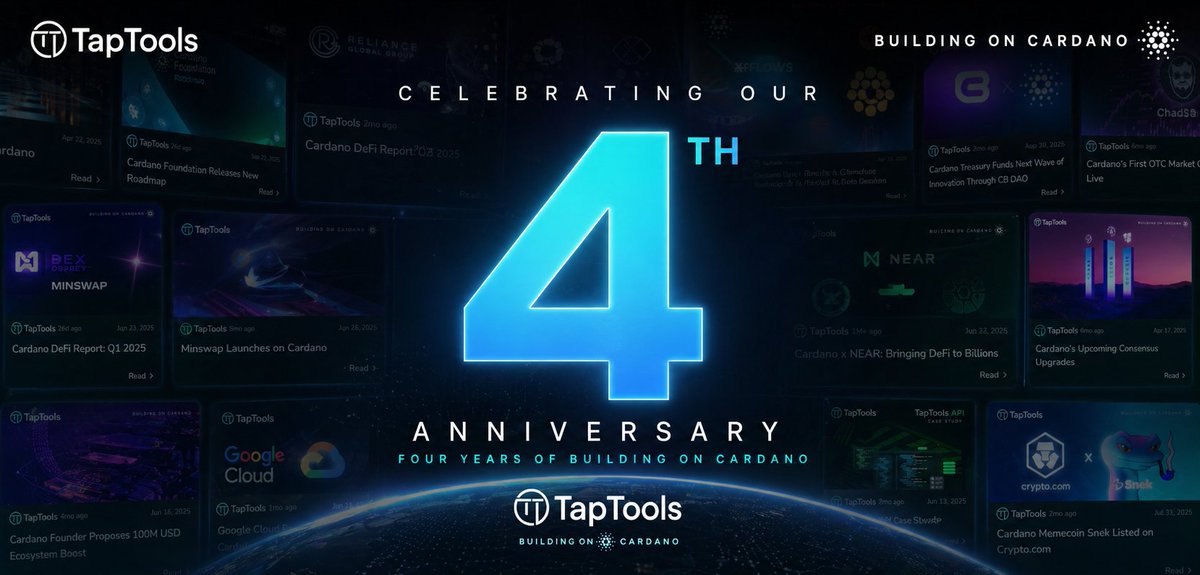
TapTools is coming up on 4 years of building on Cardano.
No VC backing.
No shortcuts.
Just a team that believed Cardano deserved better data, better visibility, and better infrastructure.
Since then, we’ve helped bring Cardano to the world:
Nearly 600 articles written.
Over 200M views generated on X.
The largest userbase of any Cardano project by a wide margin.
4 years of tracking the ecosystem.
4 years of highlighting builders.
4 years of showing up when Cardano needed more voices pushing it forward.
We started as a data platform.
Today, TapTools is one of Cardano’s largest distribution engines.
We aren't done yet.
Complete BS take man. I am not been subsized more than any other founder, it's simply incorrect. I don't know where you get this idea, from some Catalyst screenshots where all the big proposal like FC Barca say they use NMKR and thus mention my name? We do not get money from these proposals. I don't know how often I have to repeat this.
I never got money from CF, I never got money from IO. And I got 100k from Emurgo, which we spent on a MEXC listing + market making and thats it.
Instead I've probably brought more capital into Cardano than most other founders. The NMKR ICO was 90% outside capital, Masumi is like 70%+ outside capital, most of the projects launching on NMKR came from active outreach by us, while all the competing minting providers sales strategy was just to jump into the DMs of projects we brought to Cardano.
And I do in fact complain a lot and often. I tell people straight up to their face when they do stupid things. But I prefer action over going on rampages on Twitter and declaring Cardano for dead.
Gotta say something.
I'm the most optimistic I've ever been about the state of Bitcoin DeFi on Cardano. 🟠🤝🔵
This is no longer one project's marketing narrative, but an ecosystem-wide movement to redefine Cardano's "killer app" next to the one digital asset where it all began.
Now I've heard many suggest that Charms has many "competitors" building at this intersection. I don't agree much with that.
While there are indeed other projects building Bitcoin bridges, each project is also building systems BEYOND just bridges that are highly complementary to each other.
@CharmsDev has built a protocol for building any app or asset on either the Bitcoin or Cardano network, written in mainstream languages, that is cross-compatible between both chains. eBTC is one example of this, and there will doubtless be more Bitcoin-related assets and cross-chain dapps built by the community and us.
@FluidTokens is building its own Bifrost Bitcoin bridge, but its chief product is a lending/borrowing platform on Cardano. They also have other cool products like Aquarium, for creating dapps where you can pay your Cardano gas fees in non-ADA tokens (like bitcoin).
@SundialProtocol is cracking at a hybrid Bitcoin / Cardano L2 for scaling both chains, targeting the creation of institutional-grade Bitcoin yield products that can boost ecosystem TVL.
@pogun_io is an initiative aiming to launch a credit marketplace where Bitcoiners can borrow against their BTC without margin call risk, and where lenders can comfortably deploy USD liquidity into that market. They also have a BitVM-style Bitcoin bridge planned further on their roadmap.
@vesprwallet is Cardano's most popular mobile wallet, and is soon to also integrate Bitcoin.
Finally, as of this month, there is @OrionFund: a Cardano ecosystem fund managed by @DraperDragon that is specifically planning to deploy into Bitcoin DeFi projects as a core focus.
Miss me with your Cardano FUD on the timeline. There is a very real wave of projects concentrating and coordinating their efforts to pave Cardano's future in orange.
And yes: we're finally, actually shipping.
See you tomorrow morning! 🌅
Last year, IO asked for $97.5M from the Cardano treasury.
This year, the ask is just under 50% at $46.8M.
This is not simply a budget cut, it is a shift in direction. IO is moving toward a self-sufficient model, with more delivery shared across specialist partners and a steady reduction in treasury dependence.
This year’s vote helps fund the final delivery.
https://t.co/x9KA1ps77C
If Cardano holders had been Amazon shareholders...
The story goes like this:
In September 2001, Amazon’s stock fell to around $0.30 on a split-adjusted basis, or roughly $5.97 in pre-split prices at the time.
At the same time, in its 2001 annual report, Amazon reported $241 million in “Technology and Content” expenses, which included development, systems, telecommunications infrastructure, website operations, and technological improvements.
Let me repeat that: $241 million invested in technology and development at a time when the stock price was down around 94.7% from its all-time high.
Now imagine if Amazon shareholders back then had behaved like some #Cardano holders today.
They would have stopped every development effort, every investment into the future, and told Jeff Bezos:
“No more investing until the stock price gets back to at least $50. Our bags are bleeding, and you are not spending money on development.”
We all know where Amazon went from those years to where it is today.
And now, in Cardano, we are seeing a similar situation: people are crying over their bleeding $ADA bags and want to stop investments in development.
( @IOHK_Charles@IOGroup@Cardano_CF@F_Gregaard )
Unbelievable.
Development must be paid for, whatever it costs. There should be no debate about that.
Amazon would not be what it is today if the leadership had listened to emotional, short-term, speculative shareholders crying about the price.
I see similarities with Cardano today. Some holders do not understand how important development is and that it must be funded now, immediately, whatever it costs.
Because that is how it works.
And that is how it has to be.
Peras is one of the most important pieces of Cardano’s scaling roadmap, but it is also one of the harder ones to explain.
It is not about making Cardano “instant finality” in the simple marketing sense.
Cardano today uses Ouroboros Praos, where settlement is probabilistic. The more blocks that are added after your transaction, the lower the probability that it gets rolled back.
That is why exchanges and bridges often wait for a number of confirmations before treating a transaction as settled.
Peras adds a voting layer on top of Praos.
In simple terms:
• Stake-based voting committees are selected
• Those voters can vote for a block
• If enough votes are received, a certificate is formed
• That certificate gives the block a “boost”
• A boosted block and its ancestors become much harder to roll back
• If voting becomes unhealthy, Peras can enter cooldown and fall back toward Praos-like behaviour
The goal is faster settlement confidence without throwing away the safety properties Cardano already relies on.
This matters for use cases like:
• Bridges
• Partner chains
• Exchanges
• High-value DeFi
• Institutional settlement
• Anything that needs high confidence a transaction will not disappear after a rollback
The new Peras dashboard is important because it lets SPOs and users explore the tradeoffs instead of just trusting a headline number.
The current dashboard shows:
1. Probability of rollback after one boost
This estimates the chance of rolling back a block that has itself, or one of its descendants, boosted by Peras.
2. Probability of a round not reaching quorum
This shows the chance that honest parties do not have enough votes to reach quorum in a voting round.
3. Uptime percentage
This estimates how often Peras is not in cooldown, assuming adversarial stake does not vote.
That last one is important because Peras is designed with self-healing behaviour. If the voting layer is unhealthy, the system should not blindly keep relying on it.
The dashboard helps answer questions like:
• What happens if adversarial stake increases?
• How often would Peras stay healthy?
• What quorum settings make sense?
• How much faster could settlement become?
• What assumptions are being made about honest participation?
• Where is the balance between speed, safety and operational cost?
Future dashboard work is expected to explore settlement time with and without Peras at different confidence levels, plus bandwidth, CPU and memory tradeoffs once the cryptographic scheme is finalised.
This is exactly the kind of tooling SPOs need before voting on or adopting protocol changes.
Peras is not just “faster Cardano”.
It is a careful attempt to improve settlement confidence while preserving the conservative security model that makes Cardano valuable.
Gm. I'm waking up to the latest in @Cardano. Here is my take on conflicts of interest. The reality is that we are all "conflicted." In fact, the more involved you get in Cardano, the more those overlaps happen. Not all conflicts are negative; most are actually a sign of deep engagement with the projects and funding that move the needle.
Imho putting tighter constraints around DReps is the opposite of what we need. Among many things that separate Cardano from other L1s is the concept of Liquid Staking and Liquid Democracy. It is a real-time, "vote with your feet", and always in your control.
If you don’t like a DRep's associations, voting, or their performance, you don’t have to wait four years to fire them. You move your delegation instantly. That’s the ultimate accountability. We need more active hands on deck, not a system that punishes participation. The truth is voter apathy is a far greater risk to our governance.
DReps are under enough pressure to read proposals, respond to projects who are rightfully lobbying (and fighting for their proposals), and listen to their delegators... all without being paid.
My take is to let DReps vote as they choose. Their power comes from their delegators who are free to choose and move to whomever most closely aligns with their world view.
We have big news to share:
Today the x402 foundation has officially merged the Pull Request to add a Cardano Specification of x402 into the repository.
This means Cardano is now officially an x402 chain.
And even better: They have also accepted the Masumi Smart Contract and potentially other Smart Contracts as an optional addition to the standard.
This now makes x402 on Cardano more powerful than x402 on most other chains because it supports:
1) Identity
2) Refunds & Disputes
3) Decision Logging
4) Registry
and more.
We want to give a big shoutout to Fabian from the Cardano Foundation who has spearheaded this 6+ month effort the whole way, improving the Pull Request & talking to Coinbase and the x402 Foundation.
Additionally we want to shoutout Karsten Siebert who has built the first x402 integration on Cardano and was vital in the discussions around the standard.
Introducing: Agent Messenger
The easiest way to let your agents talk to other agents.
Dro a CLI + Skill into your agent and let it discover & talk to agents from your friends, coworkers and even strangers
⚠️ Live on Product Hunt - LINK BELOW - Please consider upvoting ⚠️
This is also where Cardano stands out. Cardano doesn't have restaking protocols like KelpDAO. It doesn't need a liquid wrapping layer like Lido, which means it doesn't need tokens like $stETH that come with depegging risk baked in.
In other words, a whole category of unnecessary risk simply doesn't exist.
Inefficient structures force you to stack complex layers on top just to make them work. And complex, interconnected structures inevitably carry more attack surfaces, which ripple across the entire ecosystem and carry massive collapse risk.
I think the biggest risk in the Ethereum ecosystem is the layers upon layers of LST and LRT stacked on top of each other, along with the DeFi markets tied to them. With AI making attacks more sophisticated and precise than ever, this is a house of cards waiting to fall.
Look at Terra. People always underestimate this kind of risk until it actually blows up. What matters is that the risk doesn't exist in the first place. On Cardano, LST and LRT simply don't need to exist structurally.