Planning/Geog/GIS prof, studying food systems, green infra, sustainable dev, digital tech & society, using equity & justice lenses and focusing on wellbeing. 🙏
NEW PUBLICATION: "Understanding caregiver perspectives to improve food security screening in healthcare settings: A focus group study." Out now in @JAFSCD! https://t.co/ijR40AakJD
Pleased to share an update on our Camden #Environmental#Education Project, supported by the @EPA and TD Bank. The project webpage now features air pollution-related educational materials and updates on a Participatory Science project: https://t.co/YxwXYyUM89 @RowanUniversity
Analyzing #vehicle#electrification within the state of #NJ. How do #policy#advocates participate in the policy diffusion process via interface with the constellation of policy-making systems and actors? Free access to the research article in Cities: https://t.co/mYLSOOysbC
New research article, Community perceptions of small-town #food#environments, food #equity, & home-based food #cultivation, published in the Journal of Agriculture, Food Systems, & Community Development @JAFSCD.🥕
@RowanUniversity#Glassboro. Free access: https://t.co/eDRTOh5SbC
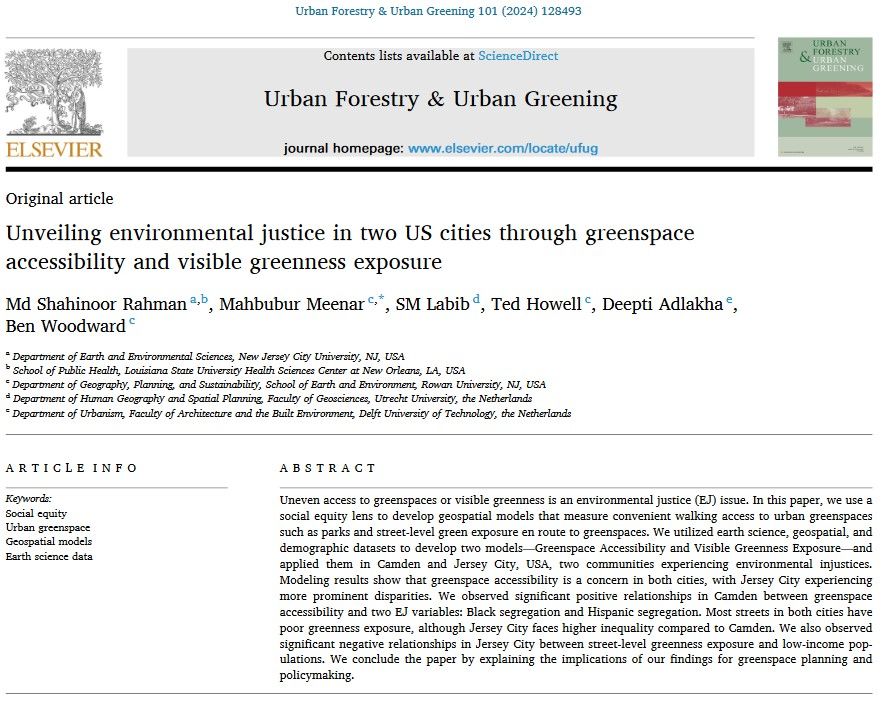
🌳Sharing free access to the first paper from a @NASA-funded project "from Green to GrEEEn." We used an #Environmental#Justice lens to model equitable walking access to greenspaces and street-level green exposure. https://t.co/dE0BG0gsMu @RowanUniversity@rowan_earth@thatguyneb
What Next in #Bangladesh. My thoughts below, and in @NetraNews
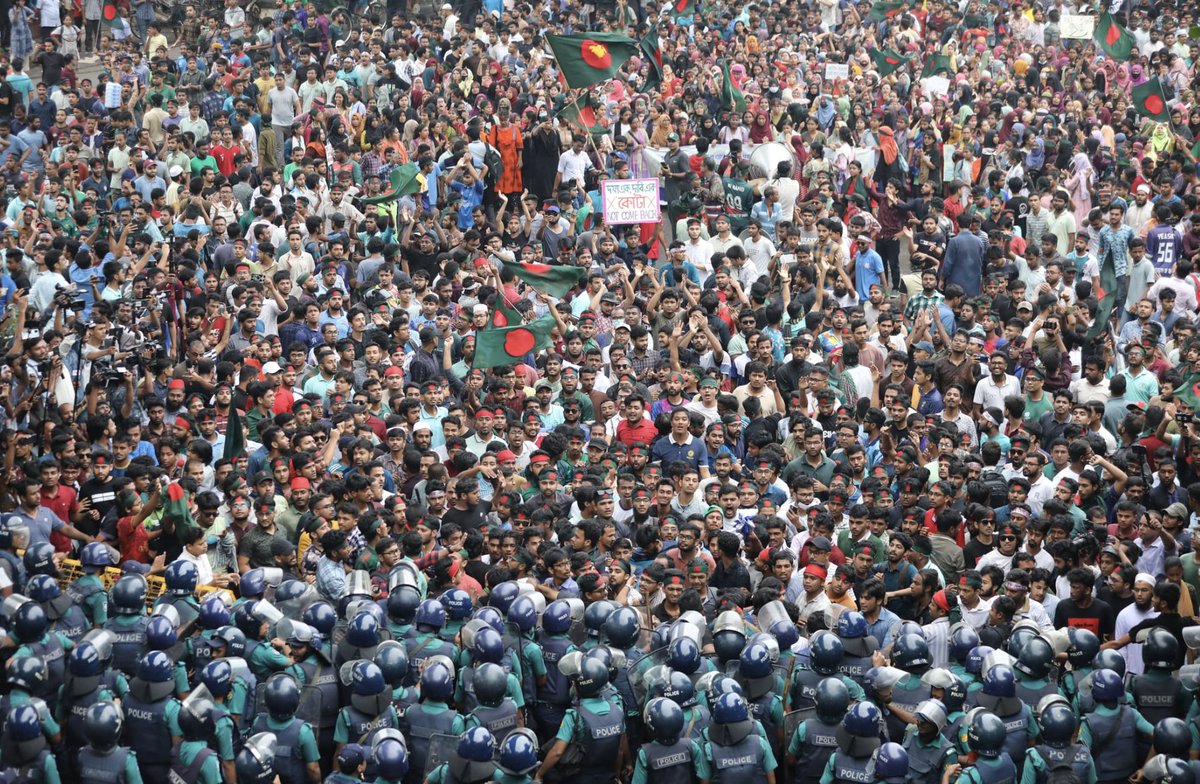
On Sunday, close to 100 people died in Bangladesh, mostly protestors, but the number also includes significant numbers of policemen and governing Awami League members. The government has announced an indefinite curfew and has said that it will come down hard on “terrorists.” The student leaders, however, have announced that everyone who supports them should converge on Dhaka “to mark the ultimate signature of this student citizen uprising” as they want to lay siege on Prime Minister Sheikh Hasina’s residence, which has turned into a military garrison right now. The army has stated it will fulfil its constitutional duty and enforce the curfew, but it will not shoot protestors.
The government’s decision to call on its party activists to assemble on Saturday, at the same time as huge numbers of protestors were on the same streets, was extremely reckless, and it was entirely foreseeable that clashes and deaths (on both sides) would result. The government gains by being able to brand protestors as “terrorists”: the more violence there is, particularly when its side are victims, the better it suits them politically.
The government’s decision to call a curfew on Saturday evening is primarily to try and prevent people from converging on Dhaka. The students are, however, not going to stop their programmes simply because a curfew has been called. Many people who would otherwise have taken part in converging on Dhaka may well be deterred by Sunday’s killings, but enough will take part to make it potentially a huge rally.
The army’s position on how it will enforce the curfew is crucial. It is significant that the army chief has, it appears, agreed not to shoot at “the people” and has messaged that the army is on the “people’s side.”. However, there are lots of internal dynamics that can complicate the situation, with some generals more loyal to Hasina than others. To make it all more complicated, junior officers also have mixed views - so, for example, the generals loyal to Hasina may feel they cannot risk alienating their subordinates. It is notable that a video shared widely showed some army officers today siding with the protestors against the police and Awami League.
All things being equal, it is, more likely that the army will allow the protestors to gather in Dhaka, as long as there is no serious violence.
However, going by Saturday, Awami League activists (and the police) will try to clash with the protestors seeking to congregate in Dhaka, something that could push the protestors’ aims off course. This is where the army will have to make a crucial decision - to side with the protestors or with the Awami League and police.
The international community continues to be silent. There are unconfirmed reports that India has told Hasina that her time is up, or at least that they can do no more to support her. Since India is a key external supporter of the Awami League and the Hasina regime, this would, if true, be significant. (Of course, if things do come to a crunch, India will make sure Hasina and her family are safe).
However, India will be very concerned about what comes after Hasina and may seek to be involved in the process of transition. It is important to note that India also has significant influence over certain parts of the army.
What about the US, EU, UK and the rest of the liberal democratic countries? They have in the past taken their cues from India, and will no doubt continue to be influenced by it. However, the total silence of these countries over recent days is both shameful and extraordinary.
On the one hand, there are all the signs of a popular revolution going on, and on the other hand, a government (which they have supported) willing to create anarchy in the country for the sake of staying in power. You would imagine that this would be the moment for them to finally put pressure on Sheikh Hasina to resign and take the appropriate steps to allow a peaceful move (with the likely assistance of the army) to a transitional government.
Perhaps something is happening in the background, but reports suggest that there is no unanimity amongst the international community on what to do. In addition, some embassies are said to have concerns about the safety of their own staff. Together, it appears right now that these countries are paralysed.
Not helping with this, of course, is the fact that the United States has no ambassador in position. Haas, the former ambassador who left the country just a few weeks ago, was a significant critic of the Awami League, and had he been in Dhaka now, the international response could well have been different.
How does one make the transition from an Awami League government to some kind of interim government? It is not straightforward, particularly if you want to avoid the impression of an army coup. In 2007, when the army did take over (and set up an interim government) there was no political government in place, only a caretaker one. It was therefore easy for the army to get the President to proclaim a state of emergency. Now, however, there is a prime minister, a Cabinet and a parliament in place - none of whom want to leave power.
This means that Sheikh Hasina has to agree to resign and also make the relevant moves to allow an interim government to take over. She clearly does not want to do anything of the sort at the moment - nor see a need to. It therefore appears that the protests have to reach a level where she has no option but to resign – or at least she realises it is in her own best interests to do so.
The army’s role in the transition will be important - to ensure law and order in the country and a move back to stability.
The next few days are likely to be decisive. One can only hope that Hasina and the Awami League do not want to go down fighting, resulting in an even higher toll of deaths and that she will agree sooner rather than later that she has to quit.
https://t.co/fnpYxWTpnl
Shocking violence in #Bangladesh must stop. Excessive force, disinformation & incitement to violence must cease.
Deeply worried more lives will be lost at planned mass march on Dhaka. Political leadership + security forces must protect right to life.
Accountability is crucial.
Bangladeshi authorities have ARRESTED OVER 10,000 people and investigated over 200,000.
It looks like AUTHORITARIAN PM Sheikh Hasina is conducting a WITCH HUNT.
Before giving them the body, the police asked if the family would file a case.
“We said we wouldn’t,” Mr. Ali said. “We were afraid we would not get the body.” Great report by @MujMash and @saifhasnat in @nytimes#QuotaReformMovement#StepDownHasina
https://t.co/9JaYNxFykZ
There is not a SINGLE statement from any government - whether it be UK, US, European Union, German, Canadian, Australian etc etc - that directly condemns the shooting of unarmed civilians by the #Bangladesh law enforcement authorities even though there was available, right from the start, so many public source videos showing exactly that. All the statements basically say, in one form of words or the other, the "violence should stop" without saying who was responsible for the violence! So for example:
UK: "We urge an end to the violence"
EU: "The EU is deeply concerned by the violence"
Canada: "We are shocked by the violence"
Germany: "escalation of violence in recent days needs to be investigated"
This is an extraordinary benefit to an authoritarian government whose security services in sight of everyone, shot dead nearly 200 students/protestors. (The statements could also, of course have condemned protestors for committing criminal damage.)
The lack of any single condemnation - yet alone a joint one - of the law enforcement killings gave the Awami League a green light to continue shooting, which is what happened. And it also gave it a green light to order the hugely repressive measures which are now ongoing involving the rounding up students and opposition activists, disappearing some of them for short periods of time and torturing them.
#Bangladesh: @volker_turk calls on authorities to urgently disclose information on protests crackdown amid reported cases of horrific violence.
Estimates indicate over 170 people killed & thousand injured.
Law enforcement operations must abide by international human rights law.
Numerous social media posts urged @dhruv_rathee to discuss student protests in #Bangladesh. The Indian YouTuber heeded the calls. His video delved into the heart of the issue, which the local media didn't address duly as yet.
You won't regret watching it: https://t.co/WqdHpR7whX
So far, @ProthomAlo Bangladesh’s newspaper of record, has been able to verify the deaths of 203 protestors during the carnage by Sheikh Hasina’s henchmen. But the total number of fatalities is many times more. I have received reports from trustworthy sources that the police have taken away dead bodies from hospitals along with CCTV footage and death registers, so there is no record of those deaths. (And in places where they have been unable to do so, they are warning the hospital authorities not to mention the fatalities or deny receiving any patient with bullet wounds.)
The police are burying some of those hijacked dead bodies in Rayer Bazar Intellectuals Graveyard, an expansive but unsought-after cemetery in Dhaka. In this clip, 36 unmarked graves can be seen in that cemetery. Those graves were dug out between Friday late night and Tuesday night. The bodies came from Shaheed Suhrawardy Medical College and Hospital, Dhaka Medical College and Hospital and Mitford Hospital. The graveyard staff are saying that they have never seen so many unidentified corpses in their life (except massive accident/natural disaster).
The lengths this butcher of Bangladesh will go to hide her sins!
FYKI @srpoverty@UNPeacekeeping @RFKHumanRights @hrw@crdefenders@CIVICUSalliance@CIVICUSMonitor@volker_turk@StateDRL@Lacroix_UN@FCDOGovUK@StateDept@usembassydhaka@UKinBangladesh@EUinBangladesh@StateDeptSpox@State_SCA@HumanRightsCtte@MaryLawlorhrds