"Real wealth is created by starting your own companies or even by investing.
In an investment firm, they’re buying equity.
These are the routes to wealth. It doesn’t come through the hours."
@naval
Vibe Coding Is the New Product Management
“There’s been a shift—a marked pronouncement in the last year and especially in the last few months—most pronounced by Claude Code, which is a specific model that has a coding engine in it, which is so good that I think now you have vibe coders, which are people who didn’t really code much or hadn’t coded in a long time, who are using essentially English as a programming language—as an input into this code bot—which can do end-to-end coding.
Instead of just helping you debug things in the middle, you can describe an application that you want. You can have it lay out a plan, you can have it interview you for the plan. You can give it feedback along the way, and then it’ll chunk it up and will build all the scaffolding.
It’ll download all the libraries and all the connectors and all the hooks, and it’ll start building your app and building test harnesses and testing it. And you can keep giving it feedback and debugging it by voice, saying, “This doesn’t work. That works. Change this. Change that,” and have it build you an entire working application without your having written a single line of code.
For a large group of people who either don’t code anymore or never did, this is mind-blowing.
This is taking them from idea space, and opinion space, and from taste directly into product. So that’s what I mean—product management has taken over coding. Vibe coding is the new product management.
Instead of trying to manage a product or a bunch of engineers by telling them what to do, you’re now telling a computer what to do. And the computer is tireless. The computer is egoless, and it’ll just keep working. It’ll take feedback without getting offended.
You can spin up multiple instances. It’ll work 24/7 and you can have it produce working output.
What does that mean? Just like now anybody can make a video or anyone can make a podcast, anyone can now make an application. So we should expect to see a tsunami of applications. Not that we don’t have one already in the App Store, but it doesn’t even begin to compare to what we’re going to see.
However, when you start drowning in these applications, does that necessarily mean that these are all going to get used or they’re competitive? No. I think it’s going to break into two kinds of things.
First, the best application for a given use case still tends to win the entire category. When you have such a multiplicity of content, whether in videos or audio or music or applications, there’s no demand for average.
Nobody wants the average thing. People want the best thing that does the job. So first of all, you just have more shots on goal. So there will be more of the best. There will be a lot more niches getting filled.
You might have wanted an application for a very specific thing, like tracking lunar phases in a certain context, or a certain kind of personality test, or a very specific kind of video game that made you nostalgic for something. Before, the market just wasn’t large enough to justify the cost of an engineer coding away for a year or two. But now the best vibe coding app might be enough to scratch that itch or fill that slot. So a lot more niches will get filled, and as that happens, the tide will rise.
The best applications—those engineers themselves are going to be much more leveraged. They’ll be able to add more features, fix more bugs, smooth out more of the edges. So the best applications will continue to get better. A lot more niches will get filled.
And even individual niches—such as you want an app that’s just for your own very specific health tracking needs, or for your own very specific architectural layout or design—that app that could have never existed will now exist.”
If your circle isn’t talking about:
- The collapse of traditional banks
- The future of finance
- Money laundering
- Escaping the matrix
- AI invasion
- Self development
Then it’s time to find a new circle
Imagine seeing 9/11, the dot-com bubble, the 2008 financial crash, COVID, and the Epstein files and STILL trusting the government and mainstream media.
What if the Epstein leak is the world's biggest ad for the New World Order?
Listen to the end to understand.
The Hegelian Dialectic could be in play.
STAY ALERT ⚠️
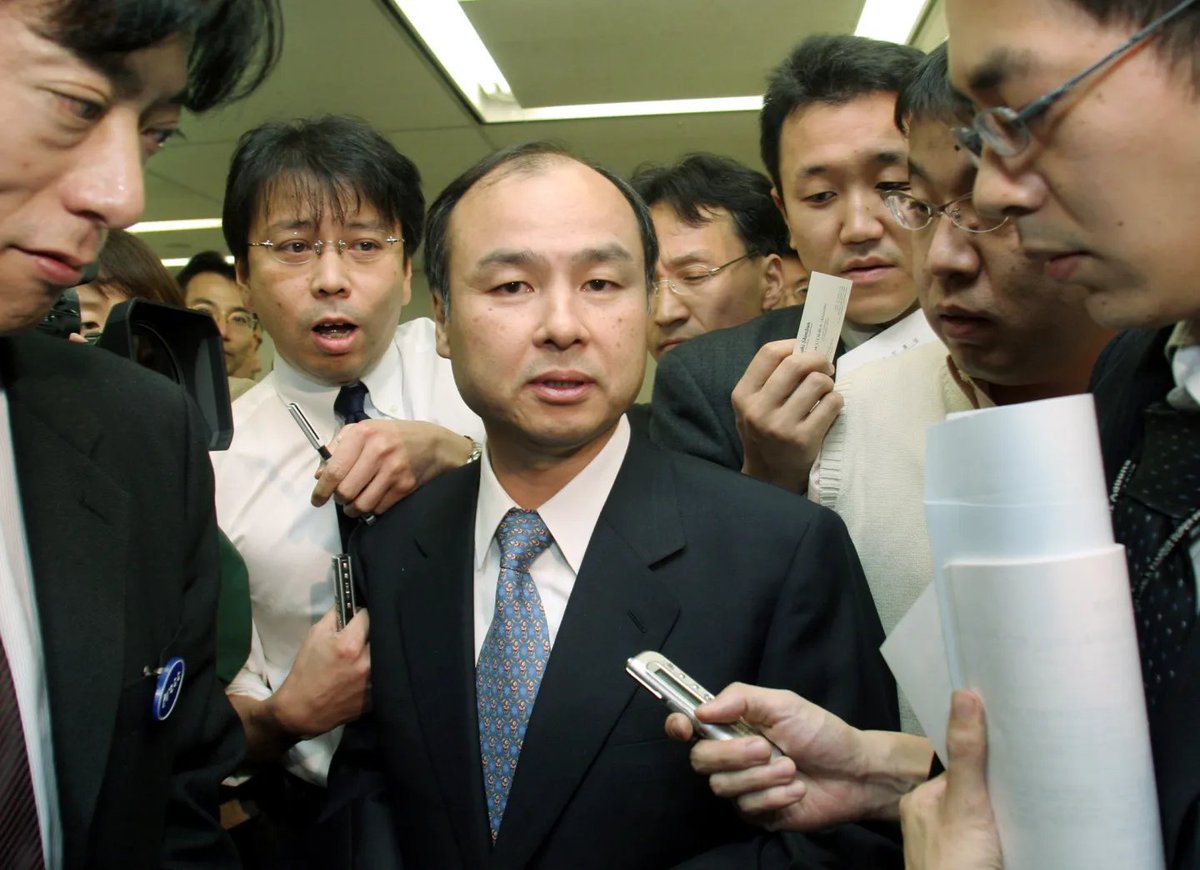
>be Masayoshi Son
>born 1957 in Tosu, Japan
>ethnically Korean
>family lives in a shack on an illegal pig farm
>no running water
>collect scraps to feed the pigs
>use a fake Japanese name because Koreans are discriminated against
>called "dirty" by classmates
>grandmother tells you: "you're special, you'll do great things"
>you believe her
1970s:
>read a book about Den Fujita
>the guy who brought McDonald's to Japan
>cold call him until he agrees to meet you
>you're 16
>ask him: "what should I study?"
>Fujita: "computers, they're the future"
>you listen
1974:
>convince your parents to let you go to America
>move to California alone at 16
>barely speak English
>enroll in high school
>graduate in 3 weeks
>not a typo
UC Berkeley:
>study economics and computer science
>invent a pocket translator
>sell the patent to Sharp for $1.7 million
>you're 19
>first million: unlocked
1981:
>go back to Japan
>start SoftBank
>software distribution
>two part-time employees
>first day, stand on an apple crate
>give a speech declaring you'll be a $1 billion company in 5 years
>they think you're insane
>they both quit
1982:
>get hepatitis
>doctors say you might die
>spend 3 years in and out of hospitals
>run the company from your hospital bed
>nearly go bankrupt
>survive both
1990s:
>SoftBank becomes Japan's largest software distributor
>take it public in 1994
>valuation: $3 billion
>start making bigger bets
1995:
>meet Jerry Yang
>he started a website called Yahoo
>invest $100 million for 33%
>everyone says you're crazy
>the internet is a fad
>Yahoo IPOs
>your stake: worth billions
>first legendary bet
1999:
>meet a weird Chinese guy in Beijing
>English teacher, couldn't get a job anywhere
>started something called Alibaba
>18 employees in an apartment
>you talk for 5 minutes
>invest $20 million
>he didn't even ask for money
>his name is Jack Ma
2000:
>dot-com bubble pops
>your portfolio explodes
>not in the good way
>lose $70 billion in 12 months
>the largest personal financial loss in human history
>stock down 99% from peak
>media writes your obituary
>"Masayoshi Son is finished"
but:
>you still own Yahoo Japan
>you still own Alibaba
>everyone tells you to sell
>you hold tighter
2006:
>buy Vodafone Japan for $15 billion
>everyone says you overpaid
>bring the iPhone to Japan exclusively
>it explodes
>back from the dead
2014:
>Alibaba goes public
>biggest IPO in history
>your $20 million investment?
>worth $50 billion
>5,000x return
>the greatest venture investment ever made
>you held for 15 years
>everyone told you to sell
>you didn't
2016:
>meet Saudi Crown Prince MBS
>pitch him your vision: AI will change everything
>45-minute meeting
>he commits $45 billion
>you launch the Vision Fund
>$100 billion total
>the largest investment fund in history
the portfolio:
>Uber: $7.7 billion
>WeWork: $10.6 billion
>DoorDash, ByteDance, ARM
>hundreds more
>spray and pray at scale
2019:
>WeWork implodes
>IPO collapses
>your $10 billion nearly worthless
>you go on stage mocking yourself as "foolish"
>Vision Fund reports $17 billion loss in one quarter
the thesis:
>AI is coming
>it will touch every industry
>whoever owns the AI platforms wins
>so buy everything
>every category, every leader, every continent
>own the future
2024-2025:
>AI explodes
>your thesis looks prescient
>ARM IPOs at $65 billion
>you own 90%
>announce $100 billion for AI chips
>you're 67
>not slowing down
what's undeniable:
>Yahoo: 1,000x+ return
>Alibaba: 5,000x return
>ARM: probably 3-5x and growing
>three of the best investments in history
>all one guy
the pattern:
>make huge bets
>look like a genius when they work
>look like a fool when they don't
>never stop betting
>never hedge
>never diversify emotionally
from a shack on a pig farm
>to the richest man on earth (briefly)
>to losing $70 billion
>to comeback after comeback
300-year plan.
infinite resilience.
one insane bet at a time.
People who like privacy
Naval
Vitalik Buterin
Roger Ver
Edward Snowden
Zooko
GOD
the founding fathers of USA
People who don’t like privacy
NSA
Kim Jong- un
President Xi
Communists
The devil
Craig wright