É triste ver adultos e que muitas das vezes universitários, disseminando informações sem antes pesquisar sobre, compartilham só pq o jornal tal, a mídia tal, a página tal publicou... uns com boa intenção, “já outros...”aff mano
Learning resources play a key role in shaping where talent goes. Today I’m launching my side project, BioTorch, in public beta to give researchers a clearer path into biological AI.
LLMs have a wealth of great tutorials, courses, and minimal implementations from great teachers. They make the path from curiosity to contribution easy to see and offer researchers from fields like math or physics a legible roadmap to transition into AI research.
In bio AI, that path is much harder to piece together. That friction can mean fewer researchers entering the field, fewer startups getting built, and less investment allocated to promising ideas. This ultimately leads to fewer life-saving cures being discovered than would otherwise be possible.
BioTorch is my attempt to help change that.
It starts with 116 PyTorch exercises and 17 model guides. You implement the building blocks, test your code, and see how the pieces fit into seminal models like AlphaFold2, ESM2, and RFdiffusion.
The goal is to make influential papers in bio AI something you can understand and build on, bringing researchers up to the frontier as rapidly as possible.
I want more people working on biology’s hardest problems. My mission is to help researchers find their way into the field, and BioTorch is the result of that ambition.
BioTorch is completely free while in beta.
Try your first problem now!
https://t.co/BHmN59S3bI
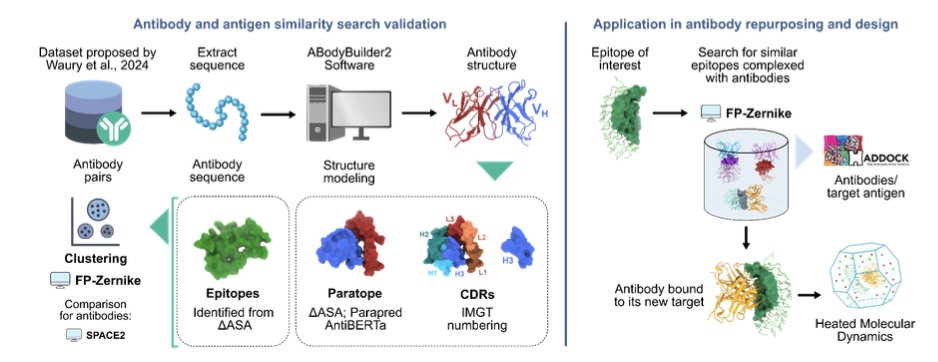
Application of 3D Zernike Descriptors in Antibody Structural Clustering and Repurposing
1. The study proposes an alignment-free, rotation-invariant way to cluster antibodies and epitopes by encoding binding-site surfaces as compact 3D Zernike descriptor vectors, then comparing them via Euclidean distance—aiming to better capture functional similarity linked to cross-reactivity and repurposing.
2. Using a benchmark set of 54 antibodies (256 known “same-epitope” pairs), the authors test multiple antibody representations: all CDRs, CDRH3-only, and paratopes (defined by ΔASA from complexes, or predicted by Parapred / AntiBERTa). Key idea: clustering should focus on the actual binding interface surface, not just loop definitions.
3. Main clustering result: paratope-based Zernike clustering gives the best tradeoff between yield and precision. With a Euclidean distance threshold of 2.7, ΔASA-defined paratopes recover 74 functional pairs at ~0.80 precision; predicted paratopes perform similarly (Parapred: 43 pairs at 0.81; AntiBERTa: 45 pairs at 0.80).
4. CDRH3-only Zernike clustering is highly precise at strict cutoffs (e.g., precision ~0.94 at low distance) but yields fewer pairs; increasing the threshold increases recovered pairs while maintaining moderate precision. In contrast, using all CDR residues produces many more pairs but substantially lower precision, consistent with “extra” CDR residues adding noise when they do not contact antigen.
5. Against SPACE2 (RMSD-based structural clustering), Zernike descriptors identify more functional antibody pairs at comparable precision. At the selected operating point (distance 2.7), paratope-surface Zernike clustering finds ~3x more pairs than SPACE2 while keeping similar accuracy, suggesting higher sensitivity without relying on CDR length constraints or atomic overlap.
6. The methods are complementary rather than redundant: Zernike (paratopeASA and CDRH3) finds many pairs missed by SPACE2 (e.g., 56 unique pairs for paratopeASA), while SPACE2 also contributes a smaller set of unique pairs—supporting combined pipelines for broader functional coverage.
7. Epitope clustering also works well with Zernike descriptors. Precision stays >0.90 up to distance 2.4, and remains robust up to 3.0 (precision ~0.83) while recovering a larger fraction of known same-epitope antibody pairs—motivating a practical epitope cutoff around 3.0.
8. Repurposing workflow: the authors compute Zernike descriptors for 6,570 epitopes extracted from AbSet antibody–antigen complexes (ΔASA-defined), then search for epitopes similar to a conserved neutralizing epitope on Nipah virus G (NiV-G; PDB 8XPY). Candidates are selected at epitope distance <3.0.
9. Screening returns four candidates (including one human antigen binder, excluded for safety). Three remaining antibodies (two anti-dengue E, one anti-SARS-CoV-2 Spike) show docking cluster centers consistently localized on the NiV target epitope in blind HADDOCK docking, then undergo directed docking + Rosetta REF15 scoring + heated MD validation.
10. Stability filtering via heated MD (up to 70 ns with stepwise heating to 390 K; interface RMSD threshold 5 Å) removes the two dengue-derived candidates (instability beyond 5 Å at 360 K). The SARS-CoV-2-derived antibody (PDB 7YVM_1) remains stable across three replicates, emerging as a plausible cross-reactive scaffold for NiV-G targeting.
📜Paper: https://t.co/HQqTBrPTln
#ComputationalBiology #Bioinformatics #Antibodies #Immunoinformatics #ProteinStructure #SurfaceDescriptors #Zernike #DrugRepurposing #NipahVirus #StructuralBiology
Application of 3D Zernike Descriptors in Antibody Structural Clustering and Repurposing
1. The study proposes an alignment-free, rotation-invariant way to cluster antibodies and epitopes by encoding binding-site surfaces as compact 3D Zernike descriptor vectors, then comparing them via Euclidean distance—aiming to better capture functional similarity linked to cross-reactivity and repurposing.
2. Using a benchmark set of 54 antibodies (256 known “same-epitope” pairs), the authors test multiple antibody representations: all CDRs, CDRH3-only, and paratopes (defined by ΔASA from complexes, or predicted by Parapred / AntiBERTa). Key idea: clustering should focus on the actual binding interface surface, not just loop definitions.
3. Main clustering result: paratope-based Zernike clustering gives the best tradeoff between yield and precision. With a Euclidean distance threshold of 2.7, ΔASA-defined paratopes recover 74 functional pairs at ~0.80 precision; predicted paratopes perform similarly (Parapred: 43 pairs at 0.81; AntiBERTa: 45 pairs at 0.80).
4. CDRH3-only Zernike clustering is highly precise at strict cutoffs (e.g., precision ~0.94 at low distance) but yields fewer pairs; increasing the threshold increases recovered pairs while maintaining moderate precision. In contrast, using all CDR residues produces many more pairs but substantially lower precision, consistent with “extra” CDR residues adding noise when they do not contact antigen.
5. Against SPACE2 (RMSD-based structural clustering), Zernike descriptors identify more functional antibody pairs at comparable precision. At the selected operating point (distance 2.7), paratope-surface Zernike clustering finds ~3x more pairs than SPACE2 while keeping similar accuracy, suggesting higher sensitivity without relying on CDR length constraints or atomic overlap.
6. The methods are complementary rather than redundant: Zernike (paratopeASA and CDRH3) finds many pairs missed by SPACE2 (e.g., 56 unique pairs for paratopeASA), while SPACE2 also contributes a smaller set of unique pairs—supporting combined pipelines for broader functional coverage.
7. Epitope clustering also works well with Zernike descriptors. Precision stays >0.90 up to distance 2.4, and remains robust up to 3.0 (precision ~0.83) while recovering a larger fraction of known same-epitope antibody pairs—motivating a practical epitope cutoff around 3.0.
8. Repurposing workflow: the authors compute Zernike descriptors for 6,570 epitopes extracted from AbSet antibody–antigen complexes (ΔASA-defined), then search for epitopes similar to a conserved neutralizing epitope on Nipah virus G (NiV-G; PDB 8XPY). Candidates are selected at epitope distance <3.0.
9. Screening returns four candidates (including one human antigen binder, excluded for safety). Three remaining antibodies (two anti-dengue E, one anti-SARS-CoV-2 Spike) show docking cluster centers consistently localized on the NiV target epitope in blind HADDOCK docking, then undergo directed docking + Rosetta REF15 scoring + heated MD validation.
10. Stability filtering via heated MD (up to 70 ns with stepwise heating to 390 K; interface RMSD threshold 5 Å) removes the two dengue-derived candidates (instability beyond 5 Å at 360 K). The SARS-CoV-2-derived antibody (PDB 7YVM_1) remains stable across three replicates, emerging as a plausible cross-reactive scaffold for NiV-G targeting.
📜Paper: https://t.co/HQqTBrQraV
#ComputationalBiology #Bioinformatics #Antibodies #Immunoinformatics #ProteinStructure #SurfaceDescriptors #Zernike #DrugRepurposing #NipahVirus #StructuralBiology
@itswillhua I think one of the main bottlenecks in the computational design of mAbs is the scoring functions. Perhaps analyse how wet-lab results correlate with the main scoring functions currently available... based on AI or those based on physics, or empirical.
I am thrilled to share that UC Berkeley and UCSF have launched a joint initiative in Computational Biomedicine!
https://t.co/X8WMamp4HL
We will soon be recruiting new faculty and postdoctoral fellows. Please repost to help spread the word.







![sokrypton's tweet photo. ColabFold 1.6.3 is out! 2.5x faster, pip-installable, ipSAE+pDockQ2 scores. Thanks Choonghwan Lee, Marielle Russo, Gyuri Kim, Martin Steinegger, Milot Mirdita
🐍 pip install colabfold[alphafold]
(1/3) https://t.co/pUy0JwEyMx](https://pbs.twimg.com/media/HSXVSRJWAAAkB9d.png)