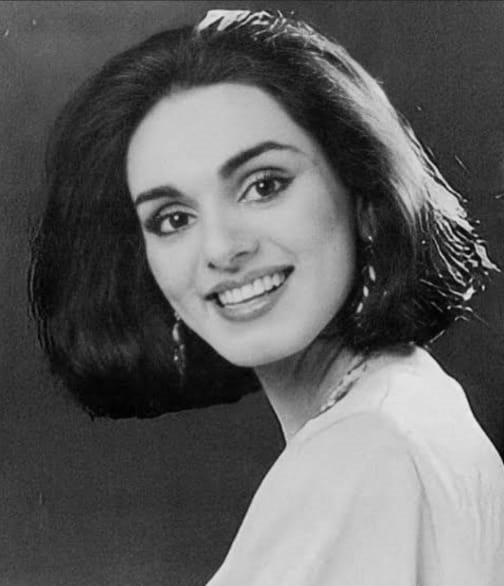
She was 22 years old, standing at an open airplane door with bullets flying—and she made a choice that would save 359 lives, but not her own.
September 5, 1986. Pan Am Flight 73 touches down in Karachi for a routine refueling stop. Passengers settle in. Children doze. No one suspects what's coming.
Then, in seconds, four armed men storm the aircraft. Screams. Chaos. Terror.
At the front of the cabin stands Neerja Bhanot, a 22-year-old flight purser with a warm smile and steady hands. In that instant, she could have frozen. She could have run. Instead, she acted.
She immediately alerted the cockpit crew, giving the pilots precious seconds to escape through an overhead hatch. That single act ensured the hijackers couldn't fly the plane to another country or crash it deliberately. Hundreds of lives were already saved—and the ordeal had just begun.
For 17 agonizing hours, Neerja became the calm in the storm. She moved through the aisles with quiet courage, hiding American passports so passengers wouldn't be singled out for execution. She cradled crying children, whispered reassurances to terrified families, and stood as a human barrier between the gunmen and the innocent.
She never thought of herself. Not once.
As night fell, the plane lost power. In the darkness, panic ignited. The hijackers opened fire.
Neerja was stationed at an emergency exit. The door was open. Freedom was right there. One step, and she'd be safe.
But as passengers rushed toward her, she didn't move. She stayed. She threw open the doors wider, pushing people out, shielding them with her body. And when three children stood frozen in fear, unable to move, Neerja did the unthinkable.
She covered them with her own body.
The bullets came. She took them. All of them.
Neerja Bhanot did not survive that night. But because of her, 359 others did.
Today, her name is spoken with reverence across the world. She was posthumously awarded India's highest peacetime bravery honor. A Bollywood film was made in her memory. Airlines train crew members using her example.
But more than awards or movies, Neerja's legacy lives in a simple, staggering truth: when faced with the ultimate choice—her life or theirs—she chose theirs. Without hesitation. Without doubt.
A 22-year-old woman who became immortal the moment she decided that strangers were worth dying for.
Heroism isn't always loud. Sometimes, it's a young woman standing at an exit, whispering, "Go. I've got you."
And then staying behind.
The dog, sensing that his owner is about to have a seizure, first makes his owner sit on the floor, then gets water from the cupboard, finds her medicine and gives it to her, then makes his owner lie on the floor.
Japan is facing a looming agricultural crisis.
The Ministry of Agriculture warns that by 2035, nearly one-third of the country’s farmland could be left without enough workers. Projections show that more than 1.3 million hectares—about 31% of Japan’s total 4.22 million hectares of farmland—may go uncultivated.
The causes are clear and deeply structural: rapid depopulation, an aging farming population, and the steady decline of rural communities. The forecast is based on newly released nationwide land-use surveys, painting a stark picture of who will be left to grow the nation’s food.
In response, the government plans to merge scattered plots into larger, more efficient farms and encourage workers from other regions and industries to enter agriculture. But experts warn this may not be enough.
A sustained drop in planting could threaten food security, drive up prices, and accelerate the collapse of local villages. Industry groups are calling for faster action—urging expanded training programs, advanced mechanization, and clearer pathways for both domestic and foreign workers to join the sector.
Without bold reforms, Japan’s farmland may soon outnumber the farmers needed to sustain it.
A new Science #Immunology study finds that adenovirus vector- and mRNA-based #COVID19#vaccines trigger crosstalk between innate-like and adaptive T cells, which promotes immunity. https://t.co/JayNtDUG56
Andy Moore at @HHMIJanelia created this time-lapse video that shows the dynamic structure of the endoplasmic reticulum (ER) within a kidney cell. As you can see, the ER is very densely packed near the nucleus, which is shown in bright orange color at the center of the cell and is less dense towards the edges of the cell.
Videos like these can give us a more complete understanding of the structure and function of the ER and this knowledge could be the basis for future research on how protein and lipid production within the cell affect human health and disease.
Download this video and discover more: https://t.co/WBHZAIkOOO
Credit: Andy Moore, HHMI’s Janelia Research Campus
A new version of the periodic table of elements has predicted hundreds of highly charged ions that could be used to create the next generation of optical atomic clocks. https://t.co/YHMkUxuAoA
Mosquitoes die after drinking the blood of people taking a drug for metabolic disorders — a discovery that could help to prevent the spread of malaria
https://t.co/S0naVbsyHR
Research is investigating the medicinal applications of #psilocybin, with studies showing how #psychedelics can promote neuronal plasticity.
This ‘fundamental’ study into the effects of #psilocin on human neurons: https://t.co/OYU3Vs6ccT
Amid the ruins and desolation of the Permian mass extinction, scientists have found fossil evidence of a refugee community of plants and animals that escaped the calamity and survived in what is now modern-day northwestern China. https://t.co/VC8Zq26Rc8 @ScienceAdvances
As we sleep, our bodies may be quiet and largely immobile—but our brains are highly active.
A special issue summarized recent insights into the basic mechanisms underlying sleep and the many functions our brains perform during it. https://t.co/NEEavK8gmm #WorldSleepDay