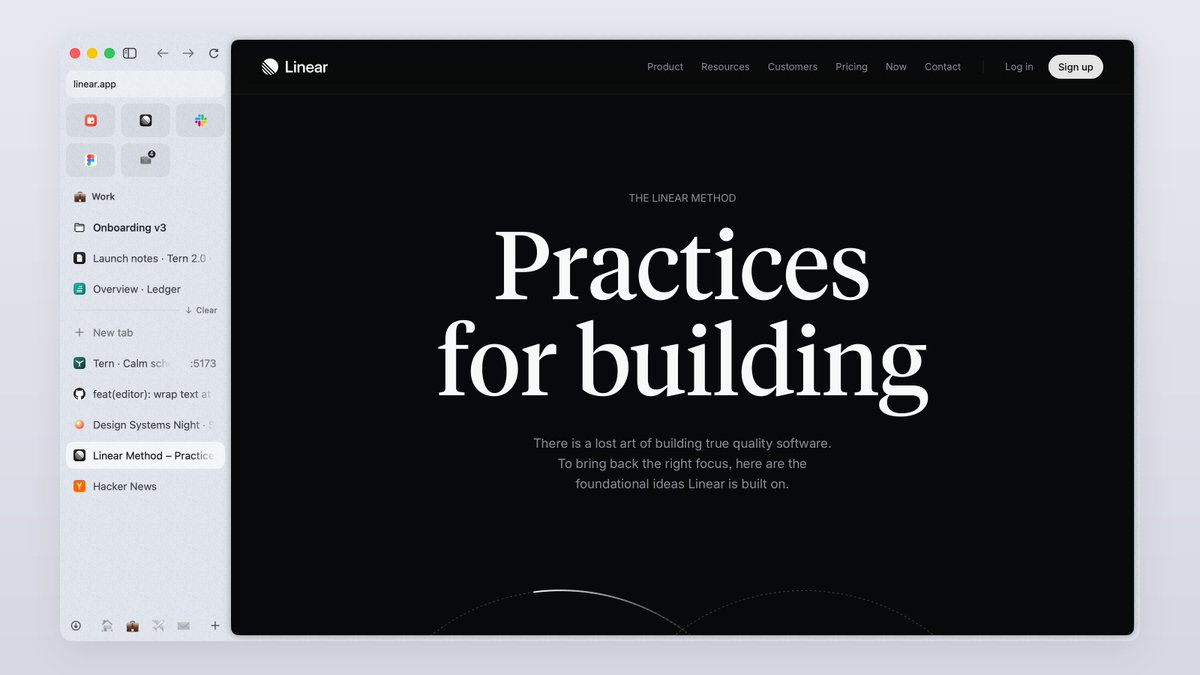
Arc shuts down on Dec 22.
I wasn’t ready to let it go, so I rebuilt it.
Spaces, pinned tabs, Peek, Little Arc, Split View, nested folders. Native Mac app, free. AI stays out of the way until you ask.
Your whole Arc setup comes over in one click.
Today we're standing up XBOX LABS (https://t.co/dJSufI1vni). Here is the note that I sent to the team:
Team,
The first video games emerged some 75 years ago. In the time since, there have been booms and busts, but every year there are more great games to play, more devices to play them, and best of all, more people than ever playing. That growth helped make XBOX what it is today, and we've helped shape the industry in return, from bringing hard drives to consoles and online gaming through Xbox Live to Game Pass and cloud gaming, alongside franchises that have brought millions of people together.
In recent weeks, we've seen games rapidly decompiled and rebuilt to run on hardware they were never originally designed to support. Windows PC builds have been translated to run on Apple Silicon or ported to run inside a browser through WebAssembly and WebGPU, the latter now approaching 90% global browser support. Perhaps more surprisingly, we've seen many of the biggest games in the world have been remixed into the source code of another.
These experiments challenge long-held assumptions about our industry: the tether between software and hardware, the boundary between creation and play, and how people discover and experience games. While it is hard to predict the future of gaming, it is easy to see the possibilities in making great games easier to access, giving old games new life and allowing more players to become creators and co-creators. These are unmistakably good outcomes for players, even when (and sometimes because) they challenge our existing business models.
To explore these possibilities, I’ve asked Scott to stand-up XBOX LABS, a small group of game makers, engineers and scientists whose job is to turn emerging ideas into things our players and developers can experience. We'll build in the open, learn from what people do, and measure success by whether more people are playing and creating.
I think XBOX has an important role to play here. Coding became the first major workload for agents because they can write, run, and test software. Games share many of those same properties, and people spend more than 72 billion hours a year playing XBOX games, roughly five times the estimated time spent writing code worldwide. We've spent 25 years learning how to make great games, and I want our game makers to help shape what these new technologies make possible. As we learn, we’ll share the tools we build with developers across the industry, just as we always have.
Our priorities aren't changing. We remain committed to the 4Cs, to making great games, to our hardware and to being responsible stewards of IP and the communities built around it. LABS gives us a way to explore new technology that is game design led without abandoning the work already underway.
Asha
After co-inventing ChatGPT, I kept asking myself: why have superhuman chat models not led to AGI?
I’ve spent the last 2 years in stealth building a new way to train models (RLCD), and a new type of frontier AI model that we are releasing today: Jev
• 20-200x faster
• 40-400x cheaper (w/ output tokens free)
• Frontier composable intelligence optimized for decisions
AFAICT the shortest path to AI-based economic revolution
this is one of the greatest, most profound monolgues ive ever witnessed in the middle of a casual conversation about psychedelics and hippies.
its so unbelievably good. I love Jesse so much, man.
my rule of thumb for buying anything is simple. if i use it at least twice a day, i buy the best version i can reasonably afford.
e.g. the best toothbrush, the best sheets, the best shoes, the best chair, the best headphones, the best phone, etc.
maybe more specifically the formula is something like frequency x duration x intimacy with your body/attention. if it touches you, supports you, or mediates reality for hours every day, buy the best version you can afford.
this also applies to product development, you should build products that touch ppl’s lives at least twice a day (when i was at g larry page would often say this rule a lot at tgif).
NYU Prof. Ruby Thelot on why everyone suddenly cares about taste:
"I wrote a book called A Few Essays on Taste, where I make the case that taste is not just aesthetic preference. Taste is a way for people to consume virtuously. The question of taste emerged in the 17th century, at a time where people needed guidance as to how to consume properly."
"In 1688, the Bill of Rights happens in England after the Glorious Revolution, and the nobility's powers are restrained. As they lose political power, they also lose cultural power. At the same time you have the growth of the British colonies, immense amounts of wealth being generated, and suddenly you have this nouvelle bourgeoisie, this new elite. And there's a belief that this emergence of excessive luxury will lead to the decay of society."
"It is in the vacuum, in the reduction of the cultural power of the previous nobility, that the question of taste emerges. What's interesting to me is that we're in a similar position now. We're entering a similar industrial revolution. We're in the midst of immense amounts of wealth being created, and we're asking ourselves, how do we consume virtuously? That is why the question of taste is emerging. It mirrors 17 and 18th century England."
@being_on_line@NYU