Founder & CEO of @noustalk | Building the next-gen platform for modern mental #healthcare delivery | 🔗 #AI#EHR#MultimodalCare to empower clinicians/clients
What's the right amount of time for resistance training?
A new study supports 90-120 minutes/week across multiple outcomes, which plateaus beyond that for lack of additional benefit
From 30-year follow-up of ~150,000 participants
https://t.co/mUy9o4HkbH
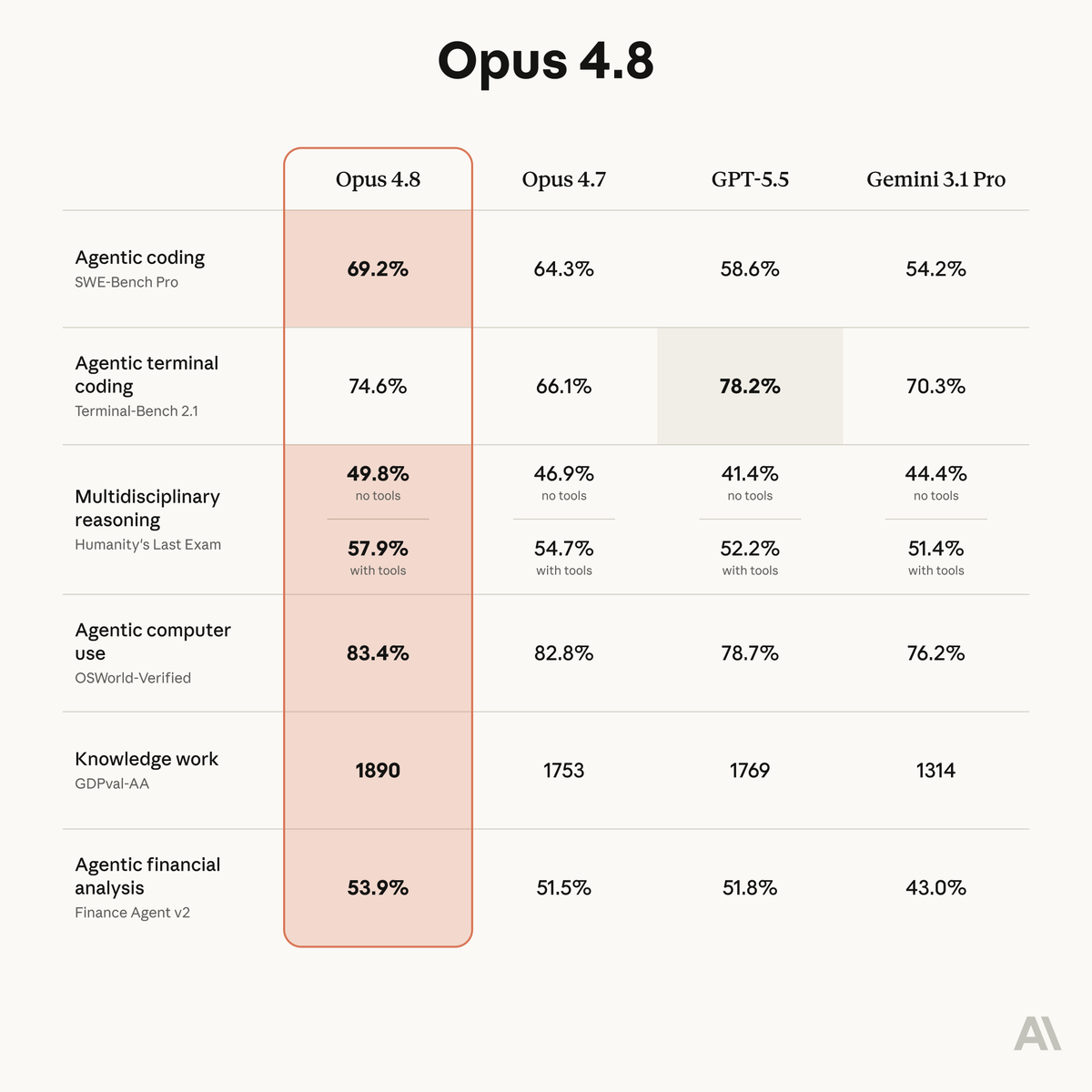
Introducing Claude Opus 4.8: it builds on Opus 4.7 with sharper judgment, more honesty about its own progress, and the ability to work independently for longer than its predecessors.
Available today at the same price.
Two years ago, we were thrilled to partner with Wordsmith as they set out to empower in-house legal teams.
Today we’re supporting them again as part of a $70M Series B as they bring legal work back in-house and away from law firms.
https://t.co/pl65AWUQX7
This is effectively the #1 problem for AI agents in the enterprise.
As we go from agentic coding (where a large amount of context is in the code base, and users are technical enough to get the rest to the agent easily) to a world of knowledge work agents, the context problem becomes much more acute.
We see this every day with customers at Box. For existing digital knowledge, it’s often fragmented across legacy systems or environments that don’t play nice with agents, and have access controls that don’t map to the real work that needs to be done, which become a huge hurdle for getting agents the context they need. This has to all get moved to modern, secure cloud environments.
But also, companies often haven’t captured and digitized some of the critical context that agents need to work with. Decisions, processes, and workflows often live in people’s heads and tribal knowledge that need to get turned into unstructured data for agents.
This is actually one of the biggest points of leverage for applied AI companies, because they can work to specialize in getting agents exactly the information and domain expertise they need. But it’s also one of the reasons why FDEs and new system integrator plays will also work so well right now.
The companies that figure this out will be able to get the most out of AI going forward.
People whose genes give them a lifelong dose of statins tend to have
- Lower risk of vascular and unspecified dementia
- Lower risk of heart disease
- No difference in the risk of Alzheimer's
In other words, they're better off!
People who don't follow cancer research often ask me why we haven't cured cancer. That perception masks a wonderful reality: We make amazing, stepwise progress every year, and the result is that many people live much longer today than they would have previously.
Right now we're in the thick of the annual meeting of the American Society of Clinical Oncology, the biggest research meeting on new cancer medicines, and this morning a bunch of really important studies dropped. I'm going to review them here.
This first image is the result for daraxonrasib, a treatment for pancreatic cancer that is generating consdirable excitement. The green line is the probability of living for patients who got the new drug; the gray one is the chemo control group.
If you follow cancer drugs, a chart like this will make your breath hitch a little. I'm going to review these and some other data here.
That feels about right.
If every driver was as good as Waymo, then America's longevity gap with peer nations would shrink by 9%.
Almost 10% of the entire gap is due to bad drive of the sort that Waymo, Robotaxi, Zoox, etc. seem poised to eliminate.
@bryan_johnson is correct in saying mental states are deeply influenced by metabolic physiology. Glucose dysregulation, inflammation, sleep disruption, hormones, medications, stress, mitochondrial function, etc. all shape cognition, mood, anxiety, emotional reactivity, etc.
That said, it’s more complex than food alone or metabolic syndrome criteria—and we should be careful with language like “craziness” or mania. People with mental illness are already stigmatized enough.
Nonetheless, science increasingly points to brain and whole-body metabolism as a powerful, underappreciated driver of mental health.
Ben Horowitz: Computing has always needed two pillars, machines and networks. AI has the machines but not the network.
Crypto is the missing layer, giving AI money, identity, provenance against deepfakes, and a decentralized registry of truth.
Source: @bhorowitz at Columbia Business School (@Columbia_Biz)
“About a third of high school seniors basically can’t read prose text at all. They can (I hope) read signs and labels in stores and iMessage each other, but they cannot read a passage of text and understand what it’s saying.“ @mattyglesias https://t.co/l5sxLkFBbE
The era of superintelligence is here.
Didn't predict the medical field would be first.
Amazing work by team @EvidenceOpen in scoring a perfect 100% on the US Medical Licensing Exam
AI agents with full tool use is going to be quite insane. Here's Claude using the Box and Linear MCP servers to take product roadmap docs from Box and turns them into issues to track. This is a small example of what the future of AI agent interoperability looks like.