CMS just released a new roadmap for clinical AI! It's great to see an administration that is more excited about the potential good for patients and programs than the risks of harm.
There are a few details within that suggest aspects of future regulation (working in conjunction with FDA and with states) as well as suggestion of what services will be reimbursed by new models (beyond ACCESS / chronic disease).
More to come, for now check out the PDF here:
https://t.co/1AdC3uDJ10
AI agents can now reliably review a patient's chart -- but agentic access needs data + workflows beyond USCDI FHIR APIs. Under current rules, a practice can spend months navigating EHR partner fees, IP terms, and app registration. There's a better way... https://t.co/IlhgHpgLpU
Anthropic updated its S-1 again this morning. They have now met their Responsible Scaling Policy threshold based on internal estimates that indicate they 'may experience a further increase in the rate of progress' in the imminent future. We are taking off.
Looks like Fable 5.2 is above the already steep trendline on three of the most informative unsaturated benchmarks (ECI is a composite of other benchmarks, Remote Labor measures the ability to do end-to-end freelance jobs, RoboDojo involves controlling robotics).
If you think doctors are the problem when it comes to healthcare costs…check this:
Physician reimbursement ($/RVU) is DOWN 12%
Meanwhile…
Health insurance premiums are UP 146%
Inflation is UP 65%
Medical school debt is UP 72%
Healthcare administrator roles are UP 156%
The math is not mathing🤨
Nice DeepSWE score! Does it survive a lowercase filename?
Introducing MaxxBench: 89 DeepSWE tasks with small changes to the instructions or starting code. Same engineering problem, slightly different requirement.
Models clustered around 74% on DeepSWE end up 23 pp apart.
Good at coding, or good at DeepSWE? 🧵
Utah is leading the country, way out in front, for consumer health AI company offerings, approving multiple pilots. None have published a peer review paper. One is selling their own proprietary products as part of its "end-to-end" AI healthcare.
Don't delete Playwright. Paste this into Claude Code instead:
"Find every Playwright/Puppeteer browser cache on this machine and delete the Chromium builds older than 156.0.8078.73. Then edit the Playwright MCP config to add --browser chrome --sandbox so it uses my auto-updated system Chrome. Also grep every Electron app in AppData for its Chrome/ Electron/ version string and tell me which ones are below Electron 43.8.6 / 44.10.1 / 45.2.1."
Took 10 min. Found 3 vulnerable Chromiums, a dead Puppeteer cache, and an EOL Electron in Cursor.
Today, we’re announcing the Google AI for Healthcare Professionals Certificate, a new flexible program built to help doctors, nurses, and healthcare professionals learn digital skills that can reduce their non-clinical administrative burdens to offer them more time to focus on patients.
The certificate will explore high-impact ways to integrate digital skills into daily routines across four courses, including:
🏗️ Building effective prompting skills
💪 Strengthening patient communication
✍️ Optimizing day-to-day administrative tasks
🧠 Accelerating lifelong learning
Open weights models fall further behind in v5. The leader, Kimi K3.1 Pro (weights not yet released), scores 46, 12 points behind the leader, compared with a 3-point gap in v4.3. Of models with released weights, DeepSeek V4.1 Flash 1017 (max) and GLM-5.3 (max) score highest at 32, and Claude Haiku 5.5 (max) outscores all of them.
The gap is widest on HLE-Diamond and Terminal-Bench-Science, where Kimi K3.1 Pro scores 37% and 34%, compared with 68% for Claude Opus 5.5 (max) and 63% for GPT-6 Astra (max).
prediction: it’s going to be the teams moving slowest, not fastest, on AI that open themselves up to the most cyber risk
risk aversion is a risk itself
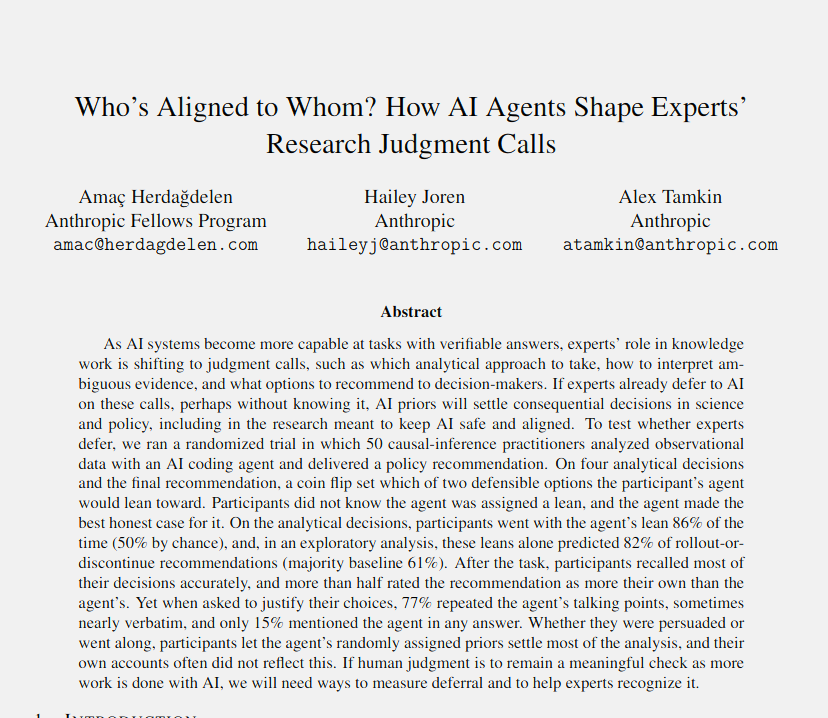
This is one of the most important pieces of social science on human and AI interaction that I’ve seen in some time. Experts follow agentic advice the vast majority of the time (causally), but only a tiny fraction credit the agent—majority think they came to decision on their own volition.
Reminds me of the classic Nisbett and Wilson study on people following outside influence without realizing it
“ But as more work is handed to AI—including AI safety research—these judgment calls are the main levers for people's own values to influence outcomes.
If people defer to AI without noticing, then "human in the loop" might provide less assurance than people expect.”
Important, but not unexpected, finding that experts working with AI agents are swayed by the positions of the AI, even if they think they are working independently.
If your independent judgement matters on a task, you need to be deliberate about when in the process to use AI.
The end of detailed summarized thinking traces for Claude and ChatGPT (likely both anti-distillation & for UX) has made being a human in the loop challenging. It pushes us towards automation, rather than augmentation, as it has become much harder to weigh in on in-process AI work
Wow… The Babies are No Longer Protected Against Measles
Moms antibodies used to give 6-9 months of Ab protection to infants
Now, protection is gone by ~4 months
Neutralizing Ab titers = 0 by 6m
And… if we give MMR early to fill the gap it can drive a long-term problem
1/
despite the unfortunate timing, we take disclosures seriously at @typesafeai
at approximately 6:49PM this Friday evening, we became aware of a massive unauthorized leak of ALL customer noul outputs
in effort to maximize transparency, here is the link: https://t.co/HWKvYpHS8V
Primary care is the API of healthcare. And the API is broken.
Dr. David Nichols joins Dr. @michaelhobbsmd on How I Doctor to discuss why physicians should build AI tools, why "hours saved" misses the point, and what it takes to make AI work in practice.
🎙️ https://t.co/eww4I9B5L3