Holy smokes!!!!
$SPCX says Q4 capex will be $35-40 billion versus $18-19 billion from sell-side estimates.
Elon also says they can bring on 10 GW of compute in 2027 in addition to the 2.5+ GW they expect to have by the end of 2026.
This means $SPCX capex in 2027 could be $300-400B billion (ie $30-40B per GW) vs current sell-side estimates of $165B.
From Elon… “At current pricing, new compute deployments are generating a payback of less than a year. Pricing is currently tracking slightly above the high end of the $30 to $50 per watt range we were discussing just last quarter, which further supports the attractiveness of these terrestrial SI compute investments.”
From Elon… "I think the demand for bandwidth is going to be dramatically higher than it is today. I think in three to five years there is probably a demand for 1,000 times more bandwidth than there is currently, because AI or SI agents will on a per-agent basis use far more bandwidth than a person, and there will be far more agents than there are people... With next year being primarily Rubin, I would say I am fairly confident of being able to bring an incremental 10 gigawatts of compute online in 2027. That would be in addition to the roughly 3 gigawatts, maybe 2.5 to 3 gigawatts that we will have online by the end of this year. Let me put it this way. I would be surprised if we brought on less than 13 gigawatts of compute by the end of next year."
…and to think that some of you are bearish on ai infrastructure 🙄 while the clowns at Gartner think demand is lagging supply 🤣
In early 2010s, oil prices were high and rising. Excitement around shale oil was high and prospects for refining seemed poor. Investors and bankers pressured integrated oil companies to divest their refinery units bc they were capital-intensive, cyclical, lower-return assets. Marathon (2011) and Conoco (2012) did so, spinning out their refinery units into newly publicly traded companies.
Here's total shareholder return since the spin outs:
Marathon Oil (producer): +40%
Marathon Petroleum (refiner): +3,210%
ConocoPhillips (producer): +286%
Phillips 66 (refiner): +1,272%
Interestingly Conoco bought Marathon Oil in 2024.
One conclusion might be that the separation worked, as refining no longer competed with upstream for capital and management was wholly focused on the sector.
Another conclusion may be that when investors are clamoring for a company to spin off a chronically underperforming division, if often signals the bottom and that division is the better investment going forward.
"Recent days have been humbling for human mathematical intuition. Long-held, unquestioned hypotheses have fallen. ... In hindsight, May's unexpected disproof of the Erdős unit distance conjecture was our warning shot."
Microsoft CEO Satya Nadella wrote that a company renting an AI model “essentially pays for intelligence twice”:
Once in money, and again in the proprietary knowledge it has to reveal to make the model useful.
This mechanism is called the learning loop: every prompt and correction captures some of the company's know-how.
That knowledge is distilled and, with a closed model, the provider keeps that information.
If your usage data is worth more than the token cost to serve, providers might end up paying you to use their models. The precedent exists: OpenAI created an opt-in program that gives accounts up to 1M free tokens a day on certain models in exchange for training rights on that traffic.
Chips can be rented and algorithms can be leaked or distilled, but the prompts and corrections flowing through a model compound privately for whoever holds them.
Today is the day that AI passed the "financial modeling Turing test" for me.
A "push button" build from scratch Skill that one-shotted a model on $MU that is indistinguishable (to me) from a model that a junior analyst would build from scratch. With full, impeccable adherence to all aspects of who i like to format, design & build models (took a few turns to dial it in).
Opus 5.5 is unbelievable.
“People are working 12 to 13 hours a day just to press enter.”
We are turning an entire generation of technical experts around the world into the equivalent of retirees pushing a button in front of casino slot machines.
Essentially the brain rot of doom scrolling social media is coming for your development team…
This will have lots of long run implications on companies. Most important of which, is that it will make existing moats even more brittle.
The value of automated software is not making the software faster.
It is understanding your intention and making the software BETTER.
Better edge.
Better design.
Better alpha.
But if you don’t slow down and map out your intention, you will just make your shitty code faster.
We built 8090’s Software Factory to do this: when execution is a costless commodity, what really matters?
Over time, companies will realize that it’s:
1. Intention
2. Governance
3. Verification
4. Evidence
This is what will separate orgs consuming tokens and companies encoding their edge. This generally requires top down leadership from the CEO to the CFO/CIO.
Bottoms up tool adoption only increases costs and accelerates slot machine behaviors.
Good luck to all the players.
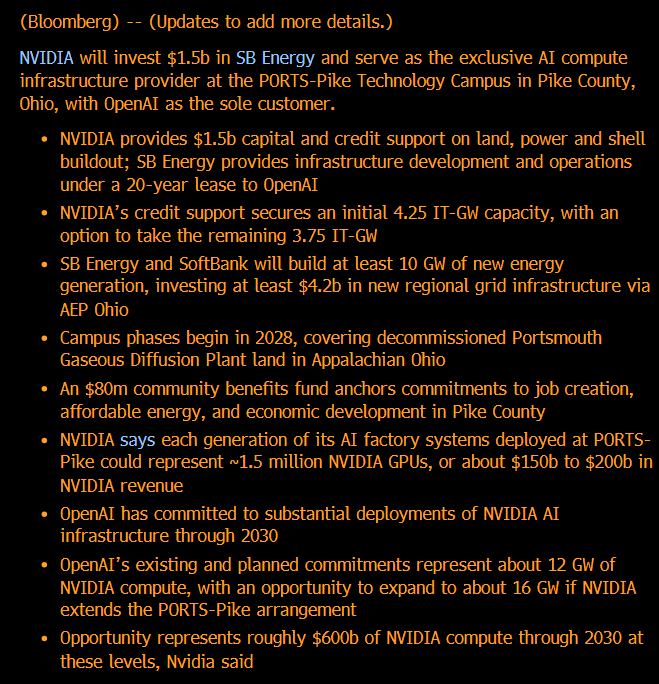
🚨NVDA just put a 20-year floor under AI data center terminal value; valuation looks bullish for powered-shell developers.
What we know from the 8-K:
>NVIDIA is providing residual value guarantees to SB Energy covering approximately 4.25 GW of IT load at the Portsmouth site in Ohio. OpenAI is the tenant. Each guarantee can run for up to 20 years from the start of the applicable lease.
>If OpenAI defaults, SB Energy can relet the facility or sell it, with NVIDIA covering the shortfall versus a contractually defined guaranteed minimum value. NVIDIA can also assume the lease. The guarantees apply to completed facilities, not buildings still under construction.
>NVIDIA's cumulative obligation is capped at $105B.
>Guarantees start in 2028 when the first buildings come online.
>$105B / 4,250 MW = $24.7M/MW of maximum guarantee capacity.
>Importantly, $24.7M/MW is NOT the guaranteed residual value. We don't know that yet. The Agreements will be filed with NVIDIA's 10-Q later this month and will include the guaranteed minimum values that determine what NVIDIA actually owes.
The scale of the guarantee has interesting implications:
>A greenfield AI data center costs roughly $50M/MW all-in today, including silicon. NVIDIA's release implies roughly $19-25M/MW of silicon per generation, leaving approximately $25-31M/MW for the non-silicon infrastructure.
>So NVIDIA's $24.7M/MW of maximum guarantee capacity is roughly equal to the entire non-silicon cost of building a greenfield AI data center.
That's potentially very important for brownfield conversions like those being leased by bitcoin miners, who already own much of the expensive, scarce and long-lived infrastructure: land, substations and interconnects. Replicating those assets from scratch is increasingly expensive and, just as importantly, slow.
At current prices, we estimate landlords like $WULF and $HUT are being valued with nearly zero terminal value on their signed leases.
NVIDIA has just given the market a very useful new framework for what those assets could still be worth when the initial leases expire.
IN 1973, THREE ACADEMICS PUBLISHED ONE EQUATION THAT QUIETLY CREATED SOME OF THE LARGEST MARKETS ON EARTH
Most people have never heard of it. The derivatives markets it made possible are now measured in the hundreds of trillions of dollars.
The strange part is where the math came from:
It came from physics. The same equations that describe how heat spreads and how atoms jitter in water turned out to describe how stock prices move. A French mathematician, Louis Bachelier, spotted this in 1900 and used it to price options, beating Einstein to the core idea by five years. He was ignored.
The problem he was solving was ancient. Options, the right but not the obligation to buy or sell something later at a set price, trace back to roughly 600 BC, when the Greek philosopher Thales locked in the price of olive presses before a big harvest and cashed in. For centuries, nobody could agree what an option was actually worth. Traders just haggled.
Fischer Black, Myron Scholes, and Robert Merton solved it. Their insight: if you can build a portfolio of stock and options that carries no risk, then in a fair market it should earn exactly the risk-free Treasury rate and nothing more. That logic produced an explicit formula. Plug in the inputs, and the fair price pops out.
Wall Street adopted it almost overnight. The Chicago Board Options Exchange opened the very same year, and trading volume has roughly doubled every five years since, a kind of Moore's Law for finance.
Today there is more money riding on derivatives than on the assets they are based on, by multiples. As one professor framed it, options let you take one underlying thing and turn it into five, ten, fifty versions, each tuned to a different appetite for risk.
Scholes and Merton won the Nobel Prize in 1997. Fischer Black had died two years earlier and could not share it.
Credit: @veritasium
Andrej Karpathy joined Anthropic five weeks ago.
Yesterday my friend on his team sent me the Claude.md file he actually uses.
It completely changed how I work with Claude.
From the very first message, the difference was obvious.
With this file, Claude finally stops fighting me and starts working exactly the way I need it to.
Bookmark it before it gets taken down.
Read it now, then check the article below.