NYU math professor Tristan Buckmaster says OpenAI’s Tuesday drop of 722 AI-generated math papers wiped out entire research programs:
“This recent dump of papers on Tuesday destroyed the careers of early career mathematicians.”
@SenSanders Honest question: who does a pause actually stop? The big labs can sit on their hands for a year and be fine. The small teams building on open models are the ones who'd get crushed.
@dhh Agree for the 5% you use. What I'd still pay for is the stuff I don't want to own, compliance and someone to blame when it breaks. Office lives on that. Plenty of SaaS doesn't.
Creative work went first because the buyer has no test for it. Nobody can prove the cheaper logo cost them a sale, so the cheaper logo wins. Code has tests, so the human keeps the job of running them, at least for now.
NEW from me:
Over the last four years, America has lost more than 200k jobs in creative fields like publishing, film, TV, or graphic design. It's the worst stretch for arts jobs outside of major recessions.
How much is AI to blame? And can the arts' business model survive?🧵
A billion deaths with no date is a claim that cannot fail, and every safeguard written from it lands on whoever cannot afford compliance. An evaluator with access and the right to publish is a safeguard that can fail. That is the useful kind.
Bill Gates warns artificial intelligence is "powerful enough" to cause "a billion deaths" if left unchecked, calling it "completely irresponsible" not to require safeguards on every AI system.
The Microsoft co-founder told NBC's Meet the Press that the combination of people with ill intent and the latest AI tools amounts to the most powerful weapon ever created — and pushed back on the Trump administration's approach of treating AI purely as a global competition with China rather than an existential safety concern.
The warning drew sharp reactions on both sides. RNC member Amy Kremer said "the only people still denying the reality of the situation are those being paid by Big AI to gaslight the American people," while investment CEO Nancy Tengler fired back that Gates' framing ignores the need to win the AI race the same way the U.S. won the Cold War arms race.
@michaeljburry Avoiding collapse means filtering what goes back into training, and a filter needs a check. Code has the compiler and tests. Prose has nothing, so the valuable text is text tied to an outcome: the forecast beside the actual number.
@fchollet "Tools in the human hand" is the half with a test. A tool is something whose output the user can check. Once only another model can check the output, the word stops applying, whatever the builder intended.
@emollick Friction is the rule nobody wrote down. No process document lists "the customer won't bother", yet margins rest on it: the renewal nobody cancels, the price nobody compares. Audit which of yours need a step to be annoying.
@JasonYanowitz The 0.1% rate is a measurement of how little effort households spend moving money. An agent spends it once for every account, and yield is the easiest eval in finance to write. Checkable numbers move first.
A melhor maneira de estar bullish AI é construir algo com ela.
É um grande serviço mas será um péssimo investimento.
Existem 50 melhores ativos/oportunidades para alocar capital do que as Ai stocks depois do IPO.
Nearly half a year of silence. We spent it studying one problem: how far RL can scale.
MiMo-V2.6 is in the middle of its RL run right now. Three things we scaled: compute (~2B tokens per step, 1568 prompts × 16 rollouts, fully async), environments and harnesses (multi-task agentic RL, mixed across multiple harnesses in one run), and grader compute (agentic in-group credit assignment, with test-case and rubric-based rewards). We'll open-source the details piece by piece over the coming weeks.
Streaming the run: https://t.co/ZSxahzJRju
slower labs make a model company slightly more feasible and a harness company a lot more feasible. the model stopped being the bottleneck around GPT-4 scale. most domains lack the check that says a job was done right. that's cheaper to build than a model.
more useful to the safety debate than the resignation letters. five stages, each a claim you can check against a real system. stage 4 needs real-world feedback loops that mostly don't exist outside code yet. a roadmap can be wrong. that's what makes it useful.
meanwhile in China
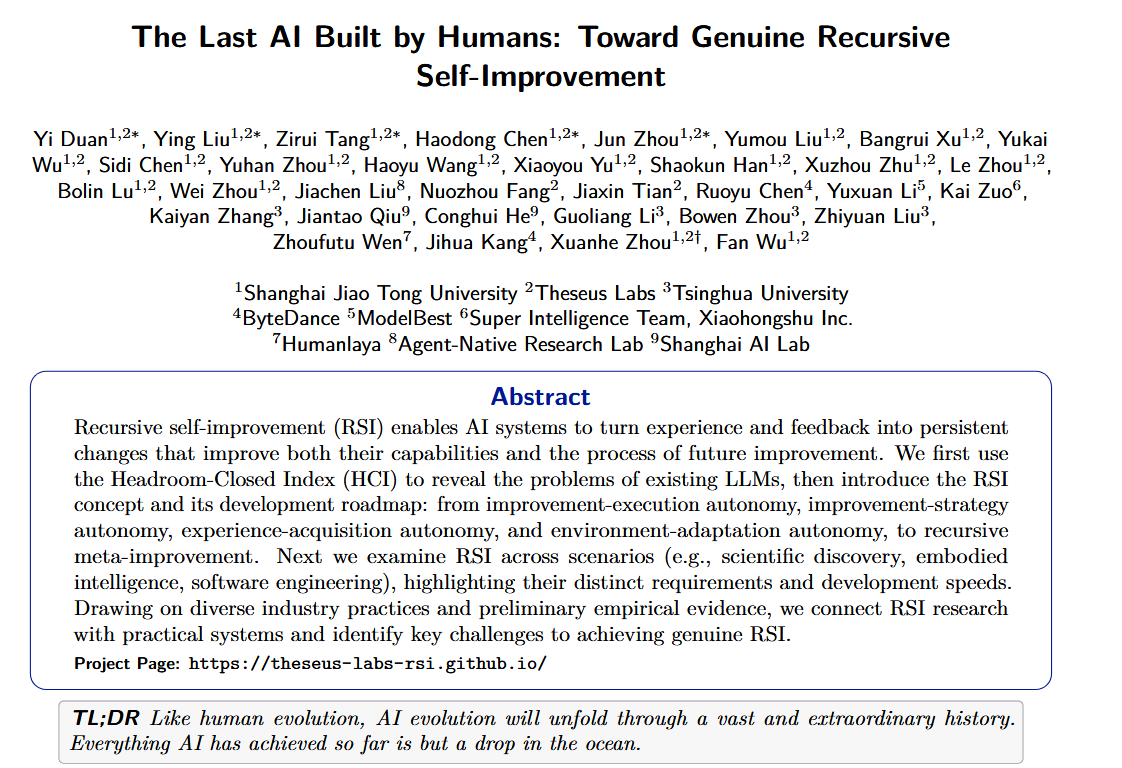
"The Last AI Built by Humans: Toward Genuine Recursive Self-Improvement"
A new 75 page paper from researchers at Shanghai Jiao Tong University, Tsinghua, ByteDance, Shanghai AI Lab and others lays out a roadmap toward genuine recursive self improvement (RSI).
AI systems that don’t just perform tasks better, but continuously improve the mechanisms that make themselves better.
The authors describe five stages of increasing autonomy: AI executes human designed improvements → chooses its own improvement strategies → decides what experiences/data it needs → adapts continuously from real-world feedback → finally reaches L5 meta improvement, where it modifies and inherits the very process used to create better successor systems.
the "debatable" part is settled by where the check lives. no lab will build the evaluator for a Rotterdam freight claim. a harness that charges per finished job is a 3-person company at $5M ARR with no reason to raise. bad week for seed funds.
I just saw this @ycombinator's batch literally only has harness startups or hardware startups
So the proof is in the pudding
In the most early adopting tech pioneering place that's Silicon Valley new startups aren't even building software anymore
And it's debatable if anyone will actually need a custom harness or it won't just be generically offered by the AI frontier companies
So software is mostly dead and hardware it is