One of my biggest regrets while building companies was abandoning my hobbies. I convinced myself I was too busy. Looking back, it was a terrible and illogical trade. Keep surfing. Keep lifting. Keep reading great books. Life should never be put on hold in the pursuit of money.
Andrew Huberman on the best advice he ever got: figure out the most real work you can do every day, consistently, and find a way to reset every week.
"The best advice I ever got: there was a neurologist out at UC Berkeley and UCSF, Bob Knight, some years ago, very talented. I asked him for advice starting graduate school."
"He said, 'Figure out the maximum amount of real work that you can do every day consistently, and then figure out some non-destructive way to reset yourself every single week.'"
"I said, 'How do you reset?' He said he likes fishing. I like to hike. I like to get into nature and spend time with people while I do it. I figured out I could work X number of hours per day, 5 days a week, and I just stuck to it for 25 years."
"People who take a ton of stimulants and just blitz, blitz, blitz, blitz, blitz. These are the same people that crash and disappear. You have to figure out and build your capacity."
"Yes, you have to work extremely hard. You have to be extremely focused. But you also have to figure out how long you can keep this up."
@hubermanlab
@diligentsAI@HighyieldHarry Not worth responding to AI slop, but why mention the dry powder in PE and then bring up Main Street (500k-5M) which aren’t targets of PE?
@diligentsAI@HighyieldHarry The exits aren’t happening though. Deal count was down in 2025 YoY and GPs are holding onto portcos for longer and longer. Something has to budge before all of the overpaid 2021 vintage companies near the end of their holding period.
@HighyieldHarry Totally agree. The outlook in PE looks a lot more uncertain. Distributions as a percentage of nav have been below 15% for the last 4 years which has never been seen before. Not to mention the average company exited in 2025 was from the 2017/2018 vintage.
Of course that's your contention. You're a first-time SaaS bear. You just got finished listening to some podcast, Dario on Dwarkesh, probably. Now you think it’s the end of white collar work and seat-based pricing is screwed. You're gonna be convinced of that til tomorrow when you get to “Something Big is Happening”. Then you’ll install ClawdBot on a Mac Mini, vibe code a dashboard on top of a postgres database and say we’re all just a couple ralph loops away from building a Salesforce competitor. That’s gonna last until next week when you discover context graphs, and then you're gonna be talking about how the systems of record will be disintermediated by an agentic layer and reposting OAI marketing graphics.
“Well, as a matter of fact, I won't, because ultimately the application layer is just ….”
The application layer is just business logic on top a CRUD database. You got that from Satya’s appearance on the BG2 pod, December 2024, right? Yeah, I saw that too. Were you gonna plagiarize the whole thing for us? Do you have any thoughts of your own on this matter? Or...is that your thing? You get into the replies of anyone posting a SaaS ticker. You watch some podcast and then pawn it off as your own idea just to impress some VCs and embarrass some anon who’s long SaaS? See the sad thing about a guy like you is in a couple years you're gonna start doing some thinking on your own and you're gonna come up with the fact that there are two certainties in life. One: don't do that. And two: you dropped thirty grand on Mac Minis and LLM API calls to come to the same conclusion you could’ve got for free by following a handful of VC accounts.
@JulianKlymochko@JohnCoxCap I think you’re missing a key piece here. For LPs, smoother return stream is usually worth more than a cheaper entry price. Their liabilities (pensions, insurers) are a better duration match, often can't invest in RICs and fee structure for private funds is often more attractive.
Independent Sponsors are always going to have a very hard time beating out funded PE firms for a deal. Not that it never happens but it is pretty rare.
Intermediaries all understand the difference between a PE fund that can speak for the purchase price and an independent sponsor that is just trying to sign something up to go to try to raise the capital. Even if you have a long track record as an IS it is tough.
Many people who are spinning out of PE funds quickly discover just how different it is. When we started a lot of the banks that I thought I had real relationships with simply stopped sending me deals. And even if they would send us the deal it was hard to a meeting. That is just what happened.
So how do Independent Sponsors find deals? You have to hunt in deals that the funded guys aren't pursuing.
Maybe you find a diamond in the rough from a small deal broker who doesn't understand what they have. But this is rare and PE is now calling on even the small deal brokers.
You can take risks that many in PE don't like:
Founder transitions
Poor systems
Limited processes
But these types of deals have real risks and you have to be good at managing them.
I think the best place to hunt is smaller deals. Most PE won't go below $5M of EBITDA to start. Some will, but the competition is way less. Put a couple of $1-3M businesses together and you can really have something.
The reality that I see from the Independent Sponsor deals that we review is a lot of these guys are over paying for businesses with real issues...
Apollo–Athene shows why insurance capital is a natural home for private credit. Long-dated annuity and PRT liabilities align with long-duration, contractual private credit cash flows. No daily liquidity, no redemption reflexivity, no forced selling. Duration matching—not asset labels—is what de-risks the system.
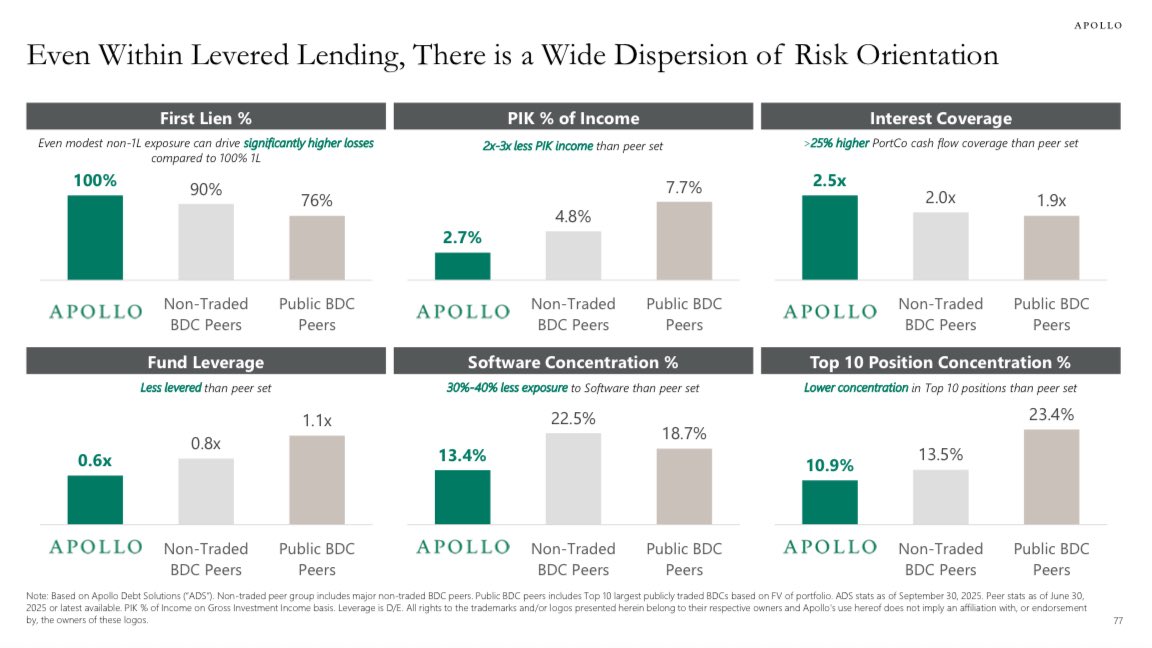
Lots of great info in a recent Apollo deck on private credit and levered lending. This slide shows why Apollo continues to be one of the best in the business. They understand where the risk lies in these deals and how avoid it. Just look at what side of the First Brands collapse they were on.