Great day at @runwayml's AI Festival in Tokyo. Got asked all day what MIXI does and where we're going.
The festival didn't teach me anything new, it confirmed what I already believed: as production gets abundant, the scarce thing is story. And I love this so much it's thrilling, it's the world I've been wanting. You could feel it in the whole room, every piece that landed had a story worth telling, and I walked out fired up to tell ours.
Here's ours: nobody in Japan believes in what Runway is building more than we do, and in entertainment, we move fast enough to put AI into the real world, not just the lab.
I'm looking for people to build it with, inside MIXI or alongside it. If any of this resonates, let's find a way.
Just watch. 🇯🇵 見とれやー!
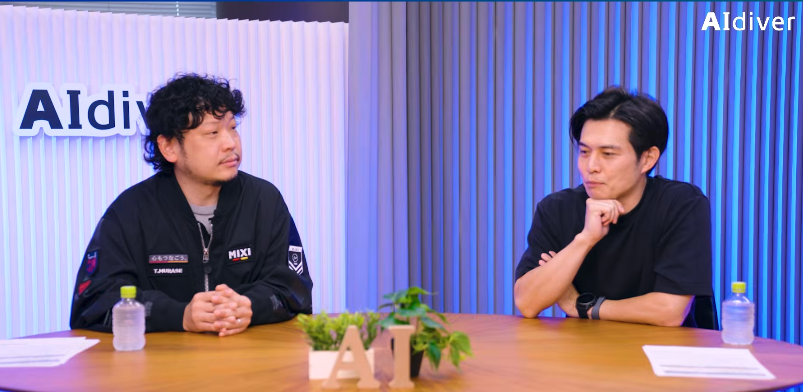
Sat down with Sugai-san from COLOPL, one of my favorite people in this industry.
Yes, we talked numbers. 99% AI adoption at MIXI, roughly ¥1B in profit. But we kept drifting back to the thing we actually care about: the moment a player gasps.
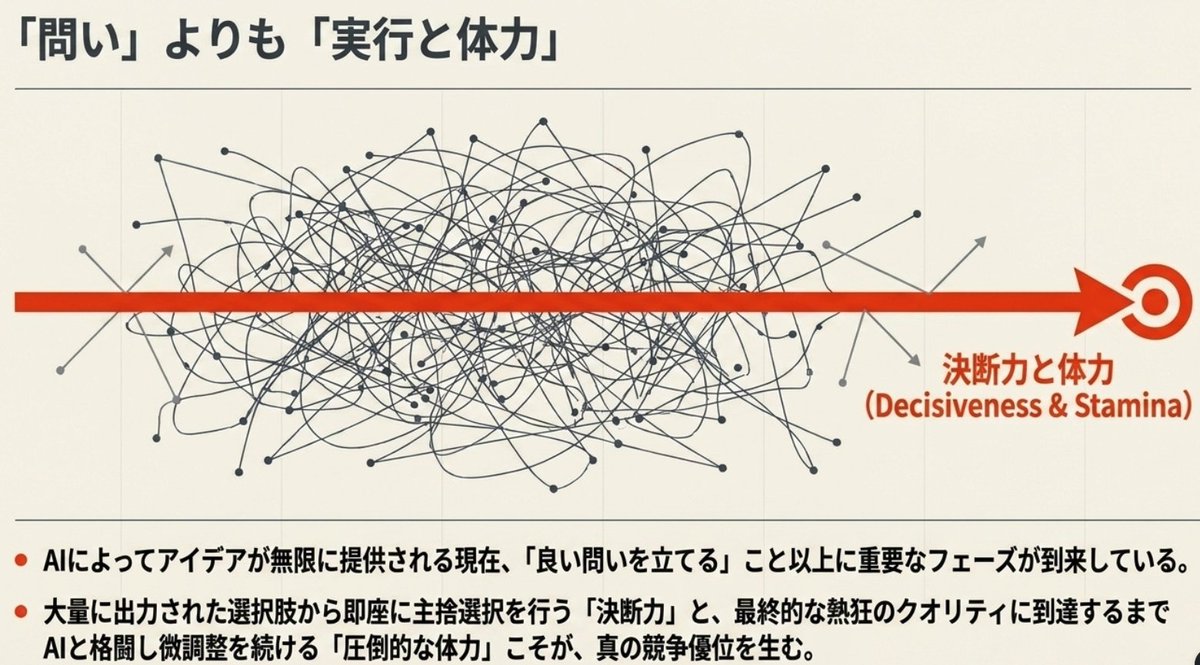
AI has made creation absurdly cheap. It hands you an ocean of uniformly good output. What it still can't do is decide who any of it is for, or design the emotional peak of a game.
One example we kept chewing on: an engineer can now generate 10,000 features overnight. Ship them all and your users open the app to chaos. Somebody has to hold the story. Who is this for, and what's the one surprise everything else gets cut for.
So when a 30-day task gets done in 1 day, we don't pocket the savings. The 29 days go into craft and into building that moment of delight. Making things got cheap. Making people care didn't.
Video (in Japanese) in the replies 👇
大好きなコロプラの菅井さんと対談しました。
MIXIのAI利用率99%とか利益約10億円の話もしてるんですが、本音はもっと手前にあって。
「AIを使うか使わないかの議論は、もう終わりにしてほしい」
「人の役割がどうこう言うより、物を10倍100倍作って世界に出してか��考えたい」
ROIを証明してから投資、だと動き出しが遅すぎる。腹をくくって投資額を先に決めて、その範囲で全社適用する。30日かかってた作業が1日で終わったら、次の見積もりは1日から始める。浮いた29日は削減じゃなくて、こだわりと熱狂への再投資に使う。
AIは「誰のために作るか」までは決めてくれない。だから最後は人間の意志と、あとは体力です。
動画はコメント欄に👇
Starting August 1st, I'm taking on the role of CAIO (Chief AI Officer) at MIXI.
99% adoption was the starting line. Two things happen from here.
First, inventing experiences that only AI makes possible. From R&D through to product, shipping forms of communication that did not exist before.
Second, rebuilding the company on an AI foundation. Not redesigning jobs. Asking what the work even is when AI does the doing, then building around that answer instead.
The goal is to retire the word "AI" entirely. You don't say you're using electricity. When it stops being worth naming, the transformation is done, and this role stops being necessary. A CAIO should be a temporary job.
None of this is ours alone. With Runway, OpenAI, Google and every partner ahead of us, we're going to make MIXI more like MIXI than it has ever been. Connection with meaning, at a scale we couldn't reach before.
The next two to three years decide it. We're not coming back.
8月1日付で、MIXI の CAIO(最高AI責任者)に就任します。
活用率99%はスタートラインでした。ここからやるのは2つです。
ひとつは、AIでしか作れない体験を発明すること。研究開発から事業まで、これまで存在しなかったコミュニケーションを世に出します。
もうひとつは、全ての仕事をAIベースに作り替えること。効率化ではありません。仕事の形そのものを、AI前提でゼロから組み直します。
AI変革はここから2〜3年で決まると考えている中、一気にやっていきます。
MEDIAMIXI で、Runway 提携の裏側と AI 時代の「つくる」について話しました。
制作が21日から3日になって終わり、ではなくて。浮いた時間でモノをもっと沢山作って、みんなを魅了する。こだわりたいところに、こだわり続ける。そこからが本番だと思っています。
Talked with MEDIAMIXI about the Runway partnership and what "making things" means in the AI era.
Video production went from 21 days to 3. The real question is what you do with the time that frees up.
My answer is simple. Make more things. Delight more people. Keep obsessing over the details worth obsessing over. AI is the tool that buys you that time.
Now live in English.
The part I keep coming back to isn't the time saved. It's my team's own conclusion: with @runwayml in the pipeline, the skill that mattered most was putting intent into words, telling the model what we usually judge by feel. That's the new craft.
Full piece in the replies 👇
Runway and MIXI just announced a strategic partnership, and it reads like a clean case for the video-vertical bet: MIXI spans gaming, sports and entertainment — exactly where Runway's move from video generation into world models has the most room to run.
The numbers are the headline. A Monster Strike video that used to take 21 days shipped in 3. A brand film cut from 20 days to 7. Character animation and in-app effects dropping from several days to roughly five minutes. Real production timelines, done in-house — not demo reels.
But the part I keep coming back to is the direction of fit. Sports and games are dynamic, motion-heavy, interactive — the kind of content that pushes a model toward actually understanding a scene, not just rendering one. That's the same territory Runway's been mapping with its world-model research. So MIXI isn't only a customer here; it's a testbed that lines up with where the research wants to go.
And as AI makes production abundant, the scarce thing flips to direction — point of view, taste, the stories actually worth telling. That part only gets more human, not less.
Today, we're announcing a strategic partnership with MIXI, one of Japan's largest gaming, sports and entertainment companies. MIXI will be deploying Runway across their organization, and we'll work together to explore emerging applications for world models across gaming, animation and interactive experiences.
Learn more at the link below.
Today, we're announcing a strategic partnership with MIXI, one of Japan's largest gaming, sports and entertainment companies. MIXI will be deploying Runway across their organization, and we'll work together to explore emerging applications for world models across gaming, animation and interactive experiences.
Learn more at the link below.
If you've put agents into production, you already feel this — without yet having the word.
A proposed term, by direct analogy to Cunningham's Technical Debt (1992):
Coordination Debt — the meetings, approvals, reports and committees an organisation continues to perform after the information scarcity that justified them has lifted. Ritual on the surface; interest underneath.
What Technical Debt was to code, Coordination Debt is to organisations.
Six forms it accumulates in:
i. Sync Tax — meetings without information value
ii. Status Debt — humans aggregating what tools surface
iii. Layer Debt — middle stratum that decides nothing
iv. Decision Debt — Type 2 decisions sought as Type 1
v. Capital Debt — annual budgets in a quarterly world
vi. Craft Debt — manual work agents would do faster
The lineage:
1992 — Technical Debt (Cunningham)
2009 — DevOps (Debois)
2018 — Platform Engineering (Fournier et al.)
2026 — Coordination Debt (proposed)
The four-to-six-year average for term diffusion came from a pre-AI world, where terms diffused through conferences and books. This one diffuses through the very medium it names — agents — propagating the friction at the same speed they execute it. Compressed expectation: install ca. 2028, perhaps sooner.
. @garrytan's gstack is the cleanest dev stack I've come across. Each skill captures a role — PM, QA, security, growth — I'd otherwise context-switch into for hours. The whole product lifecycle just flows.
Pulling from 14+ years in game dev, I'm layering game-specific skills on top: GDD, playtest, balance tuning, fun reviews.
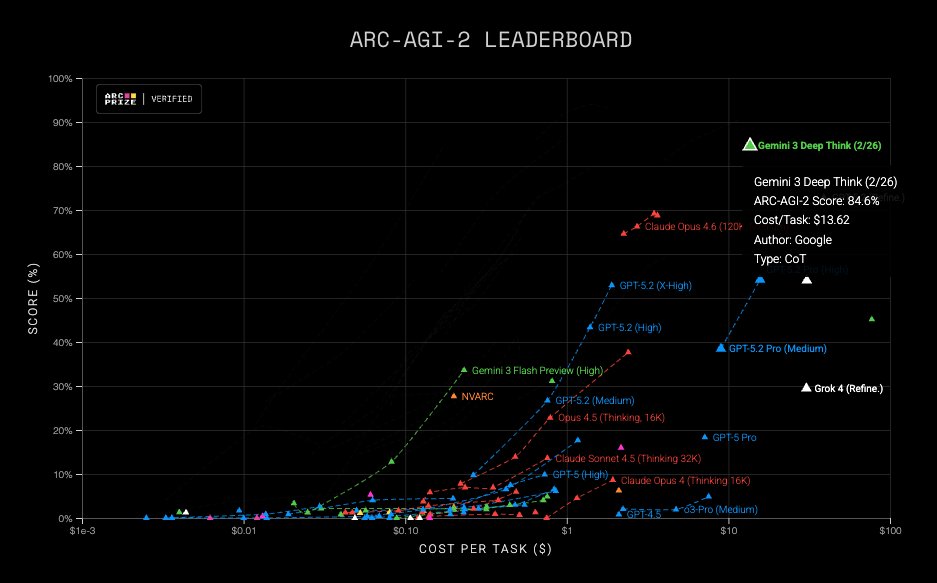
Congrats to the @GoogleDeepMind - 96% on ARC-AGI-1 and 84.6% on ARC-AGI-2 is a huge milestone.
ARC was specifically designed to test reasoning that can't be brute-forced through memorization - abstract puzzles humans find intuitive but AI historically struggled with. ARC-AGI-2 was made even harder after models started cracking the original.
At $7-14 per task it's not cheap, but watching the "AI can't do novel reasoning" argument get harder to make in real-time is pretty exciting.
Neat approach to brain mapping: the AI doesn't just classify cells one by one - it learns which cell types tend to hang out together, like figuring out neighborhoods by their mix of buildings.
CellTransformer masks a cell, guesses what it is from its neighbors, and repeats this millions of times until it learns the brain's "neighborhood rules."
Result: maps with 1,300 subregions from 10 million mouse brain cells. Areas like the striatum - previously drawn as one big blob - turn out to have distinct subdivisions. This could explain decades of debate where scientists assigned totally different functions to the "same" brain region.
Pretty wild that the AI finds boundaries matching hand-drawn atlases while also discovering ones humans missed entirely.
Biologists have fed genetic data from millions of mouse brain cells into a custom machine learning algorithm. The program delivered maps of the brain with unprecedented detail, revealing a thousand-plus novel regions. https://t.co/ZhqbQCSCfX
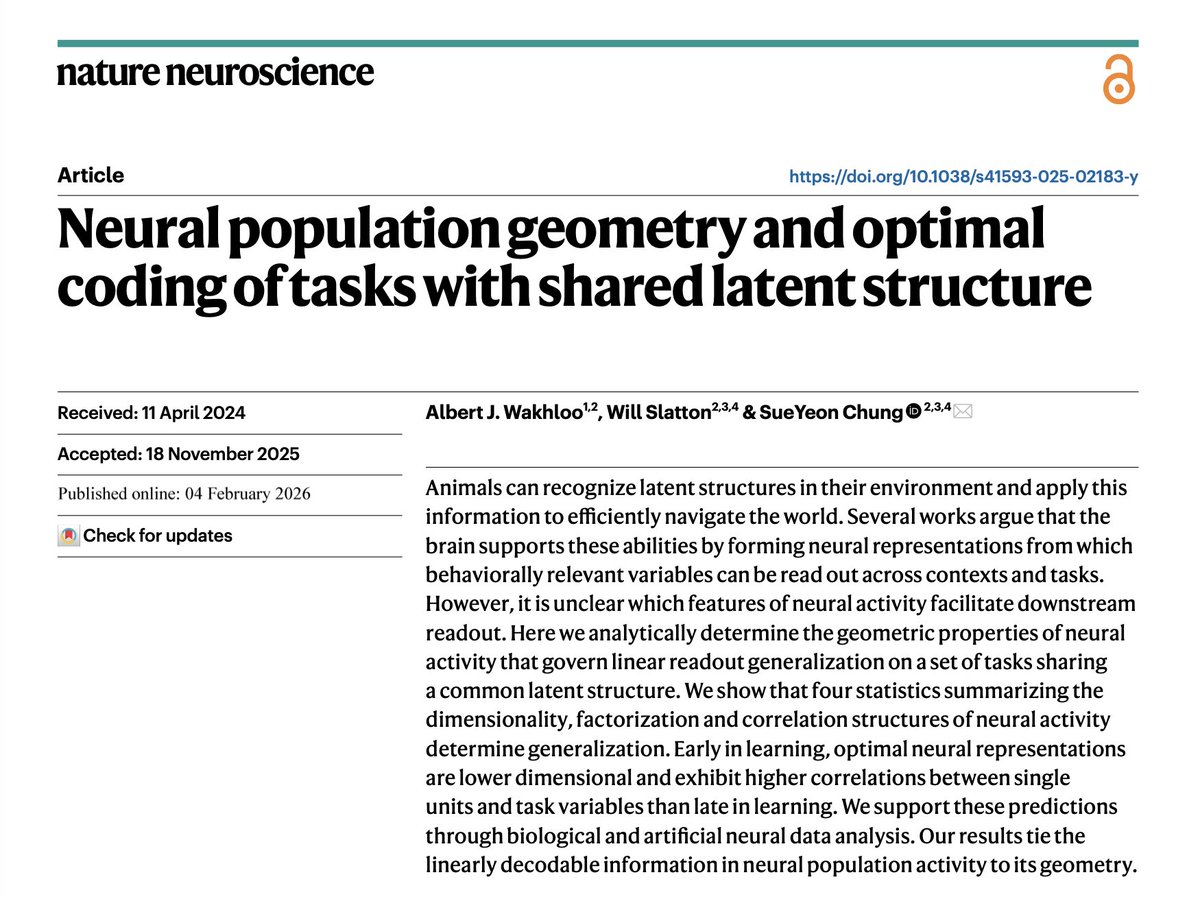
Came across this Nature Neuroscience paper that asks a deceptively simple question: what makes neural representations good at supporting multiple related tasks?
Their answer: four geometric properties - correlation with latent variables, signal factorization (disentanglement), noise factorization, and dimensionality. They derive an analytical formula showing how these interact to determine generalization.
But here's what I find most interesting: the optimal geometry changes during learning. Early on, lower-dimensional representations with stronger single-neuron correlations work best. As learning progresses, the optimal code becomes higher-dimensional and more factorized.
This captures something intuitive - when data is scarce, compress and focus on the most informative signals. When data is abundant, expand to capture subtler distinctions. The brain seems to follow this strategy in rat PFC/CA1 recordings during spatial learning.
Pretty cool to see a principled framework for why "disentangled representations" actually matter for downstream tasks.
How smart is a flatworm?
Researchers tried to measure this by asking: if you gave a problem to random chance vs. a living organism, how much faster would the organism solve it?
A flatworm exposed to a toxin that destroys its head can regrow a toxin-resistant one in about a month. Finding that genetic solution randomly? Would take 10^20 years.
That's not just "biology doing its thing." That's navigating an impossibly large search space with precision we barely understand. Makes you rethink what "simple" organisms are actually doing.
Remotion keeps shipping. New Maps skill for Claude Code - not always one-shot, but highly steerable. The skills ecosystem is becoming the real moat here.
Might try this out for my Australia trip vlog coming up. :P
Suno adding one-shots and loops is exactly what I've been waiting for. Full songs are great, but being able to generate individual sound elements opens up completely different use cases.
Loops for background music, one-shots for sound effects and foley - this makes Suno actually usable in production workflows. Drop a generated loop into a DAW, layer it with other elements, build something custom.
The shift from "generate a complete song" to "generate building blocks" is a big deal. Two credits per generation feels reasonable for this kind of utility.
https://t.co/xzA65sUQxY
Introducing Sounds (Beta)
Pro and Premier users can now create one-shots and loops from scratch for two credits per generation.
From sound effects to foley, you can make it all on Suno!!!
KREA's Realtime Edit is pretty wild - complex instruction-based image editing at interactive speed. The demo shows "turn into wax figurine, add suit" happening as you type.
Real-time style transfer isn't new, but real-time instruction-following edits are a different thing entirely. You're not just applying a preset filter - you're describing arbitrary transformations and watching them happen live.
The latency here is the real achievement. Getting diffusion-based editing fast enough for this kind of interactive feedback loop changes how you'd use these tools. Iterate by watching, not by waiting.