Very excited about our newest paper! "Efficient training for optical computing"
Great job by Manon and Nick:
https://t.co/1hw3Jv5Q1q
@Tulane@TulaneSSE@mpbquantum
New paper in @MLSTjournal: task difficulty leaves a clear signature in neural networks, and for harder tasks even simple binarization can collapse performance to chance.
Read more: https://t.co/sq9UEHD2CE
@filrad@MAngelsSerranoM Marián Boguñá @santo_fortunato
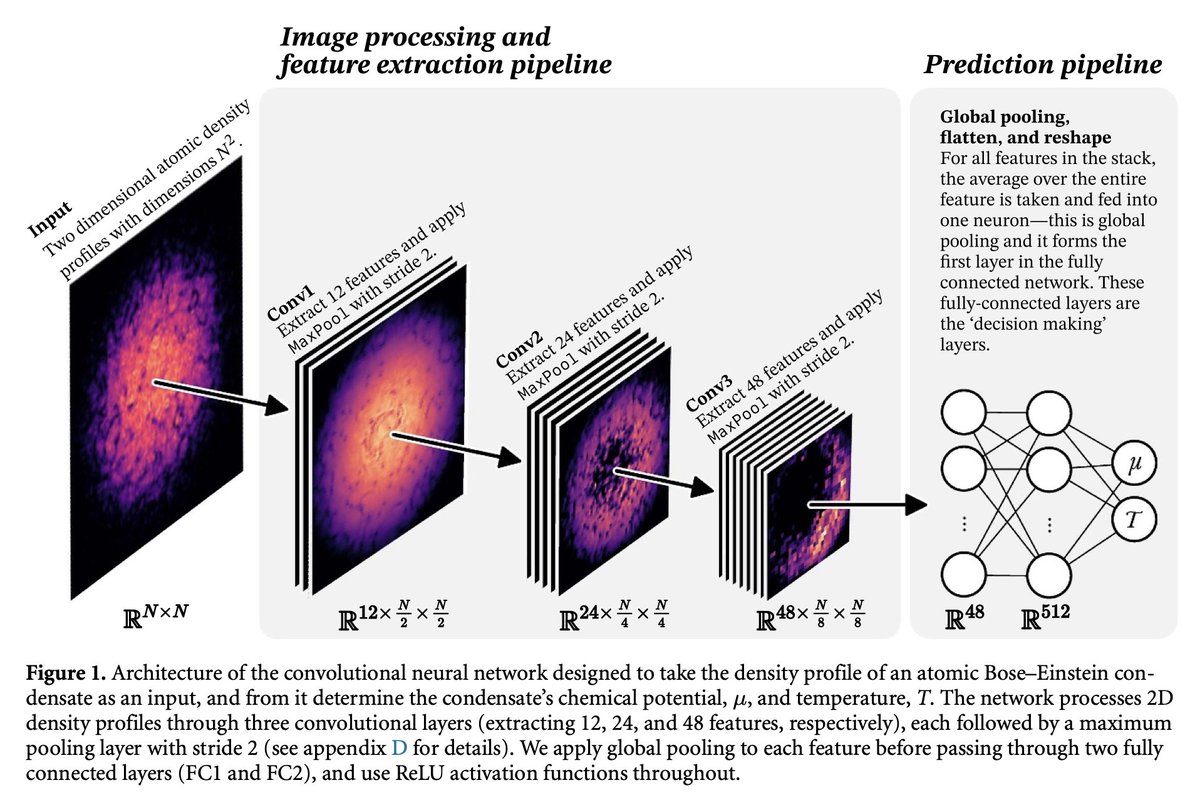
Our paper on machine learning methods for thermometry of simulated Bose–Einstein condensates is now available on IOP @MLSTjournal:
https://t.co/PjalIA8apP
From Thursday, 5 June, X will no longer be our primary platform for sharing news.
We would love to connect with you on:
🦋 Bluesky - https://t.co/TpdKfZMFJt
LinkedIn - https://t.co/63ZbvafCID
Facebook - https://t.co/KDmF5IZrHq
Threads - https://t.co/pZpzITBIsT
Our paper is now out in @MLSTjournal, the BEST place for stat mech for ML!
Response theory of first passage processes and the quasi-steady-state hypothesis helps optimize training protocols for neural nets👇@chemistrytau@BioSoftTAU@TelAvivUni
https://t.co/dRokyVxhGt
My video interview with @QuantaMagazine about AI-designed physics experiments, AI as a Muse for new ideas in Science, and Artificial Scientists: https://t.co/L1SkbNwBxw
We show how to estimate the impact of research ideas before they were even born -- just published in @MLSTjournal
[paper] https://t.co/8koHuCL1IZ
[GitHub]: https://t.co/w07tYAqycE
spearheaded by @GuXuemei
Important for future artificial muses, to generate impactful new ideas.
Our LLM4Mat-Bench paper is now published @MLSTjournal ✨ Test your favorite LLM on the benchmark to predict material properties.
📖Paper: https://t.co/L4146XlWmH
💻Code: https://t.co/y00TEqrDtH
Congratulations to all recipients of our Outstanding Reviewer Awards! 🎉Your commitment, timeliness, quality, & quantity of reports is celebrated across our journals. Let's celebrate all #PeerReview contributions that uphold #ResearchIntegrity
Discover 👉 https://t.co/3mNc9fLqnG
📜Our new paper on detecting quantum vortices with Convolutional Neural Networks has been published in @MLSTjournal!
✅The scheme offers efficient, system-wide vortex detection - even in noisy, experimental data.
🔗 Read here:
https://t.co/8cUUQAJqo7
#MachineLearning
Physics and AI: A powerful duo expanding our understanding of the Universe!
Join our workshop at AI UK 2025, The Alan Turing Institute, to explore how physics can tackle AI's biggest challenges.
In-person delegate booking opens 10am on March 12th: https://t.co/7jTGyNf7gs
#Turing
Paper alert! "New gravitational wave discoveries enabled by machine learning", A. Koloniari, E. Koursoumpa, P. Nousi, P. Lampropoulos, N. Passalis, A. Tefas, N. Stergioulas, https://t.co/LuLWzjIt9k μέσω @MLSTjournal (Open Access)
📣Join us on April 27, for the "AI-driven discoveries: Machine Learning for the Physical Sciences" workshop. This international event will bring together top researchers to discuss the role of #AI and machine learning in advancing physical sciences. https://t.co/dyOuYS8Ama #AI
✨Become an IOP Peer Review Excellence graduate this month! With more than 4,300 researchers already signed up to our free and rigorously assessed online course, come and take a look today - https://t.co/Qy5LogEDXp
#EarlyCareerResearcher#PhysicalScience#PeerReview
@MLSTjournal is proud to be the supporting journal for this exciting hybrid workshop and thrilled with the line-up of speakers so far, including MLST EiC @KyleCranmer, Professor Weinan E, @SmitBerend, and Professor Xingao Gong.
#AI#MachineLearning
IOP Publishing and @FudanUniversity are organising a one-day international workshop on April 27th, AI-driven discoveries: Machine Learning for the Physical Sciences. 🌍
🔗 Find out more: https://t.co/coN1T7o4pE
📆 Register now: https://t.co/9gYufuM8Hm
👋 Are you an #EarlyCareerResearcher looking to gain #PeerReview experience, or an experienced supervisor eager to support the next generation? We've got you covered! Find out more 👇
https://t.co/8JQh7zDvJm
Our new research article on "Characterizing out-of-distribution generalization of neural networks: application to the disordered SSH model" published in @MLSTjournal by our great student @KacperCybinski led by Prof. A. Dawid @MolecularRobot with @ICFOnians
https://t.co/7i94Rvkvp7