Imagine telling the parents of a child with a chronic disease, “Our goal is to improve your child's health, but not to help them live longer”!!
Medicine gets more unethical issues as people get older!
Should aging research focus on lifespan or healthspan? What is the ultimate goal of the field?
Delighted that our paper, led by David Gems, is finally out @GeroScienceAGE !
We argue that extending healthspan rather than lifespan is a misguided cliché.
https://t.co/FuRGjNCg2K
I recently sat down with @JonLipseyMedia to talk about the journey of @LonLongevity, my views on the industry, and what I imagine the future will look like.
A few key takeaways from our chat:
🧵
5/ A massive shout out to Jon for the interview and to his team at @UnfilteredExtra for their work mapping the industry. If you want to understand where the real influence in a fortune 100 style, definitely check out their Longevity Money Map report here: https://t.co/OwvXR0b1np
Excited to share TERRA, a tissue world model 🧬
Over ~1.5 years we ran a large data-generation + modelling effort to build a world model for human tissues, pretrained on 112M cells from spatial transcriptomics (mostly Xenium 5000-plex + public data).
It's built on one of the largest human spatial transcriptomics corpora assembled to date, spanning 20 tissues across development, health and 26 disease conditions, ~two-thirds newly generated in-house.
Why a "world model" for tissue? Images have universal representations (ViT/DINOv3), so do proteins (ESM, @alexrives) and pathology (UNI, @AI4Pathology). We've worked hard to build something similar for human tissue: one model that captures its multi-scale logic, genes → cells → their native microenvironments.
Like the JEPA approach @ylecun has championed, TERRA learns by prediction in embedding space, but for human tissue. How it works: it tokenises each cell together with its nearest neighbours into one sequence while keeping every gene's identity, then masks part of a neighbourhood and predicts the representation of the hidden part, not raw noisy counts. From one backbone it reads out three scales, gene embeddings (what a gene is doing in a cell and its niche), cell embeddings (cell type and state) and neighbourhood embeddings (the niche), and because it keeps gene-level resolution it can knock a gene out in silico and predict the response. Applied entirely zero-shot, TERRA maps and perturbs human tissue across unseen organs, diseases and technologies, outperforming existing spatial approaches.
Three take-homes:
1️⃣ One model, any tissue. A single pretrained backbone provides tissue representations zero-shot, handling genes, cells and niches across organs and platforms, off the shelf.
2️⃣ New biology, development to clinic. We built a new spatial atlas of the developing human pancreas and found an islet-associated capillary state that looks like a precursor of mature islet vasculature. In kidney, TERRA's in silico knockouts predicted the tissue-injury programme from cancer immunotherapy (checkpoint blockade), confirmed in treated kidneys, detected in blood, and linked to declining kidney function.
3️⃣ A grammar of tissue architecture. By coupling each cell's state to its niche, TERRA defines recurring cross-organ "archetypes" of macrophage neighbourhoods, including a tumour-boundary niche that tracks poor survival in kidney cancer.
TERRA is already in use: it powered our recent skin atlas of hidden immune-memory niches (https://t.co/LeWxOKkgMt), with more studies coming soon.
This was an amazing collaboration between clinicians, machine-learning scientists and cell biologists 🙏 Led by @SebastianBirk_, @ValiSanian@AmirhVahidi, Samuel Ogden, @daniyal_jafree, @Adib_m_, @CarloLeonardi7 and Arpit Merchant, with Lassi Paavolainen, Menna Clatworthy, @bayraktar_lab, @Muzz_Haniffa, Tom Mitchell and @bakhti_mostafa. Huge thanks too to everyone who shared data and helped along the way.
What excites me most is seeing how the community builds on this. The model, code and tutorials are all public, so anyone can run TERRA on their own tissues, extend it, or build new models on top. Huge thanks to the whole team across @sangerinstitute and our many collaborators.
📄 Paper: https://t.co/AOOIcwuTnq
💻 Code: https://t.co/ZBwTmd6SNI
🤗 Model: https://t.co/gyQA79lVfW
#SpatialTranscriptomics #SpatialGenomics #FoundationModels #AI4Science #MachineLearning #ComputationalBiology #SingleCell #WorldModels
It’s been a while since we sent you one of these, but welcome back once again to the London Longevity Newsletter! 🗞️
This month we’ve got our New Website Reveal 👀, DeepTech Festival Announcement, Oral PCSK9 inhibitors and Peptide news, fellowships, and lot more! Open below 🔗
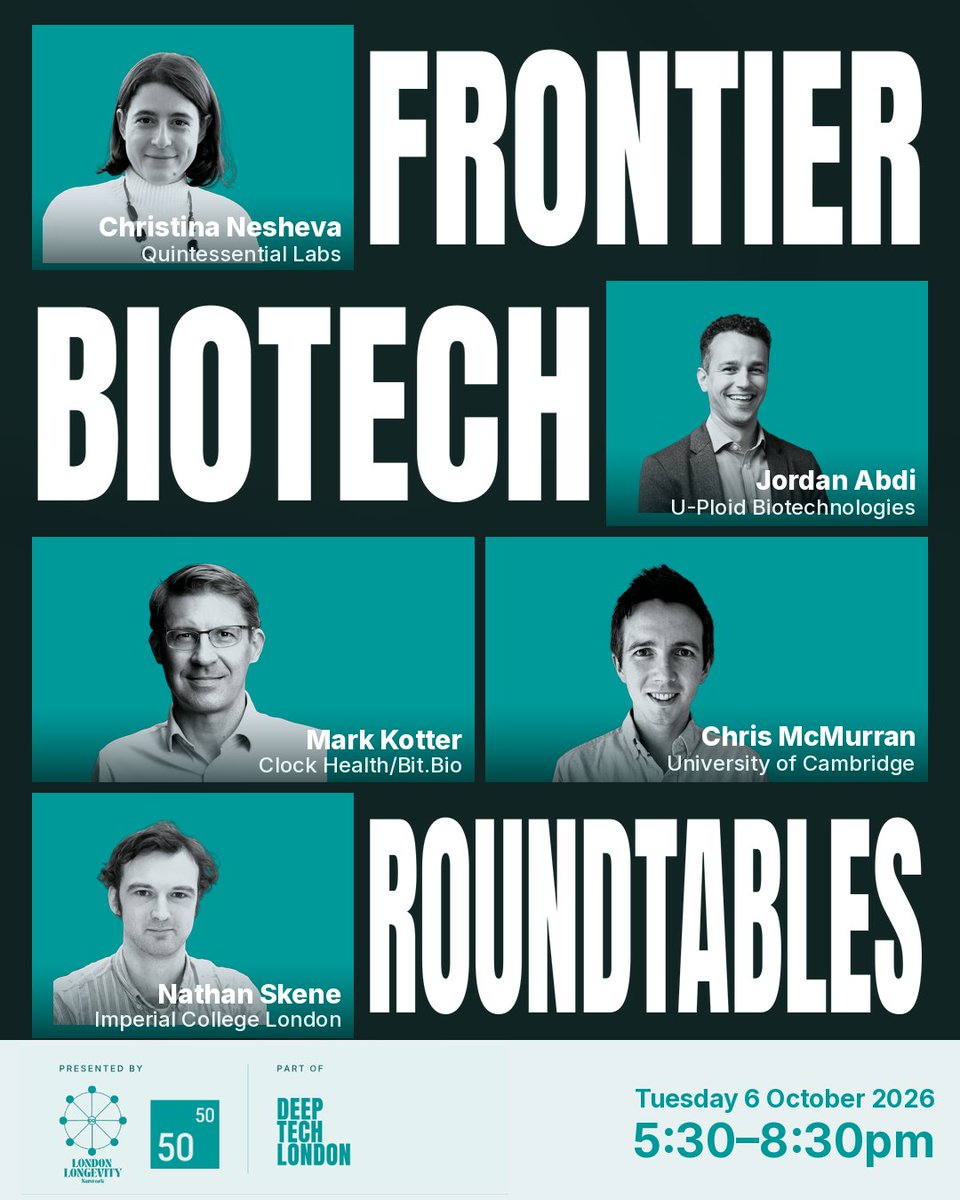
Chuffed to be joining Deep Tech London as a community partner, helping bring the vision for frontier science and human potential to London for a full week this October.
This has been in the works for a while and it’s going to be massive. Well done @lachlan_xyz and Bharat Harbham!
Take a look here: https://t.co/8klS1d9h4z
Ping @LonLongevity for a super reduced ticket
75 years ago, the Festival of Britain brought design, science, and technology to the public as a celebration of the country's future.
In 2026, Britain needs another future-facing moment: one built around frontier science, hard technology and the people turning it into companies.
𝗗𝗲𝗲𝗽 𝗧𝗲𝗰𝗵 𝗟𝗼𝗻𝗱𝗼𝗻 𝗶𝘀 𝗼𝘂𝗿 𝗮𝗻𝘀𝘄𝗲𝗿.
https://t.co/TBwmLx4B9U
First tickets drop today - through our community partners only.
@DeepTechLdn@VentureCafeLond@LonLongevity@kickstartldn@Eurodefensetech@sotalikesfuture@ignitelon@fiftyyears
3 months today 1000 scientists, engineers and innovators will gather to build the future.
rockets, robots, photonics, fusion, automated labs.
ticket release #1 16.07 through our community partners ONLY.
https://t.co/wnEaivxkhR
Biotech is siloed, but people don’t need to be.
You need biologists, chemists, engineers, clinicians, data scientists, regulatory experts and more.
All too often, they work like a team who have never met before.
We are breaking that in London. 🧵
Frontier Biotech Tables is back for round two.
Tomorrow, 25 June, 6–9pm in London, we’re bringing together scientists, founders and operators to map AI across the drug discovery and development pipeline.
Hosted with VentureCafé London, powered by @ARIA_research.
RSVP below.