Preprint from my lab @YalePharm uncovers the molecular mechanisms of uncoupling nociceptive and neurotrophic TrkA signaling using #singleMolecule#microscopy, #cryoEM, #ephys, #signaling, offering a clear blueprint to target this much sought-after pathway! https://t.co/tpkHpoW14d
New paper from the lab. Using AI-guided modeling and experiments, we identified a hidden allosteric pocket in the cancer kinase PKMYT1. Led by @NHerrington24 in collaboration with @LazarusLab https://t.co/TOVfd0tesd
For those keeping track of kinases and brain diseases, LRRK2 inhibitor fails to benefit idiopathic Parkinson’s patients. Trial for PD caused by LRRK2 mutations still ongoing. https://t.co/f66bukNSl5
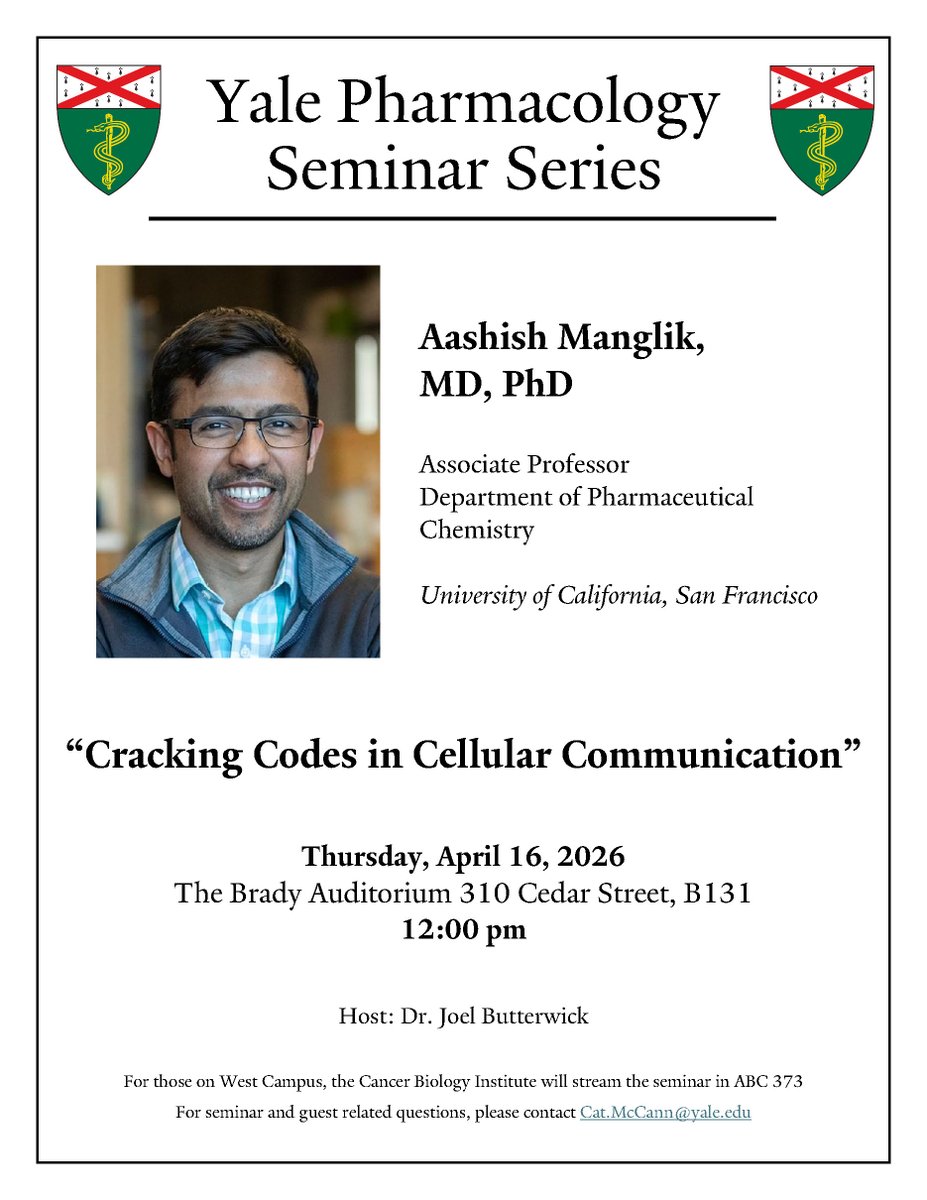
Join us in welcoming our next 2025–2026 Pharmacology Seminar Series speaker, Dr. Aashish Manglik of the University of California, San Francisco. He will be presenting his work at 12 pm on Thursday, April 16th in the Brady Auditorium.
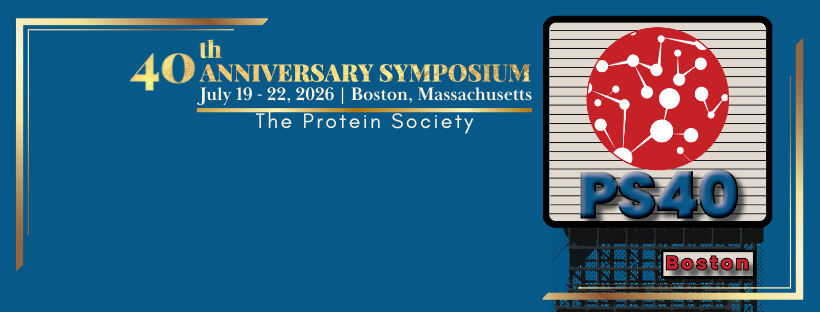
March 17 is the deadline for abstract submission for Open Talks (in every session) and Travel Grants (up to 100) for our 40th Anniversary Symposium in Boston, MA. Don't miss it! Abstract fees are $15 for student members and $30, for non-members.
https://t.co/RtXn1NrQeo
Starting 2026 with Quan Pham's paper expanding the chemical toolbox for engineering AAV
- New bioorthogonal labeling, including IEDDA, for efficient macromolecule attachment
- Incorporation of two different chemistries for dual capsid labeling & much more:
https://t.co/ITupX1fsXq
Delighted to have our work on 🧬 resilience to 🩸cancer led by @GauravA_UK & amazing collaborators, including @KharasLab, published in @ScienceMagazine: https://t.co/lZDCy8CSBv 🧵
Super excited to share our latest finding on the EGFR activation mechanism. In our paper, we found that cholesterol in the inner leaflets of the plasma membrane is essential for ligand dependent EGFR activation.
https://t.co/vyuJJQihsq
This project was led by the very talented Dr. Shailesh Kumar and Harry Jung in my lab, with outstanding collaborative support from what was truly a dream team! Special thanks to Drs. Shyamal Mosalaganti and Yamuna Krishnan for making this fun!
Preprint from my lab @YalePharm uncovers the molecular mechanisms of uncoupling nociceptive and neurotrophic TrkA signaling using #singleMolecule#microscopy, #cryoEM, #ephys, #signaling, offering a clear blueprint to target this much sought-after pathway! https://t.co/tpkHpoW14d
Our findings have outsized implications for selective targeting of #ChronicPain without adverse effects on trophic signaling OR treatment of #neurodegeneration without eliciting dose-limiting pain. A detailed step-by-step description of this preprint is coming soon!
We now provide a molecular framework to uncouple the nociceptive from neurotrophic TrkA signaling, using #singleMolecule#microscopy, #cryoEM, #electrophysiology, #signaling. This finding has outsized implications for selective targeting of chronic pain and neurodegeneration.
Researchers in the Vosshall lab have discovered the first evidence of what happens when a female mosquito chooses to mate for the one and only time in her life.
We spoke to @leslievosshall and @LeahHouri about their unexpected findings. See the full Q&A:https://t.co/4NODZOfc9n
Super-resolution single-molecule fluorescence meets quantitative phase contrast! This powerful combo enables ~0.05 nm optical path difference detection, < 20 nm resolution, and continuous live-cell imaging with digital staining, opening new windows into molecular dynamics!🔬