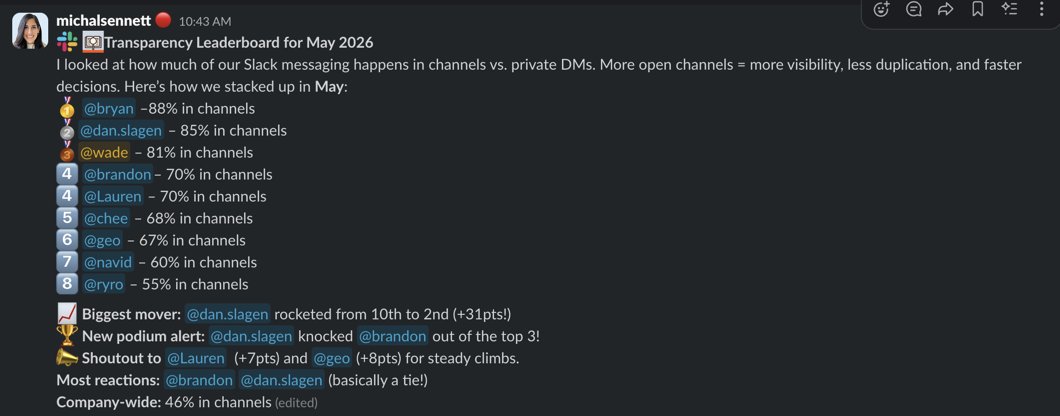
We're killing the DM at @Zapier. Starting with the executive team.
We've long held Default to Transparency as a value. That value has largely encouraged communication in public channels. But as the company grew, DMs are a hard habit to resist and break.
But every DM is a gap in our Shared Brain. It's context that is lost for humans and AIs. As a result the cost of DMs keeps going up.
So earlier this year I posted about our exec transparency leaderboard. The leaderboard has become quite the competition internally…
I'm 3rd today. My co-founder @BryanHelmig has held the top spot as long as I can remember…
It sets a standard for the rest of the company. In fact, since last year we’ve seen the % of Slack messages in public channels go from 33% to 46%.
What the leaderboard measures
Transparency is a team sport, and a disinfectant. Every month we track what percentage of our execs' Slack messages happen in public channels versus private DMs.
When your CEO debates strategy in a DM, that decision is invisible to every agent and every team that needs to know what was decided and why. The decision happens but the reasoning vanishes.
When that conversation happens in a channel, it stays. New hires can search it, agents can read and verify it, etc. Your Shared Brain knows what's true now: ask it a question and the answer reflects the latest reality.
Taking It to the Next Level
Reducing DMs are one way to increase transparency and open up context for humans and AI, but there are other mechanisms that help too. Three things beyond the leaderboard:
1. Meetings get recorded, transcribed, and become queryable
2. We run a shared skills library. Anyone on the team can encode a workflow they've figured out into a skill and share with the team
3. And we keep score. It's a silly scoreboard, but it subtly drives positive behaviors
Raising Your Ambition
In order to get the most of AI in your company, the AIs need context. So making your context queryable is one of the most practical moves you can make to improve the effectiveness of your AI agents.
P.S. I’m coming for #1, Bryan...
@mepritijain Using your primary card for foreign transactions also opens it up for fraud. I have personally faced it couple of times. And the 1% is positive future rewards, for which you have to spend today. For regular travelers it might make sense. For tourists, I think trade off is fair
Already created 10 stories. Must try this out if you even have nephews or nieces.
Real unlock - my dad created story about his temple trip for his society group!
Storybook is now available to Gemini users on the web at https://t.co/gTWOnOwiO6 and on mobile in 45+ languages 📖
Some of our favorite stories we’ve seen so far ↓
One random person says something to someone. Everyone is a subject matter expert.
The OG ones are still happening with same rigour. Campus and alumni don't want to wait till 25 years for meetup. So more are happening earlier.
@ActusDei@apri_sharma If it's 1 lakh, 2 lakh, 3 lakh who will pay the future premiums? If you don't, you will not get the return. Your example is hence misleading to people reading this as a great investment option.
@ActusDei@apri_sharma Lastly, these products are one time investment products where the AUM leakage of surrender is transferred from insurers to the investor. There is no guarantee that the investor will pay future premiums. Hence, they don't help in improving the Persistency.
@ActusDei@apri_sharma The ULIP numbers are also conveniently misleading. If you pay 1 lakh per year and the current fund value is 4.85 lakh, then it means you have paid 5 premiums atleast (since there are charges in ULIP). So policy holder can withdraw the whole fund themselves.
Someone in a gated society brought water from Maha Kumbh and poured it into the swimming pool with a mutual consent. Now everyone is taking a dip in the pool.
These are the millions of such numbers we don’t even talk about