People often ask how we balance speed and quality at @tryramp.
We don’t. Because speed is how you get to quality.
Even the best hitters in baseball miss 70% of the time. A .300 batting average means the world’s best still fail twice as often as they succeed.
Building products is no different.
Even if you deeply understand your customer, you’ll still be wrong most of the time — it just takes iteration to discover what actually works.
Take two teams:
Team A ships every 2 weeks.
Weeks 2, 4, 6, 8 — all wrong. Week 10 — nailed it.
Team B waits for “perfect.”
Week 8 — wrong. Week 16 — wrong. Week 24 — finally right.
Team A made more mistakes, but found truth faster.
Team B “protected” quality and ended up slower, later, and with less conviction.
In the real world, there’s no limit to your at-bats per inning.
You can swing 100 times if you design your org and culture for it.
Speed isn’t a trade-off with quality. Speed is the way to get to quality.
I'm proud to announce that I have joined the @pumpdotfun team
Over the past 8 years, I've hunted, built & invested in high-potential opportunities within crypto - from kickstarting ecosystems working at @jump_/ @jumpcapital, @SkyMavisHQ, @axieinfinity & @Ronin_Network, to creating vast wealth-effects within those networks. I've helped hundreds of projects obtain investment, partnerships & scale to huge valuations, resulting in thriving businesses
Now, I'm in a unique position where I'm able to leverage the connections that I've built over the past 8 years, skills I've acquired in BD, talent management (and everything in between) to deliver high quality projects & investable creators.
My mission has always been to break the ceiling on what's possible, and the team at pump are the only people in crypto which I think have a shot at achieving the impossible
I'm pumped to sculpt the future of Internet Capital Markets and Creator Capital Markets. If one thing is clear, it's that pump is the next paradigm of social platform that combines capital, creativity, engagement and entertainment. I couldn't be more excited to bootstrap this industry & ultimately create the runners that the trenches deserve.
Chain-Abstracted Launchpad for memes
One token. Any chain. Zero friction.
@printr is a chain-abstracted launchpad + trading platform that turns a token into an omnichain asset from day one. Creators launch once; traders buy or sell from any chain in one click while Printr handles the clunky mess of: bridging, routing, and smart contracts behind the scenes.
When bonding-curve milestones are reached, liquidity “graduates” to leading DEXs per chain, ensuring a unified and aggregated meme marketplace that feels like one venue is delivered.
This piece explores Printr as the first project incubated and supported by @Bybit_Official Venture Studio and their strategic partnership with @Mantle_Official & @byreal_io.
- - - - -
1) Current issues
Meme liquidity is fragmented and momentum is chain-cyclical. Just 2 weeks ago this was evident when @Aster_DEX launched and a subsequent “BNB szn” was catalysed by a bunch of Chinese related memecoins popping up which caused volume to concentrate solely on BNB. Coupled by the fact that most users were caught offside due to a lack of funds on the chain.
Creators and traders repeatedly face the same obstacles:
• Single-chain launches silo users & liquidity: A meme’s growth is capped by the buyer pool of the chain it launched on; if the meta rotates (e.g., from SOL to BNB), projects are stranded and face a lack of trading volume and speculation
• Cross-chain infra is complex: Doing it without an abstraction layer exposes teams to problems such as duplicate tickers/wrapped versions, manual bridges, and confusing UX
• Retail can’t capture cross-chain edges: When a meme is deployed on different chains, per-chain curves can create price gaps, but exploiting them (arbing) requires bridging and multi-wallet ops that most retails aren't equipped with the right tech/skill to execute
• Creator incentives are short-lived: Many launchpads collect fees but don’t share them back in a way that sustains creator activity post-launch. Printr explicitly builds an ongoing revenue stream into its split
• Token discovery: It is no doubt that a memecoin runner discovery is spread across various platforms (X/ Telegram/ terminals/ Discord) and multiple launchpads. Printr offers a “universal search” and aggregated listings to allow for quicker discovery and flow
- - - - -
2) Printr’s USP
For Printr to win in a competitive landscape of launchpads, an aggressive GTM strategy must be in place.
Heavy marketing. Onboard strong memecoin teams to start deploying memes. Work with foundations to create runners and emphasise the benefits to creators (25% fee share) and traders (best-route swaps + points program). Make it easy to integrate existing bots/terminals into the launchpad as well.
Printr has some edges and distinct features that makes it stand out:
• One token, everywhere: Printr abstracts the cross-chain complexity of creation, trading and liquidity, so a creator can “launch once” and programmatically deploy to selected chains
• Expansion of creator + buyer surface area: Since memes can be launched via one token but on every chain, creators have the ease of deploying it multi-chain while users are not forced to bridge to save time
• Launchpad-as-a-service: Printr has the opportunity to pitch to chains (outside of @solana, @BNBCHAIN and @base) that have lower activity and volume, as a way to help bring attention to their ecosystem with this platform → bring in deployers, trading volume and TVL from other chains
• Intent-based cross-chain trading & arbitrage UX: Printr integrates @RelayProtocol, @debridge and @squidrouter so any asset on a supported chain can trade a meme on any other chain in a single flow, enabling retail-grade arbitrage (“buy on A, sell on B”) and a real-time “best route” experience
• Creator-aligned fees & community revenue recycling: Printr’s fee policy (curve + DEX LP) is split across buybacks, creator share, memecoin reserve, team → effectively recycling 90% of revenues back to its eco and giving creators a perpetual revenue stream
- - - - -
3) So how does Printr work
Simply put, the ultimate design goal is to keep tokens at the center and hide cross-chain complexity from the user:
• They have dedicated modules for storage, bonding-curve logic, trade execution, treasury/fees, liquidity to AMMs, creator revenue share, and cross-chain interoperability (intents)
• Creation → Bonding Curve → Graduation → Unification → Cross-chain
> Creation: The creator fills launch parameters and chooses deployment chains, price is smoothed by a virtual reserve so a whale buy can’t set a ridiculous starting price
> Bonding curves: Each chain starts with its own curve (no cross-price coupling). As supply is bought, price rises according to a published expression
> Graduation: When a curve hits its cap (market-cap threshold), Printr automatically migrates liquidity to partner DEXs, locks LP via @GoPlusSecurity, and renounces token ownership. The same token can graduate at different times per chain, which intentionally creates cross-chain price differentials that users can arbitrage using Printr’s router UX.
> Unification: After graduation, @LayerZero_Core OFT is used to unify instances into 1:1 fungible tokens with the same address across chains, allowing cross-chain supply management (omni-chain liq)
> Cross-chain trading, discovery and arbitrage: Intent routing (currently mostly @RelayProtocol) handles chain/hop selection, aggregates liquidity across pools, and returns the best route
Printr is currently live on @solana, @Mantle_Official, @base, @BNBCHAIN, @arbitrum, @ethereum, and @avax with support for @SuiNetwork and @monad soon.
- - - - -
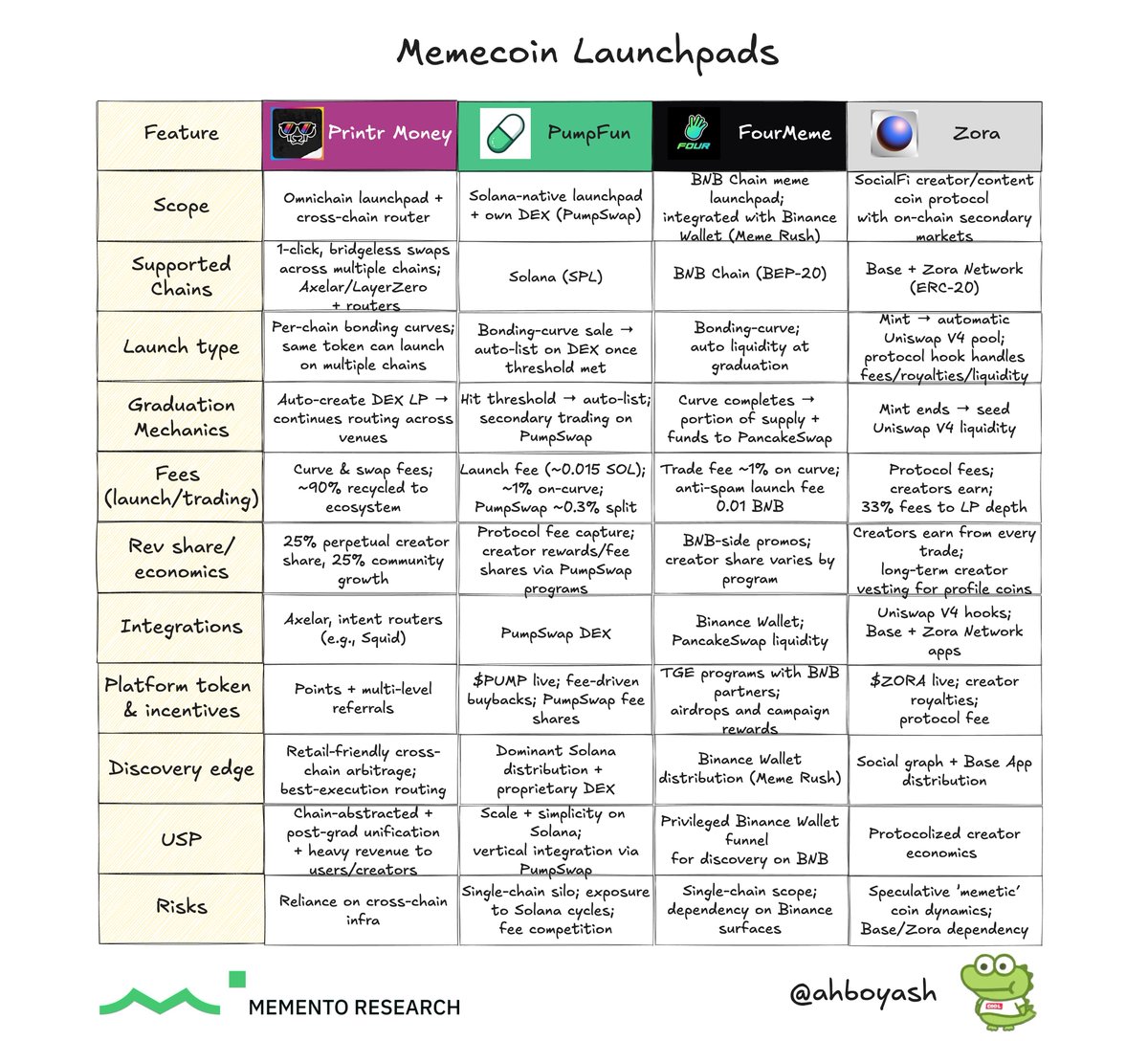
4) Competitive landscape
a) PumpFun
• @pumpdotfun is iconic and the most recognisable meme launcher with a simple bonding-curve UX, cultural mindshare, massive funnel and distribution (livestream, KOLs, good flywheel with the token)
• Fundamentally strong as well as their revenues are used for buybacks, which can be justified by liquid funds as a good investment and retails alike
• Constraints include single-chain focus by design; users/creators miss other ecosystems when metas rotate away from @solana (e.g. BNB season resulted in dramatic decrease to token deployment on Pump)
b) FourMeme
• @BNBchain's premier memecoin launchpad @four_meme_ with bonding curve mechanics, strategically positioned as the ecosystem's answer to https://t.co/sX4bYJCcSb
• Benefits from seamless @PancakeSwap integration, @cz_binance endorsements, and exclusive @binance Wallet launches that create strong network effects
• Fundamentally attractive with a revenue-sharing model, proven metrics ($1.4m daily revenue), and robust ecosystem support through the recent $45m BNB airdrops to 160k+ traders
• Constraints include BNB Chain dependency limiting cross-ecosystem reach during non-BNB metas, high speculation (1.34% graduation rate with most tokens failing post-launch), and sustainability concerns as growth remains heavily tied to cycles and incentive programs rather than organic adoption
c) Zora
• @zora is a creator-centric protocol on @Base enabling content tokenization where posts/profiles become tradable ERC-20 "content coins"
• Fundamentally strong with 92.5% market share in creator tokens, $420m+ cumulative volume across 1.5m+ launches, and proven creator monetization ($27m+ YTD royalties)
• Backed by @coinbase/@Base infra providing institutional credibility and of course a superior direct integration into mainstream platforms via @RobinhoodApp listing and @Base App
• Constraints include modest TVL and volume, dependence on Base ecosystem limiting multi-chain flexibility, and ongoing tension between genuine creator utility and memecoin speculation (90% token failure rate)
All the incumbents lack a chain-abstracted UX with an omnichain identity, something that Printr can find its niche in, Printr’s bet is that distribution (omnichain) + abstraction (intent routing + aligned fees with creators and users.
- - - - -
5) Risks
• Launchpad saturation: Granted Printr would be the first omnichain token launchpad which makes it unique and novel, but it still would be fighting among an already crowded vertical with a hot ball of capital rotating between memes/narratives
• Bridge/messaging dependencies: @axelar and @LayerZero_Core integrations carry operational and security risk (message failures, route congestion, third-party smart-contract risk)
• Liquidity fragmentation before unification: By design, each chain’s curve is independent until graduation, so price divergence is expected. While this creates an arb opportunity, it also means early holders can face volatility if a curve on one chain lags badly
• Fee durability and sustainability: Lowering curve/LP fees is a competitive wedge. The tradeoff is ensuring enough gross margin to fund the team and ops after recycling 90% to users
- - - - -
6) Points program
The Printr Points Program is designed to bootstrap distribution:
• Earnings actions include trading (1 point per $1 traded), creation (50 points per chain per token) → look out for the "trading boost" feature, where users can unlock higher trading multipliers with more trading volume
• Other actions include referrals - where users can earn tiered commissions for every successful direct and indirect referral!
• TLDR: create, trade, refer as much as possible during beta → TGE to farm a potential airdrop
Action points: Farm points before TGE by: trading on curves and graduates inside Printr; printing a token, repeating quests, and refer other users. Multipliers unlock at higher cumulative volume.
- - - - -
7) Wrapping up
Printr is building the piece of meme launchpad that has not existed before: a token-centric, chain-abstracted experience that lets creators launch once and lets traders treat chains as mere execution venues.
In terms of technical choices (per-chain curves with programmed graduation, Axelar/ LayerZero for unified identity, @RelayProtocol/ @debridge/ @squidrouter routing for “any asset → any chain”), this maps cleanly to the operational realities of meme flow. On the economics side, the fee split is very creator- and community-aligned, which should help them gain traction and volume.
Execution risk is still present, especially around cross-chain infra and ensuring the team still manages to keep the fee switch in a sustainable manner. If Printr lands the flywheel correctly, it can become the default front-end for memes across multiple ecosystems.
Printr is undergoing an audit by @ackeeblockchain, the same firm that has audited giants such as @aave, @pendle_fi, @LidoFinance and @LayerZero_Core).
Where they win imo is a) taking advantage of chain rotations by allowing users to trade seamlessly and b) offering a service to chains that have low volume to be the canonical launchpad to revive their eco.
Friend of the team and investor
We’re pleased to announce our follow-on investment in Printr, a pioneering platform built for the memecoin era and multi-chain token creation.
With strong backing from @Bybit_Official@AxelarCore + @LayerZero_Labs, Printr is positioning itself to dominate omni-token creation 🖨️
We’ve raised $4.5M, partnered with @Bybit_Official, and built the first launchpad for every chain.
Today, Printr goes live to the public at https://t.co/SF2Tawxd98
Print. Trade. Earn. ↓
Pokemon Card Gambling Exposed 👮
Trading card repack platforms have exploded recently - generating tens of millions in volume, going viral, and launching tokens with 9-figure FDVs, but some simple research suggests they aren’t all that meets the eye.
As founder of Boxed, a similar repack style platform, I've observed sketchy practices across the industry. These platforms at best lack transparency; at worst, they're scamming users. Before spending on Courtyard, Collector Crypt, Phigitals, Dyli, Arena Club, or even my platform ( @boxedhq ), consider these issues. You might think twice.
I’ll break down these shady dealings topic by topic, and show you how we have approached each with my own platform, Boxed, to give some contrast on what I believe is the ethical and fair way to implement these services.
Transparency 👀
Transparency is by far the biggest issue with every single one of these sites, and it breaks down into two main issues: randomness and odds.
Odds ⚖️
Every single repack site is entirely untransparent with the displayed odds. The key issue is that you don’t know the exact odds of what you can win, you are only presented with ranges.
When users see "15% chance for $5-$15 item," they assume even distribution (average $10 value).
Platforms even display expected value (EV) based on this assumption, often claiming that you are infinitely profitable opening their packs (this doesn't even pass the sniff test).
The reality is, there is no way to know whether the odds ranges are evenly distributed or not. A preliminary look into the on-chain data of some of these platforms indicates that the odds tables are weighted toward the low end of the value range. I will continue to investigate the data to get more conclusive evidence, and follow up with any relevant insights.
In addition to this obfuscation, they don’t even show you the full list of items you could win. They just dangle the “top pulls” in front of you to mask the fact that the majority of items are uninteresting, overpriced and of poor condition.
What we do on Boxed:
We display the exact % chance for every single item (rare and common) in every experience we offer. Complete transparency with no compromise:
Randomness 🎲
None of these platforms implement a means of verifiable randomness. Some claim to use VRFs, while others have no mention of randomness anywhere on their website. This is a critical issue on any RNG based platform… Without verification, what prevents rigging? How can you trust your luck is genuine?
This problem isn't new… online pack opening has existed for over a decade (see: CS:GO skin sites). These sites implement "provably fair" systems, the regulatory standard for licensed casinos. Many non-casino products adopt this for customer trust. This has been the gold standard for many years, with no flaws. So why do these pack opening platforms go out of their way to implement a less transparent system?
Even utilizing an on-chain VRF like Chainlink does not ensure any fairness or transparency for customers. It only ensures that a third party is handling the RNG. It’s not clear how the centralized platforms use this RNG outcome once delivered.
What we do on Boxed:
Every single item in every experience has a specific integer range that corresponds to the random algorithm labeled “provably fair range”. Using our provably fair system documented on our website (link in comments), you can verify that every item you opened was by random chance via our open sourced algorithm.
Regulatory Compliance 🧑⚖️
Each of these platforms violate US state and federal laws, plus international regulations. US gaming law (as well as many other jurisdictions) identifies illegal lottery through three elements:
Prize: Items have marketable value? (are they worth something)
Consideration: Do you have to put up something of value?
Chance: Is the outcome prize determined by randomness?
All platforms meet these criteria - they're illegal lotteries operating nationwide. You might be saying to yourself “who cares, crime is legal in the current regulatory environment! It's all crypto anyway!” To that, you are unfortunately wrong, because although federal enforcement might be relaxed, each state has its own gaming authority, and many states are known to go after platforms like these that offer illegal services to their constituents. The penalty for this offence is commonly prison.
I've been made aware of multiple reports to state gaming authorities for multiple of the listed platforms.
So the conclusion to be drawn is that all these platforms are very likely illegal lottery (not legal advice, I'm not a licensed lawyer). Even worse, they are all also offering their services to every state in the US.
In addition to this, some of these platforms provide no measures to deter money laundering, terrorism or harm to children. I can only speculate how these platforms could be used illicitly, but the fact that no measures are taken to try to prevent bad actors is not a good look.
What we do on Boxed:
We have taken a compliance first approach with Boxed. We have spent six to seven figures on our legal strategy to ensure we are not breaking any laws anywhere we operate. We have worked with lawyers who frequently represent Fan Duel, Bet365, and others. These lawyers have written detailed legal opinion letters stating that we are legal in every jurisdiction we operate in. This is how we have been able to secure VC backing from highly diligent firms as well as relationships with partners such as Nuvei and Stripe, who traditionally wouldn’t touch this category of business.
Service💙
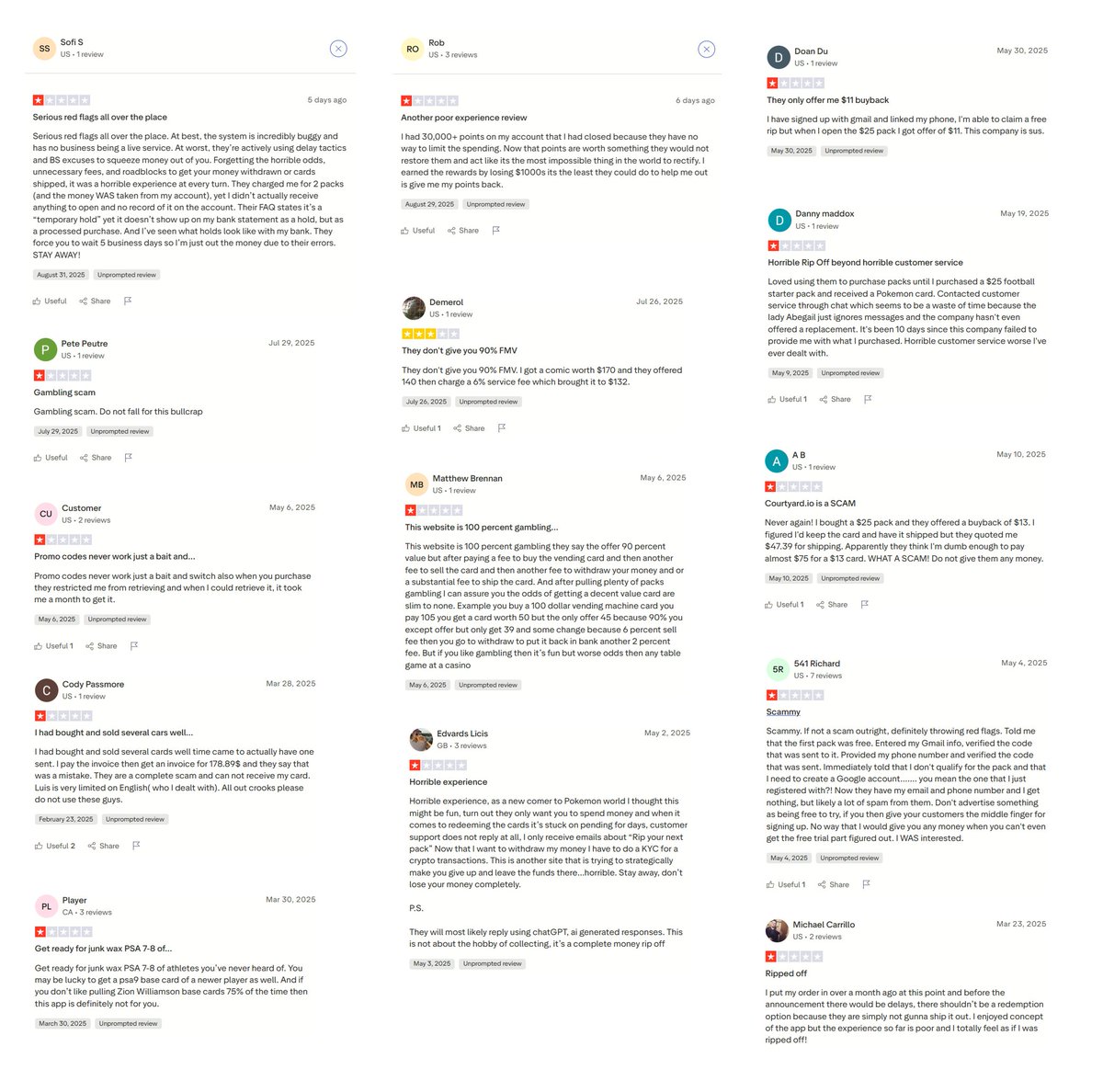
Many of these platforms fail on their core promise to customers: provide a fun pack opening experience, delivering customers the stated trading cards in the stated time frame. Although a large portion of CT seems to be using these platforms purely as crypto casinos with no care about the underlying asset, when a customer decides to redeem an item, reach out to support or interact at any other level with the services, they are often met with disappointment.
Unfortunately, many of these platforms have not existed long enough or had enough customers to even have reviews online. Here are some of the reviews I could find:
What we do on Boxed:
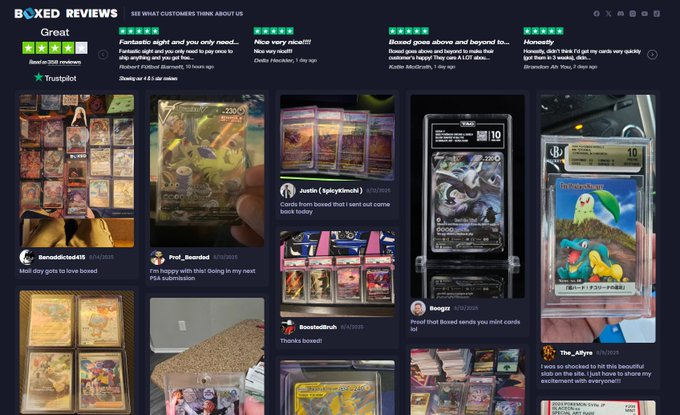
In-house warehouse and logistics, partnerships with major TCG marketplaces, dedicated support staff, strict condition policies. We have spent years of development supporting hundreds of thousands of users, who have opened nearly 50m random packs shipping hundreds of thousands of cards.
The repack industry is riddled with opacity, questionable practices, and regulatory violations.
Whether you use these platforms for trading cards or treat them as crypto casinos, you deserve transparency about odds, verifiable randomness, and legal compliance. You also deserve to get what you pay for.
Do your due diligence. Ask hard questions. Demand provable fairness.
For those interested in more info about how Boxed goes above and beyond, I'll share a dedicated thread soon.
Until then - know what you're buying into.
Was at a crypto event tonight with people from all different ecosystems. When the viral new consumer football app dropped all the Base people got out their laptops and were monitoring the situation. Everyone else was milling about wondering what was going on. If you want to be part of the action build on Base.
If you want to build where things are happening, build on Base.
If you want to build on a chain that can handle price discovery on a brand new multi billion dollar asset without even breaking a sweat, build on Base.
The SEC's new "Project Crypto" is the most bullish thing I've seen in a long time from a regulator. Read the speech, it's incredible:
* Almost all tokens are not securities
* Want to discourage decentralization kabuki theater
* Americans should not get excluded by IP/VPN blocks
* Explicit exemptions for ICOs, airdrops, etc.
* Non-securities should be tradeable alongside securities on the same platforms
* Protect software engineers
* Streamline licensing requirements
* "Innovation exemption" to protect builders pre-decentralization
Wow. Wow wow wow.
The $4 Trillion Islamic Finance market is confined by TradFi. The solution?
Islamic Finance powered by DeFi, built on @solana.
inshAllah Finance is building that financial future for 2 Billion people, and that's why we're thrilled to announce that inshAllah has raised $2.1 Million in pre-seed funding.
This round is led by AllianceDAO (@alliancedao).
Monad Founder Residency at Network School!
If you're a founder who:
- Has a live product but no growth
- Wants to present to 100+ VCs on Demo Day
Then this residency is for you.
Details and applications below 👇
Monad Founder Residency at Network School!
If you're a founder who:
- Has a live product but no growth
- Wants to present to 100+ VCs on Demo Day
Then this residency is for you.
Details and applications below 👇