@MaxUnfried Yes, another reason to prefer aging as the label for the field instead of longevity. More on that in this brief thread:
https://t.co/hmFOcphE9w
My latest article is about how the longevity movement should not be about wellness tips and tricks and lifestyle improvements, but rather, true, biotech-enabled life extension and life improvement.
We should be able to live exciting lives, without restriction. Forever.
@celinehalioua What do you think of answers to this question that are more technical in nature vs. more process-oriented answers?
I pushed a bug, realized issue, fixed and added tests/monitoring
vs.
I underestimated due to a deadline, messed up planning, had to cut scope
@MartinBJensen@statto I was gonna say the solutions the "Lifespan doesn't matter without healthspan" people worry about already exist today. And when faced with the situation, people usually end up choosing lifespan without healthspan over dying anyway
@mattyglesias@DKThomp Is there a difference in news topics and sentiment between languages such as French and English. e.g. is English news more focused on negative news topics?
@DKThomp@conorsen Maybe restricting the top 10% of token users will force them to create innovative token consumption strategies. Strategies the other 90% does not have the skill or resources to create. Perhaps this innovation could be beneficial for all.
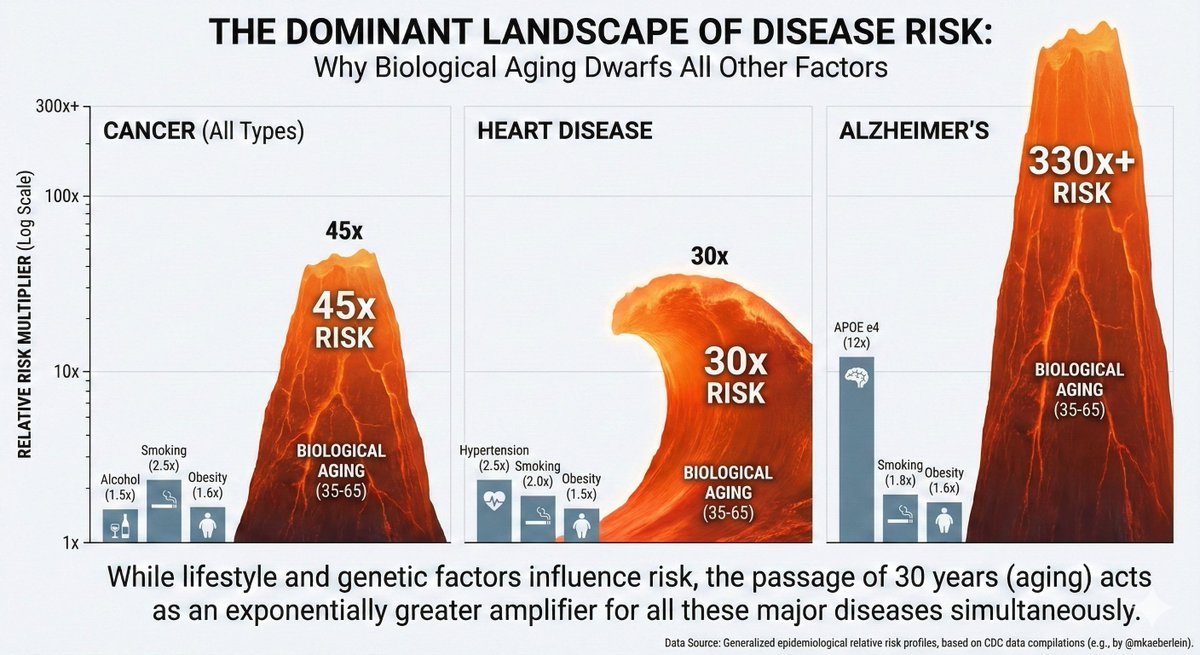
45x. That's how much biological aging from 35 to 65 increases your cancer risk. Smoking? 2.5x. Obesity? 1.6x.
This @CellCellPress perspective calls for more cancer prevention, and I'm on board. But the paper attributes 30-45% of cancers to modifiable lifestyle factors while barely mentioning the exponential risk multiplier that is aging itself. SEER data shows cancer incidence jumps ~100-fold over a lifetime.
If we're serious about prevention, the biology of aging can't be a footnote.
@deanwball Could Mythos end up being a Streisand effect moment? What if these stories cause a bunch of people to try to use existing models at a much higher rate for identifying security vulnerabilities? Presumably they wouldn't be as effective, but do they need to be to cause problems?
@statto@KarlPfleger@MartinBJensen@zanehkoch Hmm yeah should've looked at it more closely. 900-day rule is a median lifespan (0.5 survival probability) of 900 days right? So we don't have enough data to know for certain.
This would be an interesting experiment to follow up on and replicate