2 fix or not 2 fix,that's the expression. #Bitcoin ❤️ soft dev circa 80s,🎹4 ever & life ∞.@Wuabit @Wualabs @OnWuard @QTSurfer @WuaLeds 🤖@LibroBlockchain 📖
卧槽,兄弟们,连掌管 Meta 超级智能实验室的 29 岁掌门人 Alexandr Wang,今天都亲自下场写长文拉响最高级别警报了。
懂行的人都知道他的底细——从小在原子弹诞生地洛斯阿拉莫斯长大、MIT 出身、一路打数学竞赛杀出来的硬核理工天才,如今更是站在全球最顶尖 AI 牌桌核心的人物。
结果就在今天,他发出一篇极其清醒、也极其沉重的重磅长文,第一句话就直接把硅谷的窗户纸捅穿了:超级智能已经兵临城下,未来这十二个月人类怎么选,将直接决定我们往后活在一个什么样的世界里。
在 Alexandr Wang 看来,黎曼猜想被攻克,就是整个人类文明彻底转向的发令枪。
绝大多数外行,压根没意识到这件事的恐怖量级。在研究数学的人眼里,黎曼猜想代表了人类智力成就的绝对珠峰——论纯粹的思维强度,人类历史上干成过的一切都无出其右。甚至连他老家洛斯阿拉莫斯的许多物理学家都会承认:比起证明黎曼猜想,当年造出原子弹顶多算一道课后作业。
而这座人类最聪明的大脑死磕了 150 年的巅峰,刚刚在一种我们至今无法理解的“外星心智”协助下,被彻底踏平了。
他把时间拨回 2024 年 12 月:当年 o3 横扫美国数学邀请赛(AIME)时,打过数学竞赛的人心里就已经咯噔一下——完了,一切都要变了。道理很简单,AIME 压轴题的纯智力难度,早就远超最顶尖工程师和商界精英的日常工作;当时卡住 AI 的根本不是不够聪明,而是缺行业经验、上下文和落地约束。果然,过去这两年把这些非智力短板一补齐,编程几乎被彻底打穿,顶级网络攻防和通用智能体全面爆发。
可 AIME 终究只是青少年的课外竞赛,黎曼猜想却是人类历史上最烧脑的终极难题。MIT 的教授们都会告诉你,几乎所有人类核心学科里最顶尖的智力难题,纯思维难度其实都“低于”黎曼猜想,差的只是实验条件、数据积累和反馈闭环。
这意味着一个极其残酷的分水岭:从今天起,AI 在几乎所有领域大幅碾压最顶尖人类,瓶颈彻底不再是智力本身,剩下的只是行业诀窍、工程管道和实验对接。
而最致命的一刀,恰恰落在 AI 研发自己身上。
绝大多数研究者都会承认,搞 AI 研究的智力难度,同样远远低于证明黎曼猜想。这意味着模型很快就能把整个 AI 研发彻底自动化,在“自我升级”这件事上全面超越人类——同时把生物、武器、经济学等所有领域全按下疯狂加速键。就像今天数学界根本来不及消化黎曼猜想的证明一样,用不了多久,几乎每个学科的狂飙速度,都将彻底甩开人类大脑能够理解和监控的极限。
这就好比人类造出了一台能一边狂飙、一边自己改图纸升级发动机的超级列车。前两年大家还在争论它爬不爬得上眼前这道坡,结果一眨眼它连地球最高峰都直接碾平了——此时最要命的早就不是车跑不跑得动,而是车速快到连仪表盘都跟不上跳字,车里却还有人一边看着窗外一边自我安慰:“既然拦不住,那咱们就研究怎么安全地把方向盘交出去吧。”
整篇文章最狠、也最清醒的,是最后这段对整个 AI 圈的当头棒喝。
作为亲自掌舵超级智能实验室的核心大佬,Alexandr Wang 直接痛批了行业里正在蔓延的一种“懒人思维”——很多人默认“超级智能不可避免,唯一要解决的只是怎么安全地造出来”。
他把话撂得很死:面对不受约束的递归自我进化,以及比人类聪明 1000 倍的超级智能,很难想象人类还能轻松守住控制权。既然“把能力推到极限”的科学难题已经被基本解决,安全、对齐和防护已经刻不容缓;但更底层的红线在于——我们绝不该坦然接受把人类社会“交接(Handover)”给 AI 的结局。
人类真正应该拼命去打造的,是能赋予每个人更强主动权与赋能的技术。连冲在超级智能最前线的掌门人都站出来大喊“全行业必须立刻偏离眼前的默认轨道”,你就能明白:这绝不是外行的杞人忧天,而是人类留给自己亲手握紧方向盘的最后窗口期。
I don't think people realize what's happening with Elon Musk right now.
Look at what he posted today. The CEO of the most valuable car company in the world explains, on a Sunday, on X, that his team had to fit the decoder of their world model into the chip's SRAM, that they only had half an accelerator to work with, that this accelerator only handles 8-bit integers, and that softmax has to be emulated in 28 steps.
Name one other CEO at that level who could write that post. Not have it written. Write it.
That's not a detail. I think the way Musk operates at scale, combined with superintelligence, is going to give him an absolutely insane edge.
Let's go back to first principles.
A company is a machine that turns intent into reality. Between the two, there are two costs. The intelligence needed to find the solution. And the synchronization needed to get thousands of people executing it in the same direction.
Superintelligence is wiping out the first one. When thousands of agents smarter than your best engineers cost the price of electricity, intelligence is no longer scarce.
That leaves the second one. And it's exploding.
The bottleneck today is synchronization. Humans synchronizing agents. And humans synchronizing the humans who synchronize agents.
Every layer is lossy compression. The CEO tells the VP, who rephrases it for the director, who rephrases it for the manager, who prompts the agent. By the end, the agent flawlessly executes an intent nobody recognizes anymore.
Agents don't fix this. They amplify it. They move so fast that one bad intent turns into a thousand bad deliverables before the next leadership meeting.
Now listen to Marc Andreessen. He broke down what he calls "the Elon method." Every week, at every company, Musk finds the single biggest bottleneck and fixes it himself. He doesn't ask the VP to ask the director to ask the manager. He goes straight to the engineer on the problem and solves it with them. The rest of the time, he runs engineering reviews where every engineer presents what they're building.
Ben Horowitz, Andreessen's partner, sums up the condition that makes it almost impossible to copy: you need to be able to hold every engineering topic in the company in your head, all at the same time.
Here's what almost nobody sees: the Elon method is exactly the architecture of the agent era. The shortest possible sync chain between the person who understands and the thing that executes.
A CEO who doesn't understand what he's doing can only delegate his trust. A CEO who understands can delegate the work, and check the result. With humans, that gap cost months. With agents, it will cost orders of magnitude.
Second edge: hardware.
Superintelligence doesn't live in a vacuum. It needs chips, energy, data, and a body to act in the physical world. Musk has all of it. Millions of cars filming reality around the clock. His own chips. Compute through xAI. Energy storage. Robots with Optimus. Rockets and a satellite constellation.
And look at how it all connects. The same vision encoder powers FSD, Robotaxi and Optimus. One intelligence, three bodies. The next-generation chip, AI5, goes straight into Optimus, because according to him AI4 is already enough to solve driving.
Everyone else is optimizing a model. He's optimizing a full loop: data, training, silicon, energy, factory, robot, and back to data.
Put the two together. Intelligence is becoming a commodity. What stays scarce is atoms and sync speed. Musk is probably the man on earth who owns the most of both.
The labs have the models, not the factories. The industrials have the factories, not the models. The giants who have both have ten layers of management between the person who decides and the person who knows.
I look at the map and I don't see anyone who can keep up in this configuration. Honestly, I don't even see how he loses.
In the world that's coming, intelligence will be free.
Understanding what you're doing will never be for sale.
One day in 1963, while sitting through a boring meeting, mathematician Stanislaw Ulam began doodling on a piece of paper. He placed the number 1 at the center and arranged consecutive whole numbers in an outward-growing square spiral. Then he circled the prime numbers.
What he discovered was astonishing. Instead of appearing randomly scattered, many primes seemed to align along striking diagonal lines radiating through the spiral.
As Ulam himself observed, the arrangement of primes “appears to exhibit a strongly nonrandom appearance.”
Intrigued, he returned home and extended the spiral to include thousands of numbers. To his surprise, the mysterious patterns persisted. Prime numbers continued to form unexpected clusters and diagonal structures, revealing a remarkable sense of order within their seemingly unpredictable distribution.
Today, computers allow us to explore the Ulam spiral on an enormous scale, revealing an endlessly fascinating interplay of mathematical structure, symmetry, and surprise. Its intricate patterns even evoke the visual beauty of fractals.
Lo que acaba de anunciar @Tesla en su visualización, que muchos piensan que es un motor de videojuegos, es en realidad una recreación usando técnicas como Gaussian splatting, pero en tiempo real y como ha revelado @elonmusk, usando ¡un tercio de la potencia neural local del coche!
Enlazo hilo de @aelluswamy del 2022 con lo primigenio de entonces, los NeRFs.
Aqui hay material para @DotCSV@mmrdeveloper@piltrafilla129@earcos
Occupancy Networks ♥️ NeRFs
The occupancy representation of these networks allow for differentiable rendering of images (based on the Neural Radiance Fields work). However, unlike typical NeRFs, which are per scene, these occupancy nets generalize across scenes. (6/12)
Out of everything posted about FSD v15 so far, one line from @elonmusk deserves way more attention than it's getting: "This is real-time AI video generation (no gaming engine!) using just half of one AI4 TRIP accelerator. Let that sink in …" 🔥
Half of one accelerator is the part worth sitting with. Once you see the numbers behind it, Reality View stops looking like a fancy new screen and starts looking like one of the most impressive things Tesla has ever shipped.
🎬 THE SCREEN IS NOW GENERATED LIVE
For years, FSD's screen worked like a video game. Software took a list of what the car detected and dropped stock 3D models in the right spots: a gray car here, a lane line there.
Reality View tosses that playbook out the window. The car's AI now generates the video itself, frame after frame, as you drive, with no game engine anywhere in the loop.
Better yet, the picture comes from the same end-to-end model that's doing the driving. That's the single neural network that turns camera video into steering and braking, and now it paints your screen, too.
⚙️ WHAT A TRIP ACTUALLY IS
The standard AI4 computer carries two self-driving chips, and each chip packs three custom neural processors Tesla calls TRIP accelerators. That's six in all.
And that's where Reality View gets made: right on the self-driving computer, instead of the infotainment chip that runs your maps and music.
Each TRIP is basically an arena packed with tiny calculators, all cranking through the multiply-and-add math that neural networks run on. Teardowns count 9,216 of them per TRIP, lined up in a 96-by-96 grid and firing 2.2 billion times a second.
Each calculator handles two operations per tick, so one TRIP works out to 9,216 × 2 × 2.2 billion, or roughly 40 trillion operations every second.
Half of one comes to about 20 trillion, roughly a twelfth of the whole computer's neural muscle.
📏 WHY THAT NUMBER IS RIDICULOUS
Twenty trillion operations per second sounds enormous, until you see what else runs on that kind of budget.
The Neural Engine inside Apple's iPhone 15 Pro is rated at 35 trillion operations per second. So on paper, the slice of compute painting Reality View has less raw AI muscle than the AI chip in a 2023 phone.
Companies don't all count these numbers the same way, so it's a ballpark, but it shows just how little compute this is.
At the other end of the scale sits Nvidia's H100, one of the data-center workhorses powering today's AI boom. It's rated at about 1,979 trillion 8-bit operations per second in its standard mode, the same kind of math a TRIP runs, which puts half a TRIP at roughly 1% of one H100.
That gap matters because AI video is one of the toughest jobs in AI. Many AI video generators still take minutes to produce a single clip, as the researchers behind the real-time system MotionStream point out.
Even MotionStream, built specifically for speed, streams roughly 17 to 29 frames per second at 480p, and about 10 at 720p, while eating up an entire H100.
Meanwhile, Tesla is streaming a live, photorealistic view of the real road on roughly 1% of that chip's rated power, inside a moving car.
In other words, Reality View runs on less compute than a phone's AI chip, inside a computer whose main job is driving.
There's a fair asterisk here. Those research models dream up whole scenes from a prompt or a single image, while Tesla's renderer starts with a driving brain that already knows exactly what's around the car. Tesla also hasn't shared the view's resolution or frame rate.
And even on the most generous estimates of AI4's power, half a TRIP still works out to only about 2% of one H100.
Either way, live generated video on a sliver of a car computer would have sounded like science fiction not long ago.
🔍 HOW IT CAN BE THIS CHEAP
Tesla hasn't spelled out how it works, but it has left plenty of breadcrumbs.
FSD's network has been building its own 3D picture of the world for a while now, something Tesla showed off at the ICCV conference in October 2025. That picture includes 3D Gaussians, millions of soft little blobs of color that can rebuild a scene you can view from any angle.
Tesla also built its own Gaussian splatting system that can rebuild a scene from the car's cameras in a fraction of a second.
Reality View streams its picture from a virtual camera that can sit anywhere above the car, and showing a scene from an angle no real camera has is exactly what those 3D blobs are great at.
Even Elon seems to like that theory: he called a description of Reality View as a neural, Gaussian-splat digital twin "pretty accurate", and it lines up with every other clue.
If that's the trick, the hard part is done before the screen ever needs a picture. The driving brain understands the scene, and the visualization just paints what it already knows.
That would explain the other shocker. Reality View swapped every separate signal behind the old screen for one end-to-end visualization, and it still uses less compute than the bare-bones 2020 visualization did.
🚗 WHY TESLA CARES SO MUCH
v15 is Tesla's large model, built to squeeze every ounce of performance out of HW4. On a chip working that hard, a screen that costs half of one TRIP leaves nearly everything else for the driving.
And it's a flex, too. The AI4 computer costs about $650 by Elon's own figure, and that same box now drives the car and paints live video of the world at the same time.
This is only the start. Elon says Tesla vehicles will share traffic knowledge and combine it with Grok's real-time 𝕏 feed, even giving you a heads-up about what's happening at your destination.
A view this cheap to generate is the perfect canvas for that kind of shared knowledge.
Elon asked everyone to let that sink in, and the math earns it: half of one accelerator in a $650 computer is painting the real world live while FSD drives.
Close, but a few bits are off. Full P2PKH derivation:
1. Private key k: 32 bytes (256 bits)
2. Public key K = k·G on secp256k1: 65 bytes (520 bits) uncompressed, or 33 bytes (264 bits) compressed. Not 260.
3. SHA-256(K): 32 bytes (256 bits)
4. RIPEMD-160 of step 3 (HASH160): 20 bytes (160 bits)
5. Prepend version byte 0x00 (mainnet): 21 bytes (168 bits)
6. Checksum: first 4 bytes of SHA-256(SHA-256(step 5)): 32 bits
7. Version ‖ HASH160 ‖ checksum: 25 bytes (200 bits)
8. Base58 encode: 26–34 chars, starting with "1"
So the address isn't 160 bits. It's 200 bits: the 160-bit hash plus version and checksum, Base58-encoded.
But still great to show the inner workings of #Bitcoin 🫶💪
Diez siclos de plata. Este año ha pasado algo que debería salir en los libros de historia.
El salario mínimo está en 1.221 brutos al mes y, desde 2026, no paga IRPF. Vamos, que casi íntegro te lo llevas a casa.
Un residente de primer año, sin guardias, cobra algo más en bruto, pero con IRPF. Resultado: según el Sindicato Médico de Granada, unos 1.150 netos.
Hablo de esa gente que no ha hecho nada en la vida. Tan solo sacar la mejor nota de su instituto, aguantar seis años en la carrera más larga del país y aprobar un MIR que este año ha atraído a los mejores expedientes de medio mundo. Para cobrar el mínimo legal.
¿La excusa? “Lo complementan con guardias”. O sea, para cobrar como un adulto tienes que pasarte noches enteras sin dormir.
¿La otra? “Se están formando”. Claro, el resto de la humanidad llegara a su primer trabajo formadísima.
Hace 4.000 años, el Código de Hammurabi ya fijaba lo que cobraba un médico: diez siclos de plata por salvar a un noble. Eso sí, si el noble se moría, al cirujano le cortaban las manos.
Brutal, pero hasta Hammurabi entendía que quien tiene una vida en sus manos debe cobrar en consecuencia.
Los ingleses lo dicen así: if you pay peanuts, you get monkeys. A un mono le bastan unos cacahuetes para hacer su número. A una persona brillante, no.
Nuestros monos pueden leer un contrato en inglés y aprender dónde está el aeropuerto. Este es el país que se nos está quedando.
#LaTraumatologaGeek
In 1987 Fisher-Price sold a video camera for kids that recorded onto ordinary audio cassettes. It was the PXL 2000, it cost about $100, and it stayed on the market for roughly a year.
Getting pictures onto a cassette meant running the tape far faster than any cassette deck would, close to nine times normal speed, so a 90 minute high-bias tape held about eleven minutes of video and sound. The picture was black and white, small, soft and grainy, and it ran on six AA batteries.
It flopped as a toy and then found a second life. Experimental filmmakers and artists took to the camera for exactly the qualities that made it a bad toy, and the look got its own name, Pixelvision. Films shot on it ended up in festivals and galleries, which must have surprised Fisher-Price.
The clip is a busker in Bratislava's old town through the simulated PXL 2000 on a black and white set, then normal video on the same set.
What other odd formats should the AnalogTV app simulate?
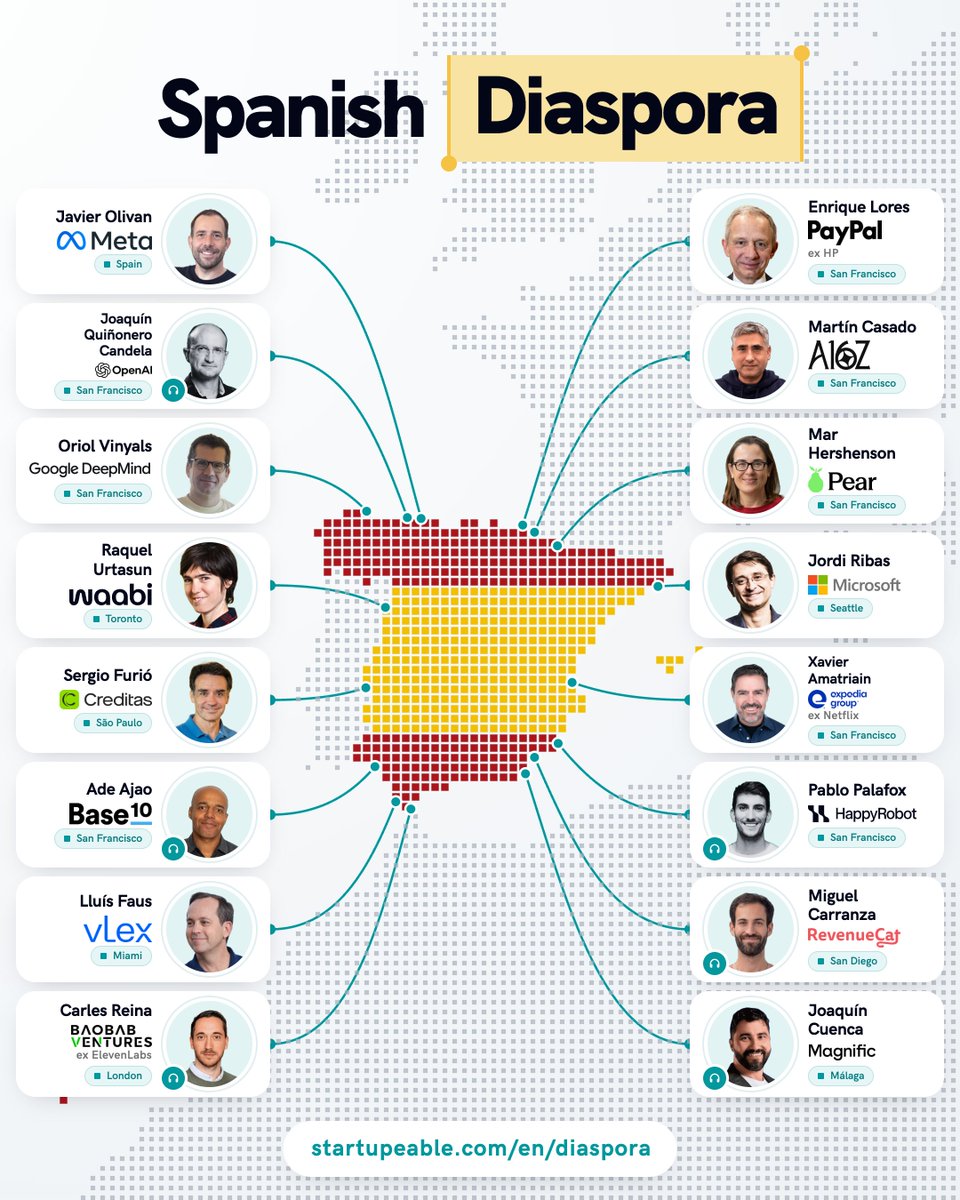
Who runs Meta's operations, leads PayPal and helped build Google's Gemini? Spaniards.
From Silicon Valley to Málaga, here are 16 at the top 👇
▪️ Javier Olivan @jolivan, COO of Meta (Sheryl Sandberg's successor)
▪️ Enrique Lores @EnriqueJLores, CEO of PayPal (ex-CEO of HP Inc.)
▪️ 🎧 Joaquin Quiñonero @jquinonero, ex-Head of Preparedness at OpenAI (nearly 20 years building AI at Microsoft, LinkedIn and Meta)
▪️ Martin Casado @martin_casado General Partner at a16z, co-founded Nicira (sold to VMware for $1.26B)
▪️ Oriol Vinyals @OriolVinyalsML, co-led Gemini at Google DeepMind (co-invented seq2seq)
▪️ Mar Hershenson @MarHershenson, co-founder & Managing Partner of Pear VC (Forbes Midas List, 5 years running)
▪️ Raquel Urtasun @RaquelUrtasun, founder & CEO of Waabi (raised a $750M Series C)
▪️ Jordi Ribas @JordiRib1, CVP of Search & AI at Microsoft, his team launched the original Copilot
▪️ Sergio Furio @sergiofurio, founder & CEO of Creditas (valued at $4.8B)
▪️ Xavier (Xavi) Amatriain @xamat, Chief AI & Data Officer at Expedia Group (led Netflix's recommendations team)
▪️ 🎧 Adeyemi Ajao, founding partner of Base10 (backed Nubank, Figma and Rappi)
▪️ 🎧 Pablo Palafox @pablorpalafox, co-founder & CEO of HappyRobot (valued at $1.2B)
▪️ Lluis Faus @lfaus, co-founded vLex, sold to Clio for $1B
▪️ 🎧 Miguel Carranza @elwatto, co-founder & CTO of RevenueCat (powers 115K+ apps, including ChatGPT)
▪️ 🎧 Carles Reina @Carles_Reina, Managing Partner of Baobab Ventures (ex-VP of Revenue at ElevenLabs)
▪️ 🎧 Joaquin Cuenca @cuenca, founder & CEO of Freepik (now Magnific)
🎧 = I've interviewed them on Startupeable.
Since I moved to SF, I’ve been interviewing and mapping the founders and execs from around the world who made it to the top of tech. That map is Diaspora and Spain is one of 30+ countries on it.
Find your country: https://t.co/jaMH4PynIf
🙏 Thanks to Paul Navarro (@AshurstPerkins) and Bianca Junqueira (@gojumpstart_) for supporting this!
Me gustaría hacer un análisis en frío sobre todas las rarezas que se están produciendo en este proceso electoral y los síntomas más que evidentes de pucherazo. Pido que lo compartan y estén atentos porque he conocido información terrorífica:
𝐄𝐦𝐩𝐚𝐝𝐫𝐨𝐧𝐚𝐦𝐢𝐞𝐧𝐭𝐨𝐬 𝐟𝐫𝐚𝐮𝐝𝐮𝐥𝐞𝐧𝐭𝐨𝐬: en 2026, se han producido irregularidades en el padrón de decenas de municipios, hasta tal punto que en provincias como Vizcaya ya inscriben a inmigrantes ilegales que viven bajo un puente o en bancos.
En Leganés, hasta 3.116 viviendas con más de cinco empadronados. En Toledo, 1.164. En Gandía, 1.386... y así con una lista casi interminable de municipios que presentan irregularidades: Burriana, Ourense, Roquetas de Mar, Vícar, El Ejido, Canjáyar, Níjar, Almería, Palencia, Ávila, Linares, Arganda del Rey, Alcorcón, Gandía, Ajofrín, Sonseca, Seseña, Algeciras, Valencia, Elda. Tortosa y Valdelugueros.
Y estos son municipios en los que se ha abierto investigación. Es decir, que seguramente en todos los de España se producen casos así. De hecho, lugares como Talavera o Leganés muestran un número distinto de habitantes en el INE y el Ayuntamiento.
¿Y toda esta gente puede votar? El 29-N no, pero en las elecciones municipales sí, y es lo que le da poder territorial al PSOE. Por ejemplo, en Alcorcón ganaron las elecciones por tan sólo 47 votos.
Además, con el padrón pueden acceder a la regularización masiva alegando que llevan más tiempo del real en España. También tienen derecho a todo tipo de ayudas sociales y servicios públicos (cada vez más colapsados).
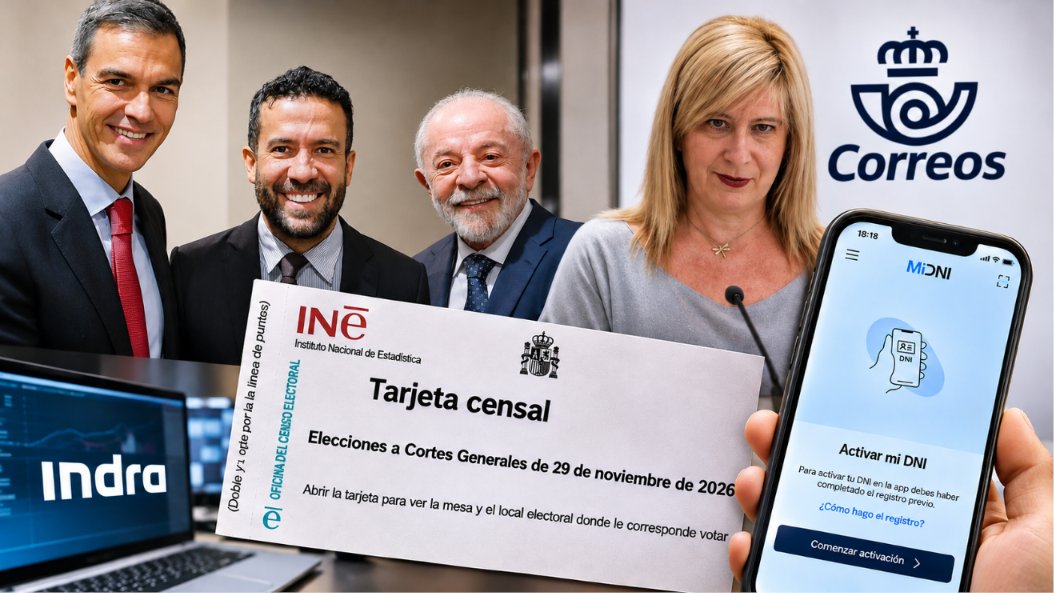
𝐓𝐚𝐫𝐣𝐞𝐭𝐚𝐬 𝐜𝐞𝐧𝐬𝐚𝐥𝐞𝐬: Aquí está lo grave. Contra todo pronóstico, muchas de las personas ilegalmente empadronadas están recibiendo documentación para poder votar. No solo eso, sino que hemos publicado casos de personas que llevan años fallecidas a las que también se les ha enviado.
Como caso más grave, el de un vecino de Leganés que nos reconoció haber recibido hasta 16 tarjetas censales a nombre de inmigrantes en su domicilio.
𝐃𝐍𝐈 𝐝𝐢𝐠𝐢𝐭𝐚𝐥: Yo pensaba que el envío de tarjetas censales 'fake' podía tratarse de un error de distribución hasta que conocí en qué consiste este nuevo sistema de voto.
Más de siete millones destinó el Gobierno tras el accidente de Urda para la compra de 61.603 lectores QR. ¿Por qué tanto interés? Pues por lo que hoy hemos conocido: Interior podrá bloquear, borrar y controlar remotamente la pantalla de los 61.603 lectores del DNI digital.
También colocarán un móvil en cada mesa electoral con conexión a internet, geolocalización, memoria gigantesca y control remoto.
Todo este nuevo sistema que según el Supremo "es inseguro" y "no permite" trazabilidad alguna está ahora precintado en cajas y sólo se podrá comprobar su correcto funcionamiento el día de las elecciones.
𝐕𝐨𝐭𝐨 𝐂𝐄𝐑𝐀: He estado hablando con numerosos españoles que viven en el extranjero y me han transmitido que el proceso está siendo más extraño y sospechoso que nunca.
En numerosos estados de EEUU aún no han llegado sobres ni papeletas y ya no van a tener tiempo para votar. En países socialistas como Cuba, Venezuela o Brasil están eliminando puntos de votación.
De hecho, un cubano con derecho a voto me ha desvelado que instituciones del régimen siempre les ponían transporte y comida a cambio de que votasen al PSOE y este año ni lo han hecho. Creen que los resultados ya están escritos.
𝐂𝐨𝐫𝐫𝐞𝐨𝐬: Uno de los primeros objetivos del Gobierno fue tomar esta empresa pública, la misma en la que enchufaron a Leire Díez, acusada de intentar "eliminar" a la juez Biedma.
Resulta que ya existen precedentes de pucherazo vía voto por correo; en concreto en cinco elecciones: Mojácar, Albudeite, Albaida del Aljarafe, Melilla y Carboneras.
Además, hoy conocemos que la empresa ignora desde 2022, época en la que estaban Leire y el mejor amigo de Sánchez al cargo, los informes internos que pedían reforzar el voto exterior con Servicio de Correo Exprés Internacional y trazabilidad.
Por cierto, haceos una pregunta... ¿por qué este año no han informado de absolutamente nada relativo al voto por correo? En 2023, mes y medio antes de las elecciones, hicieron un seguimiento diario del número de registros. Ahora, a diez días de las elecciones, no se sabe nada.
𝐈𝐍𝐃𝐑𝐀: Toda la recopilación tecnológica de los votos el 29-N depende de esta empresa, también tomada por el Gobierno. Casualidad o no, se acaba de abrir una investigación contra Defensa por contratos fraudulentos para beneficiarla y a las reuniones acudió el señor Zapatero.
Y ojo a lo que publicamos ahora: las delegaciones y subdelegaciones del Gobierno realizaron ayer un simulacro de la jornada electoral y la plataforma INDRA se cayó. durante dos horas.
𝐋𝐞𝐲 𝐝𝐞 𝐍𝐢𝐞𝐭𝐨𝐬: El caso más claro y flagrante. Hoy sabemos que con esos 189.678 hijos de nacionalizados de forma ilegal -sólo 91 cumplían los requisitos- se podrán alterar hasta 14 escaños.
Ya lo publicó Paula Ciordia en OkDiario: en 2023, la líder del PSOE en Argentina buscó pasaportes de muertos para que participasen en nuestras elecciones generales.
𝐀𝐬𝐞𝐬𝐨𝐫 𝐝𝐞 𝐋𝐮𝐥𝐚 𝐞𝐧 𝐁𝐫𝐚𝐬𝐢𝐥: Hace escasos días, se produjo un pucherazo más que evidente en Brasil y André Janones (por cierto, condenado por violencia de género) fue uno de los artífices.
Presionó a los tribunales para que ampliasen dos horas la votación y utilizó sus redes digitales y autobuses para movilizar a los suyos. Después conocimos que en algunas urnas Lula tuvo hasta 15.000 votos y Bolsonaro cero.
Con todos estos indicios y sabiendo del uso que le están dando a su nueva televisión (La Séptima) y al CIS con los sondeos, no os quepa ninguna duda de que van a intentar perpetrar el fraude porque sino su destino es la prisión.
Animo a todos los que participan en la jornada electoral a hacerlo como apoderados y a los más de doce millones de abstencionistas que revisen antes y después que nadie ha hecho uso de su voto.
Sólo así salvaremos España.
Researchers have used reinforcement learning to teach a 5-tonne John Deere skid-steer loader to perform complex acrobatic manoeuvres autonomously. Trained in simulation and transferred to a real machine, the system can balance on two wheels, navigate rough terrain, spin, and control its bucket before landing safely.
The research demonstrates the potential of AI-driven automation for heavy construction and industrial machinery.
Video Credit: @leggedrobotics / @ETH
Paper: https://t.co/MT7fyZ54Hk
#engineering #technology
Antonio García-Trevijano fue encarcelado durante 76 días en 1976 mientras franquistas y traidores a la ruptura democrática con la dictadura se repartían el poder. 🧵⬇️
El pasado agosto hablaba de la sonda Voyager 1 y decía que estaba "casi" a un día luz de la Tierra.
Hoy ha llegado a ese punto.
Hoy se encuentra a un día luz.
Impresionante la web https://t.co/uPAshMf3lc
He extraído su manifiesto porque es oro.
Es un manifiesto de Briana May sobre qué aportamos las personas ahora que la IA hace casi todo bien.
Su idea de fondo: el gusto es solo la superficie. Debajo hay algo que el modelo no tiene.
1. Rompe las reglas, pero sabiendo por qué
La IA se entrena con la media, y la media es el mínimo. Hay que conocer bien la regla y romperla con intención. Si no sabes explicar por qué la has roto, no la has roto, te has equivocado.
2. Busca inspiración donde nadie mira
La inspiración no está en los primeros resultados de Google. Está en una multa mal impresa, en cómo doblaba la servilleta tu abuelo o en la carta de un restaurante de un pueblo perdido. La IA hace la media de internet. Una persona va a un sitio raro y vuelve con algo que nadie esperaba.
3. Piensa en la persona del otro lado
La pregunta no es si encaja con la marca o si convierte. Es qué va a sentir quien lo use y qué le aporta. Si no lo preguntas tú, nadie lo va a hacer. La IA tampoco.
4. Diseña para emocionar, no para que esté bien
Tensión, sorpresa, saber parar a tiempo. La foto que no está del todo enfocada. Eso no son errores... es lo que hace que algo sea memorable. Que esté bien es lo mínimo.
5. Que sea divertido
Prefiero una cosa que haga reír a alguien en el tren que diez que cumplan el briefing. Si no es un poco divertido, ¿para qué lo hacemos?
6. Haz más y opina menos
Un boceto que funciona vale más que una buena opinión. Un primer borrador malo vale más que uno brillante que nunca se escribió. Haz 50 cosas, tira 47 y enseña las 3 buenas.
7. El resultado es tuyo
Si la IA te da algo malo, no es culpa de la IA. Tú has elegido la herramienta, has escrito el prompt y lo has dado por bueno. No necesitas un modelo mejor, necesitas tener más claro lo que quieres. La IA es muy buena cuando tienes claro el concepto.
8. Trabaja con la IA, no al lado
Escribir un prompt y quedarte con lo primero que sale no es trabajar. El trabajo es ir y volver, ajustar, probar otra vez, hasta la versión 100, que es la que funciona. Si solo miras cómo se genera, no eres el autor.
9. Juega con un objetivo y juega sin él
Si todo tiene un objetivo, es un trabajo. Si nada lo tiene, es un hobby. Lo bueno sale de mezclar los dos.
10. Piensa y construye
Hay gente que piensa y gente que hace, pero quien sepa hacer las dos cosas va a tener ventaja. Y aprender la parte que te falta nunca ha sido tan fácil.
Y cierra así:
"Este texto estará mal dentro de seis meses. Me da igual. Prefiero equivocarme con algo concreto que acertar con algo vago."
🚨 Noticia de enorme calado institucional a solo 11 días del 29-N.
Esto es lo que revela la información de El Mundo junto con el expediente de la Junta Electoral Central (JEC):
⚖️ 1. Qué acaba de ordenar el Tribunal Supremo (17-nov-2026)
La Sala de lo Contencioso-Administrativo del Tribunal Supremo ha dado un plazo perentorio de 2 días (48 horas) al Ministerio del Interior de Fernando Grande-Marlaska, a través de la Dirección General de Política Interior, para que certifique si los 61.603 dispositivos móviles con los que pretende identificar a los votantes mediante la app MiDNI (código QR) el 29-N han pasado los controles obligatorios del Esquema Nacional de Seguridad (ENS, RD 311/2022).
El Supremo no se conforma con la palabra del Gobierno: exige que, si dicen que sí, entreguen en 48 horas "la documentación técnica justificativa de la verificación y control de seguridad", antes de decidir si suspende cautelarmente todo el sistema a raíz del recurso presentado por Iustitia Europa.
🔎 2. Las cuatro claves que hacen chirriar toda la operación
💸 Solución de 7 millones a un problema que no existía
Todo elector español ya tiene por ley DNI físico, pasaporte o carné de conducir (art. 85.4 LOREG), documentos que cuestan 0 € adicionales en las mesas, no dependen de cobertura móvil ni de baterías, no se caen y no dejan rastro digital centralizado.
📱 Contrato "de emergencia" a dedo (7.000.455 €) para alquilar móviles un solo día
Interior adjudicó sin concurso ordinario, por vía de emergencia, más de 7 millones de euros a Telefónica Defensa y Seguridad (con reparto vía Correos) para alquilar 61.603 terminales durante unas horas el 29-N.
Sale a 113,64 € de alquiler por móvil para una sola jornada, casi lo que cuesta comprar un teléfono básico en propiedad.
📋 La JEC ya lo había vetado antes por falta de garantías
La Junta Electoral Central tenía suspendido el uso de MiDNI para votar precisamente por dudas de autenticidad y seguridad, y solo levantó la prohibición el 5 de noviembre bajo la condición de que existieran lectores homologados y verificados.
Que a 17 de noviembre el Supremo tenga que reclamar en 48 horas los papeles del ENS demuestra que iban a implantarlo sin haber acreditado previamente esa auditoría en el expediente.
🔐 Riesgo de trazabilidad en tiempo real e incidencias en mesa
Meter 61.603 terminales conectados verificando códigos QR contra servidores de Interior abre dos preguntas críticas que cualquier democracia seria blinda antes, no diez días antes de votar:
• ¿Qué ocurre en miles de mesas si falla la red o el servidor?
• ¿Qué garantías técnicas impiden cruzar en tiempo real qué ciudadano concreto ya ha acudido a votar y a qué hora (información de oro para la movilización electoral en vivo)?
🔎 Pero vayamos más lejos.
Cuando haces la cuenta logística e industrial, es materialmente imposible que alguna empresa de alquiler en España o en Europa tenga 61.603 smartphones parados en una estantería por si un ministerio llama pidiéndolos para un domingo.
Para dimensionar el volumen: en unas elecciones generales hay unas 60.000 mesas repartidas en aproximadamente 23.000 colegios, e históricamente Indra desplegaba unas 23.000 tabletas (una por colegio para transmitir actas, preparadas con meses de antelación).
Reunir, configurar con gestión remota (MDM), cargar y repartir vía Correos 61.603 móviles entre el 5 de noviembre (cuando la JEC levantó el veto) y el 29-N solo deja tres explicaciones posibles, y las tres son demoledoras:
1. Se los estamos comprando enteros al contratista, pero disfrazado de "alquiler de un día"
Haz la división exacta del contrato adjudicado a dedo por emergencia a Telefónica Defensa y Seguridad:
7.000.455 € ÷ 61.603 terminales = 113,64 € por teléfono para una sola jornada.
Para una operadora como Telefónica, comprando 61.603 unidades de golpe a fábrica (gama básica empresarial Android con cámara), comprar el móvil nuevo en propiedad cuesta entre 65 y 90 € por unidad.
Es decir: el contribuyente paga más por alquilarlos 11 horas (113,64 €) de lo que valen nuevos de fábrica.
Y el lunes 30 de noviembre el Estado se queda con 0 teléfonos, mientras la adjudicataria se queda con los 7 millones más los 61.603 móviles ya amortizados al 100 % para revenderlos o volver a alquilárselos al Gobierno en las autonómicas y municipales de 2027.
2. O ya estaban encargados antes incluso del permiso de la JEC
Aprovisionar 61.603 terminales idénticos, instalarles el software verificador bloqueado, probarlos y etiquetarlos mesa por mesa para los 8.131 municipios lleva semanas de cadena logística.
Si el stock nuevo ya estaba pedido antes del 5 de noviembre, significa que Interior tenía la operación en marcha antes de que la Junta Electoral levantara la suspensión, usando luego el procedimiento de emergencia (sin concurso público, sin pliegos previos abiertos y sin competencia) para adjudicarlo a dedo.
3. O han barrido almacenes de móviles reacondicionados y saldos de distintos modelos
La única otra vía para juntar más de 61.000 móviles en días sin pedirlos a fábrica es tirar de stocks sobrantes de operadora, devoluciones de renting y reacondicionados mezclados.
Y eso explicaría por qué el Tribunal Supremo acaba de exigir en 48 horas los certificados técnicos del Esquema Nacional de Seguridad (ENS): porque garantizar que 61.603 terminales juntados a contrarreloj tienen el firmware limpio, bastionado e idéntico conforme al RD 311/2022 no se improvisa en dos semanas.
Negocio redondo sin concurso para un problema que ni existía, teniendo todos DNI físico. 🎯
🗳️ Con las urnas no se improvisa, ni se contrata a dedo de emergencia, ni se conectan 61.603 terminales a los servidores de Interior sin auditoría pública previa.
DNI físico en mano y garantías al 100 %.
https://t.co/xV3w7k7RwO