Your brain is constantly rewiring itself based on what you focus on most. When you choose to notice the positive, practice gratitude, and search for opportunities instead of obstacles, your mind begins to create stronger pathways toward optimism and growth. Over time, this shift changes how you think, react, and experience life—proving that small positive thoughts can shape a powerful mindset.
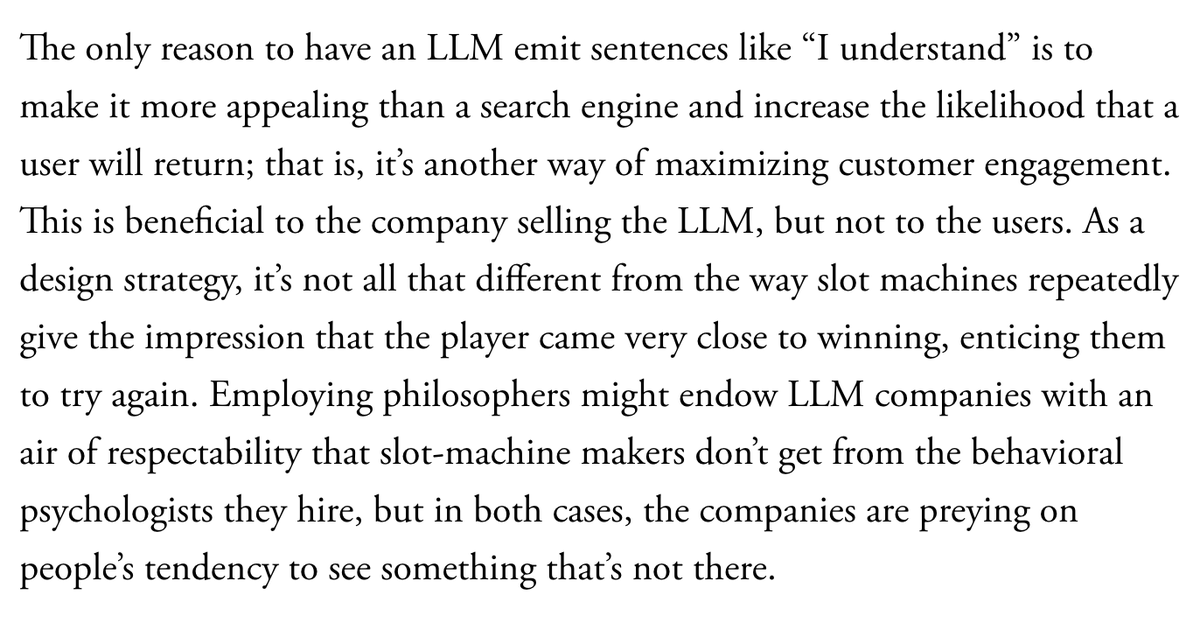
Compelling essay by sci-fi writer Ted Chiang on why LLMs are nowhere near consciousness, but why it serves the interests of LLM companies to constantly suggest that they might be.
I've pulled one quote below, but the whole article is worth reading.
@librarythingtim My understanding is that accounting and compliance departments at big companies will burn a whole lot of money to not have to manage individual subscriptions
This book by @joeljmiller is fascinating! Especially enjoy learning about how Christianity contributed to book culture by adopting the codex early on and establishing institutions based on reading.
What do you think about asking AI to give your work a read? I tell it NOT to write—the writing is bad, anyway—but to give me bullet points. About 1/3 are bad and wrong, 1/3 are good suggestions, and 1/3 are bad, but get at something I need to fix, usually a darling I need to kill. Doesn't feel much different to me from a human reader.
On the morning of January 2, 1492 AD, the long war ended not with a thunderclap, but with a key. From the towers of the Alhambra, the red banner of Islam was lowered, and Muhammad XII of Granada, known to history as Boabdil, surrendered the city to Ferdinand II of Aragon and Isabella I of Castile. Granada—the last Muslim kingdom in Iberia—passed into Christian hands. Church bells rang where the call to prayer had echoed for centuries, and the Reconquista, begun nearly eight hundred years earlier, was complete.
The story had begun in 711 AD, when Muslim armies crossed the Strait of Gibraltar and shattered the Christian kingdoms of Iberia with astonishing speed. Within a decade, most of the peninsula lay under Islamic rule. Only the mountains of the north held out. There, in damp valleys and stone fastnesses, small Christian realms endured—poor, divided, and stubbornly alive. They did not dream of swift victory. They prayed, waited, and fought—sometimes against Muslims, sometimes against one another. When Charles Martel halted further Muslim expansion at Tours in 732 AD, Europe was spared conquest, but Spain was not. Iberia became a frontier—of faith, memory, and patience measured in generations.
Over the centuries, the Reconquista advanced not as a single crusade but as a grinding tide. Pilgrims walking the Camino de Santiago brought coin, soldiers, and conviction. Kings learned that faith could move men farther than gold. And legends rose alongside armies. Saint James the Greater—Santiago—was said to ride into battle as Matamoros, sword flashing from the clouds. The tale was never proven, but it hardly mattered. In medieval Spain, belief itself was a weapon. Monks became knights. Knights became settlers. Castles rose where mosques once stood. Toledo was reconquered in 1085, Valencia after that, and Christian rule crept southward, mile by hard mile.
This war was never clean, never simple. Christians and Muslims fought together sometimes as often as they fought apart. Rodrigo Díaz de Vivar, El Cid, served both cross and crescent, conquering Valencia with an army of mixed faiths and ruling it as a warrior-lord. For a time, tolerance flickered—especially after Toledo, where Muslims were initially allowed to remain, worship, and govern their own communities under Christian rule. Spain during this time was a land of uneasy coexistence, ambition, and compromise—until unity arrived in marriage. When Ferdinand and Isabella joined Aragon and Castile in 1469, the peninsula gained something it had not possessed since the days of Rome: a single, disciplined will.
Muslim Granada stood alone by then—rich, cultured, but divided—its rulers consumed by intrigue and civil war. As Christian cannons, new and brutal instruments of the age, battered its defenses, the city’s fate was sealed as much by internal collapse as by external force. The Treaty of Granada was signed.
When the victors entered the city on January 2, 1492 AD, Christian Spain was restored. They knelt in thanksgiving. They sang the Te Deum. They released Christian slaves from Muslim jails. The Reconquista was complete.
#archaeohistories
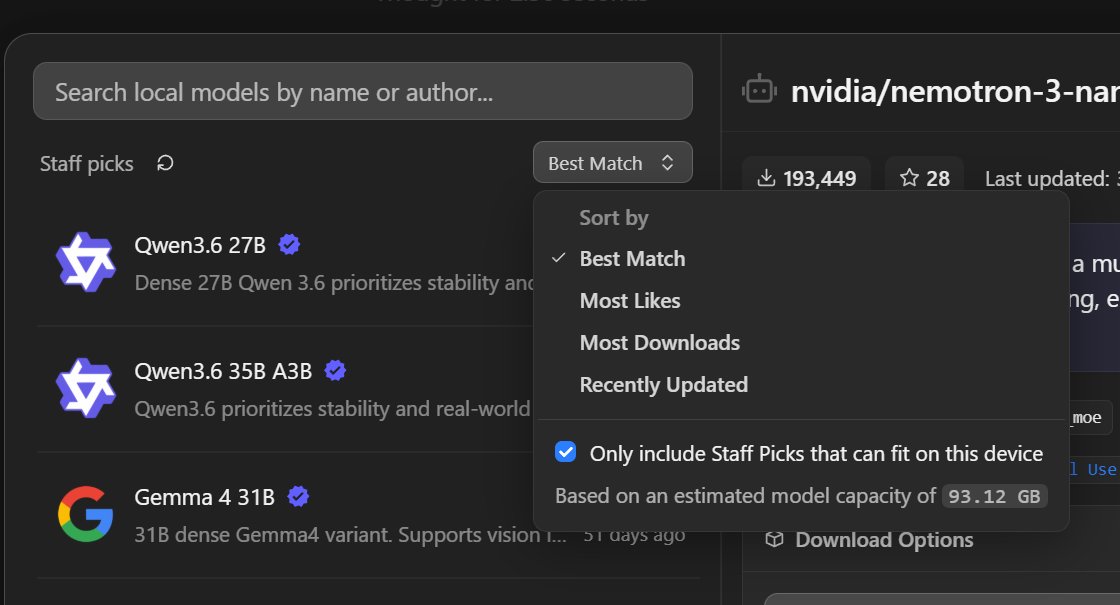
@akshay_pachaar@svpino or you can just go to LM Studio settings? and LM studio by default only shows you models that will work on your machine. Why bother with installing anything else?
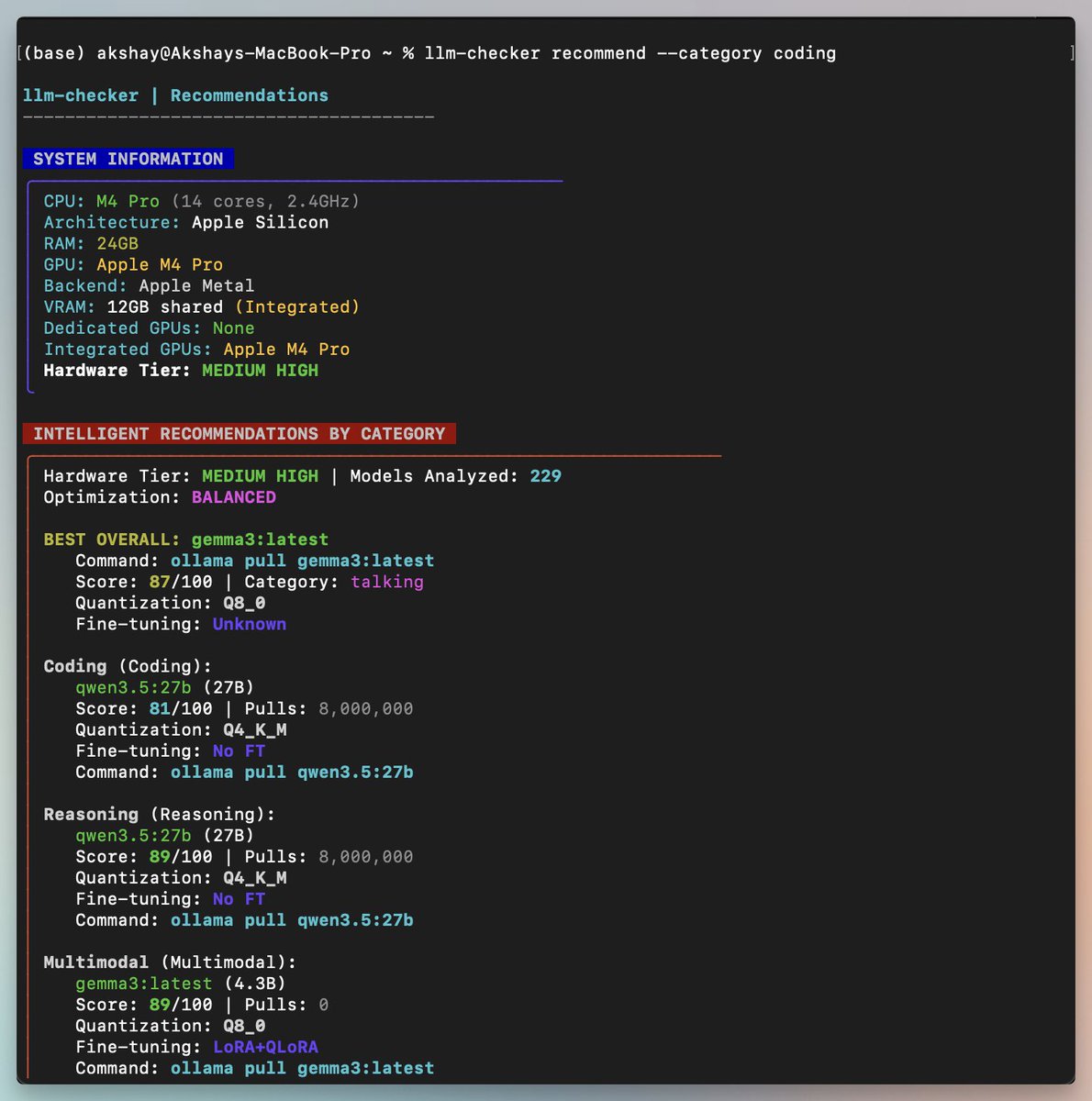
The easiest way to find out which models you can run on your computer:
1) Install
npm install -g llm-checker
2) Detect your hardware
llm-checker hw-detect
3) Get recommendations by category
llm-checker recommend --category coding
Credits to @svpino for bringing this to my attention. I found it super useful and thought of sharing it with you all.
Here are some of the recommendations I got:
New article in @PNASNews:
We all know that ChatGPT loves to delve, bolster, leverage, encompass, showcase, underscore, et cetera. I analyzed full text of 7.3 million journal articles published 2020-2025, hunting for 228 words that spiked after ChatGPT launched in late 2022.
Follow the money on this one. It is rotten to the core.
The Pentagon just lent $620,000,000 to a tiny North Carolina startup called Vulcan Elements. The company is two years old.
It had fewer than 50 employees.
And three months before the deal was announced, Donald Trump Jr.’s venture firm quietly took a stake in it.
Here is the part the administration tried to bury.
Of the dozens of companies the Pentagon was weighing, Vulcan was the only deal initiated by a top White House aide. That aide was Peter Navarro, a close friend of Trump Jr. The order came down to move fast.
One official put it plainly: The call came from the White House. We have to get this done.
Staff worked late nights to push it through in weeks. Deals like this normally take many months of vetting. And when it closed, Vulcan’s valuation jumped from about 200 million dollars to roughly 2 billion.
A windfall for the investors, including the president’s son.
This is public money. Your money.
Routed through the Pentagon to enrich the president’s family and their friends. The Bush administration’s own chief ethics lawyer called it corruption we pay for.
And there is more coming.
A drone parts company Trump Jr. holds a stake in is also under Pentagon review.
This is not a one-off. It is a pattern. The president’s family is treating the federal Treasury like a private bank, and the bill lands on every taxpayer.
https://t.co/4kB1cZNmlE
The largest #tornado in recorded History happened on this day, 13 years ago, in El Reno, Oklahoma.
This video shows the #Dominator 2 surging east for intercept of this 2.5 mile wide tornado, and we ran into a power line and launched the hood into the tornado.
Very sadly, my friend and mentor, Tim Samaras and the TWISTEX team with Carl Young and Paul Samaras lost their lives to this tornado while doing ground-breaking science.
RIP TWISTEX
There is no world in which this is okay.
Supreme Court Justice Samuel Alito did not recuse himself from cases involving Trump’s Treasury Department while his own son was secretly working there as a political appointee and attorney.
His son's employment was hidden so thoroughly that his name appears nowhere on the Treasury Department website, he has no public resume, and his bar listings are outdated.
If Alito had recused himself, the secret would have come out. He didn’t recuse himself.
This is a clear conflict of interest, and the American people deserved to know about it.
The federal recusal standard is clear: a justice must step aside in any case where there is a reasonable basis to question whether he or she can be impartial. A justice ruling on cases involving the department where his son works fails that test. The Treasury Department sits at the center of some of the biggest legal fights of this administration, and challenges to Trump’s $1.776 billion January 6 slush fund could be headed to the Court next.
The Supreme Court is the only court in America with no binding code of conduct. That is completely unacceptable, and it has to change NOW.
Congress controls the Power of the Purse, and therefore the Court’s funding. If the Court will not adopt a binding code of conduct with real recusal review on their own, I support withholding their funding until they do.
https://t.co/FV2Tkpz7Dk