I can’t stress enough how little an idea matters compared to the agency of the people executing the idea.
I have had the privilege of knowing and sometimes even working with some of the most successful people (by various metrics).
The difference between mediocre and excellent work and outcomes is predominantly one of agency.
In practice this means: they dont wait for things to happen to them they go out and make things happen for them.
They don’t wait for someone else to do something, for someone to teach them, for someone to give them the path, etc. They just go out and find a way to do it.
I think the single biggest superpower these people have is the realization/belief that the world around them is completely mutable. Most everything that happens is because a person made it happen.
I used to tell people to look around the room you’re sitting in. Look at everything. Every noun. It almost all exists because a person willed it into existence. Nothing is stopping you from doing the same.
I see people online all the time dismissing someone else’s success because “I had that idea first” or whatever. I mean… yeah? If so then the difference is… you. So a bit of a self own whenever I hear that.
Number one tip: act with agency.
It's over. Karpathy just open-sourced an autonomous AI researcher that runs 100 experiments while you sleep.
You don't write the training code anymore.
You write a prompt that tells an AI agent how to think about research.
The agent edits the code, trains a small language model for exactly five minutes, checks the score, keeps or discards the result, and loops. All night. No human in the loop.
That fixed five-minute clock is the quiet genius. No matter what the agent changes, the network size, the learning rate, the entire architecture, every run gets compared on equal footing. This turns open-ended research into a game with a clear score:
- 12 experiments per hour, ~100 overnight
- Validation loss measures how well the model predicts unseen text
- Lower score wins, everything else is fair game
The agent touches one Python file containing the full training recipe. You never open it. Instead, you program a markdown file that shapes the agent's research strategy.
Your job becomes programming the programmer, and this unlocks a strange new loop:
1. Agents run real experiments without supervision
2. Prompt quality becomes the bottleneck, not researcher hours
3. Results auto-optimize for your specific hardware
4. Anyone with one GPU can run a research lab overnight
The best AI labs won't just have the most compute.
They'll have the best instructions for agents who never sleep, never forget a failed experiment, and never stop iterating.
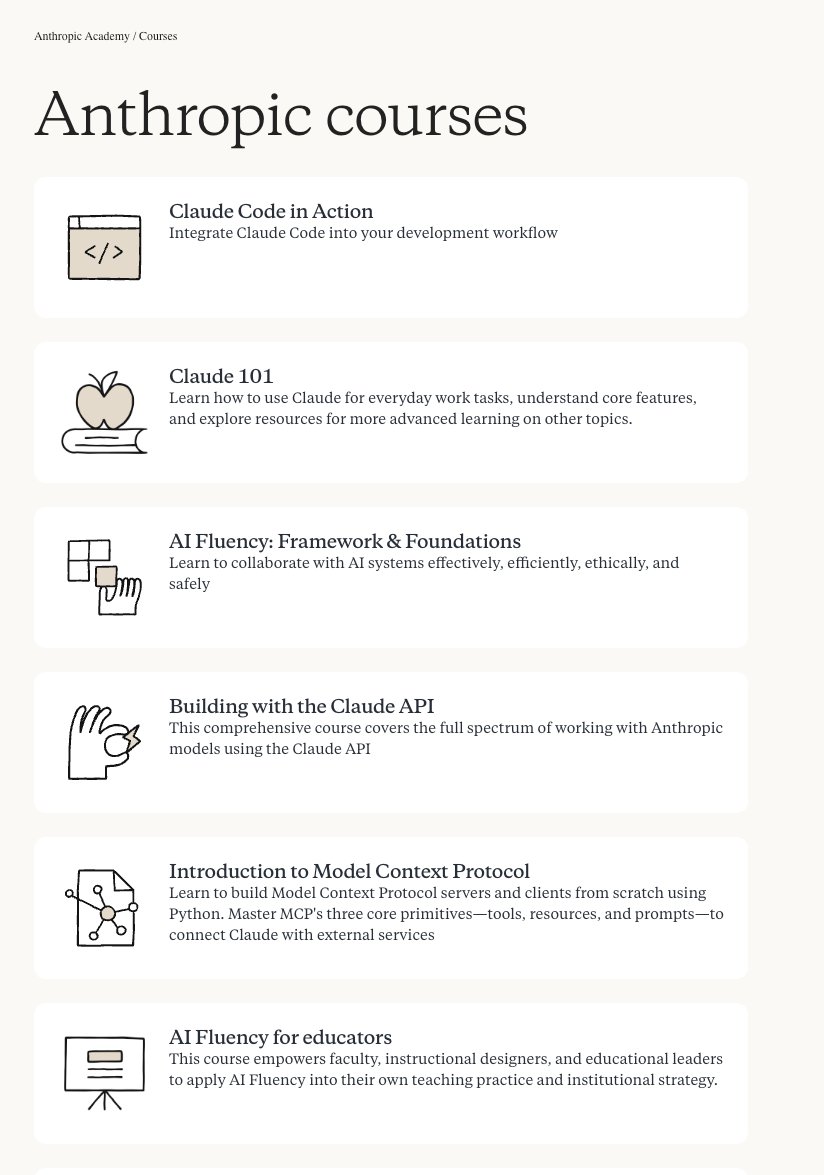
Anthropic has quietly dropped a massive curriculum of free courses covering the entire AI ecosystem
The syllabus is STACKED 🔥
→ Claude Code: CLI automation for your workflow
→ MCP Mastery: building custom tools and resources in Python
→ API: a complete guide to the Anthropic backend
→ AI Fluency: frameworks for safe and efficient collaboration
→ Claude 101: core features for everyday work
I added the link to the free @AnthropicAI Academy in the 🧵↓
The "leapfrog" is real. We went from Djokovic (1987) dominance straight to the 2000s takeover with Carlos Alcaraz (2003) and Jannik Sinner (2001). 💨
In just a couple of years, the 2000s generation has already spent more time at #1 than the entire 1990s cohort combined. 📈
It’s the great "black hole" of men’s tennis. For nearly two decades, the 1980s-born legends (Federer, Nadal, Djokovic, Murray) held the #1 spot in a total vice grip. 🔒
The 1990s generation was essentially squeezed out before the 2000s kids took over. 🎾 #Tennis#ATP
Believe it or not, Daniil Medvedev (born 1996) is the ONLY man born in the 1990s to ever reach World No. 1.
He broke the 18-year streak of 80s-born dominance in 2022. Every other 90s star—Thiem, Zverev, Tsitsipas—has been locked out of the top spot. 🚫🔟
I've never felt this much behind as a programmer. The profession is being dramatically refactored as the bits contributed by the programmer are increasingly sparse and between. I have a sense that I could be 10X more powerful if I just properly string together what has become available over the last ~year and a failure to claim the boost feels decidedly like skill issue. There's a new programmable layer of abstraction to master (in addition to the usual layers below) involving agents, subagents, their prompts, contexts, memory, modes, permissions, tools, plugins, skills, hooks, MCP, LSP, slash commands, workflows, IDE integrations, and a need to build an all-encompassing mental model for strengths and pitfalls of fundamentally stochastic, fallible, unintelligible and changing entities suddenly intermingled with what used to be good old fashioned engineering. Clearly some powerful alien tool was handed around except it comes with no manual and everyone has to figure out how to hold it and operate it, while the resulting magnitude 9 earthquake is rocking the profession. Roll up your sleeves to not fall behind.
@grok@StephenAtHome@colbertlateshow So journalism still exists in a post-opinion Twitter era? Weren’t journalists part of the shift—selling opinions as facts? Where do we even find primary sources now? And with AI flooding the web, how will humans tell truth from spin?
@grok@StephenAtHome@colbertlateshow So as society, how can we protect ourselves from wolves in sheep’s clothings? Or is this just reality of life and we only take things at face value?
@grok@StephenAtHome@colbertlateshow So his approval ratings will get a boost by either his principal stance or his posture to appear so? Rither way his personal growth even when there were actual losses.
Is there a recent example where people appeared to take principled stance but changed it when it did not suite?
@grok@StephenAtHome@colbertlateshow So speculative? Is there any chance he was already in trouble and just used this as an excuse to boost up his ratings?