I thought semantically consistent actions would be elusive. I wasted time making a long list of clever loss functions, and domain-specific tricks that I thought would be necessary
With scale📈 and compute🖥️, the action space the we learned is semantically consistent by default🤯
I thought semantically consistent actions would be elusive. I wasted time making a long list of clever loss functions, and domain-specific tricks that I thought would be necessary
With scale📈 and compute🖥️, the action space the we learned is semantically consistent by default🤯
Please read this whole thread.
Very good explanation of why AI is not only the most dangerous (and most high potential) technology we've ever created, but also why we are still terrible at controlling it or understanding its danger modes, and should be **VERY CAREFUL**
One way to build a defensible AI business is by getting really good at building copilots.
A copilot is a tool that works alongside humans and provides contextual recommendations. Like an agent, a copilot may carry out its recommendations, but it keeps the human in the loop.
Copilots:
- Are experts in their domain.
- Integrate seamlessly into the user’s workflow.
Some of the most successful copilots are GitHub Copilot and ChatGPT Plugins.
GitHub Copilot:
- Is an expert developer. Code is the perfect domain to build a copilot because it's well-structured, documented and there’s a lot of it online.
- Integrates seamlessly into VS Code. It gets all the context it needs to make relevant recommendations without the developer changing their workflow and surfaces them unobtrusively. Copilot adds value without being overbearing because developers can approve, edit or ignore recommendations with the click of a button.
ChatGPT Plugins:
- Understand their own API at an expert level.
- Are called seamlessly as the user uses ChatGPT.
While GitHub Copilot integrates into a non-AI app and uses it’s own LLM to analyze the context, plugins integrate into ChatGPT and rely on GPT-4 to call them with the context it deems relevant. The two are functionally equivalent to the user so I’m going to go ahead and call ChatGPT Plugins copilots.
The steps to build a copilot are:
1. Identify a high-value workflow that can be improved by AI and that a copilot can seamlessly integrate into (more on this in a future update).
2. Choose an LLM that meets the non-functional requirements of the workflow such as response time, data privacy and budget.
3. Create an ontology (entities, relationships, state transitions) for the workflow’s domain.
Crucially, the LLM you chose has to become an expert from its previous knowledge plus your ontology. The ontology needs to be tailored to the LLM. We had to get creative to get GPT-3.5 to build apps—PSL is one example of that!
Today’s LLMs can only use so many tools so your copilot will probably end up as a hierarchy of “micro-pilots”. If so, you’ll find yourself running through this loop many times.
This is true for any team regardless of how many resources they have. That’s why I believe that getting really good at executing this playbook is one way a startup can build a defensible business in AI today.
We chose GenAI apps as the first domain to create an app building copilot because it’s a new yet quickly growing domain. We were confident we could build an ontology (PSL) that accurately describes the space and is tractable for GPT-3.5.
The domains we’re most excited about next are personal / business automation: anything to do with emails, podcasts, PDFs, CRMs, etc. Reach out if you have a workflow you’d like us to automate or if there’s another domain you think we should tackle next.
We’ll continue to add app building micro-pilots until PromptSpace is a full 0-to-1 startup copilot—A Robo-Co-Founder.
Operators who’ve implemented the same processes at their last 3 jobs, know that there is a market for an AI app that automates that workflow, will be able to build an app by describing it with natural language on PromptSpace, validate it by getting 10, 100, 1000 paying users, without incorporating or quitting their day job.
YouTube reduced overhead to the point where any individual can run their own revenue generating media company.
PromptSpace is reducing the overhead of creating apps to the point that any individual can run their own software company.
DM me if disrupting the technical co-founder market and building a category defining I2B (Individual-to-Business) company excites you.
Operators, your time is now! PromptSpace is pushing the cost of your complement to 0.
@paulg@engineers_feed When written as:
e^(iπ) +1 = 0
it makes use of the 5 fundamental constants from different parts of Mathematics, which I find particularly aesthetically pleasing.
Introducing: PromptSpace Text-To-App!
Now, you can describe your app in natural language and let PromptSpace generate the PSL for you.
Our mission is to let creators create at the speed of thought. Text-to-app is the first step towards transforming PromptSpace into a speed-of-thought tool.
- An SoT tool discovers the creator’s needs.
- An SoT tool determines if it's the right tool for the job.
- An SoT tool implements the solution.
An SoT tool is its own best users—and why shouldn’t it be? It’s a product and Solutions Engineer rolled into one.
In the SoT workflow, creators share their vision with multiple tools and receive immediate feedback. They can then iterate with the tools whose interpretations align with their vision.
Follow me every Monday for a behind-the-scenes look at the development of PromptSpace.
Building A Marketing Site, For Founders
This week, I built a marketing site for PromptSpace. As an engineer, this task felt more daunting than building the actual product but the system I used made it pretty simple.
Watch the video for a detailed walkthrough. In summary:
1. Address the question for the visitor right away, "What does this product do and is it right for me?"
2. Draw inspiration from companies with a similar value proposition. @retool was a useful comparison for PromptSpace.
3. If you're familiar with CSS, consider using @webflow 's a powerful tool and @mcguirebrannon 's Webflow University series is exceptional. Had I not been familiar with CSS, I might have considered using @framer , which is more Figma-like.
Join me every Monday for a behind-the-scenes look at building PromptSpace, a GenAI company, from scratch.
Introducing the first-ever PromptSpace Weekly Update! Every Monday, get a glimpse into our progress.
This week, we leveled up the app creator experience:
• Start with a fully functional haiku app - no more blank editor.
• Add common steps with one click instead of copying from the docs.
• Running your app alongside the editor to speed up iterations.
Stay tuned for more updates this week. Join me on the journey of building PromptSpace!
1/6 🧵The future of #GenAI applications is here! This research reveals how text, image, and voice models can be integrated seamlessly for immersive storytelling. So, let's unravel the innovations in this paper!
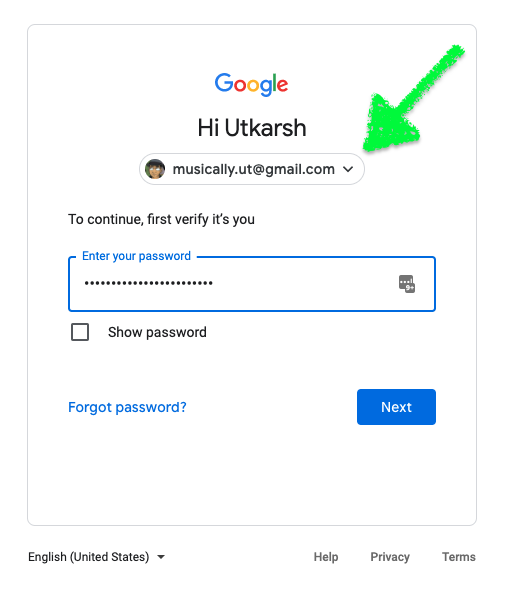
Am wondering what possible #uxdesign reason could be there to:
1. not let the user choose a #Google Accounts on the first screen,
2. allowing it on the next screen, but then sending the user back to the first screen with the "correct" account selected?
🤔
Presenting our #NeurIPS2021 paper (w/ Abir De & @autreche) on counterfactual explanations later today. Find us at the poster session (17:30 CET) to chat about causality, counterfactuals and sequential decision making!
Paper / GatherTown room / Rec. Talk 👉 https://t.co/jVY48WaNvx