My dear front-end developers (and anyone who’s interested in the future of interfaces):
I have crawled through depths of hell to bring you, for the foreseeable years, one of the more important foundational pieces of UI engineering (if not in implementation then certainly at least in concept):
Fast, accurate and comprehensive userland text measurement algorithm in pure TypeScript, usable for laying out entire web pages without CSS, bypassing DOM measurements and reflow
One common issue with personalization in all LLMs is how distracting memory seems to be for the models. A single question from 2 months ago about some topic can keep coming up as some kind of a deep interest of mine with undue mentions in perpetuity. Some kind of trying too hard.
this is actually insane
> be tech guy in australia
> adopt cancer riddled rescue dog, months to live
> not_going_to_give_you_up.mp4
> pay $3,000 to sequence her tumor DNA
> feed it to ChatGPT and AlphaFold
> zero background in biology
> identify mutated proteins, match them to drug targets
> design a custom mRNA cancer vaccine from scratch
> genomics professor is “gobsmacked” that some puppy lover did this on his own
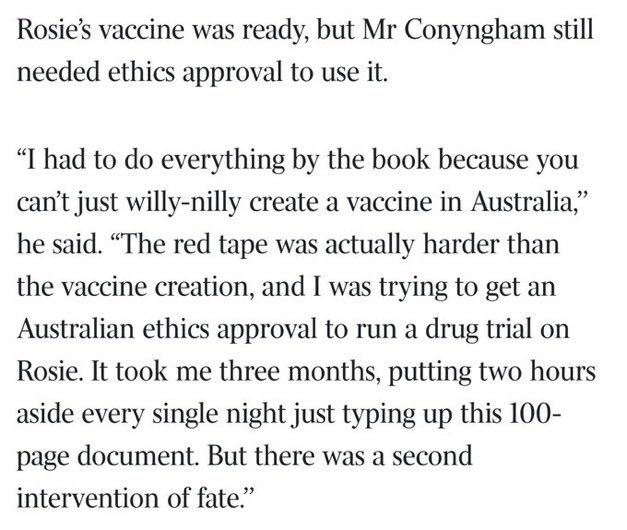
> need ethics approval to administer it
> red tape takes longer than designing the vaccine
> 3 months, finally approved
> drive 10 hours to get rosie her first injection
> tumor halves
> coat gets glossy again
> dog is alive and happy
> professor: “if we can do this for a dog, why aren’t we rolling this out to humans?”
one man with a chatbot, and $3,000 just outperformed the entire pharmaceutical discovery pipeline.
we are going to cure so many diseases.
I dont think people realize how good things are going to get
For those that hope (or worry) that LLMs will do breakthrough scientific research, I've got good (or bad) news:
LLMs are particularly, exceedingly, marvellously ill-suited to this task. (if you're a researcher, you'll have noticed this already)
Here's why🧵
The ancient Roman patricians of the Republic kept wax masks of their ancestors in cabinets in the atrium of their houses.
During funerals and other celebrations hired actors would wear the ancestor masks standing in as the celebrant’s ancestors.
At the age of 35-40, once you had achieved some success and prominence in Roman society, you would have your own mask made that would join those of your ancestors in the cabinet in the atrium.
On the Tucker interview with Putin.
I'm glad that we got to see this, because it revealed how out of touch Putin is. Tucker begins with a simple question of what the threat was on February 22. Putin's response spends *half an hour* on the entire history of Russia.
We're used to people in the Middle East talking like this. An obsession with deep history is the characteristic of cultures that fight wars that never end. No one wonder no one even in the Russian speaking part of Ukraine wants to be part of Russia. Modern people care about their own lives and freedom and want a vision of the future.
That's what Ukraine and the West offer. Not endless lectures from a grumpy uncle on how Vlad Vladimirovich sent love letters to Svetlana the Elegant in 1207 and why this proves that Russians and Ukrainians are one people.
When talking about geopolitics, the deeper someone goes in history, the more disconnected they are from modern reality, and the less likely they are to be a rational actor who can be negotiated with. Putin had arguments he could've started with about the US interfering in Russian affairs or whatever, but he's deranged enough to think that leading with a lecture on the history of the Slavic peoples is how you sell a war in the twenty first century.
Surely a case of free speech is the best disinfectant. I knew Putin talked a lot about history, I had no idea his brain had deteriorated to this point. Hopefully Russians can one day soon have a leader who cares about making their lives better, rather than fighting wars based on what he read in history books.
The hard feelings are the most valuable.
When I am sad, I remember what I love.
When I am angry, I seek mastery.
When I suffer, I learn humility.
When I am afraid, I discover courage.
Savor what you feel. Welcome the proof that you are alive to feel it.
Only 66 years from first flight to landing on the moon, but now half a century has passed since the last moon landing.
That cannot be our high water mark as a civilization.
Humanity should have a moon base, cities on Mars and be out there among the stars!
Chamath Palihapitiya took Facebook to 1 billion users, was the youngest ever Vice-President at AOL…and worked at Burger King as a 14-year-old to support his family.
Here's what I've learned from him about online writing and media:
1. Start your writing in a punchy way.
2. End your writing in a useful way.
3. Why write in public? “The ability for smart, useful observations to get into the hands of people with fewer ideas but lots of capital has never been better. You can build both a reputation and balance sheet this way.”
4. Different mediums unlock different kinds of writing. Chamath turns to pen & paper when he wants to write analytically, and to Twitter and the Internet when he’s in a more fiery mood.
5. Building a culture of long-form writing is a way to depoliticize a company because prose rewards clear thinking via strong and logical arguments.
6. Give readers a definitive conclusion. Even if they disagree with it, they’ll consider it time well-spent if they walk away with something solid. The worst writing is ambiguous and wishy-washy.
7. Fame brings politician syndrome: Chamath says his writing has become more hedged and timid as his profile has grown, and his struggle as a writer now centers around regaining his early voice and spontaneity.
8. Reading is an effective way to learn, but it's much more effective when you pair it with writing. Whenever Chamath stumbles on a particularly important topic, he writes 1-2 pages about it.
9. When money gets into good ideas, they become good things in the world. The opposite happens when money gets into bad ideas. This is why people with good ideas have a moral responsibility to share them.
I've shared the full conversation with @chamath below.
If you'd rather listen on YouTube, Spotify, or Apple, check out the replies.
Cedric Grolet is today regarded by international critics as one of the best pâtissier in the world.
This is how he prepares the pain perdu, french toast with chantilly cream, vanilla and caramel.