We decided to provide more transparency into pretraining progress at OpenAI for the sake of moving toward shared safety bars. In “Perplexity and Intelligence” I argue for common limits based on perplexity and other measurements, with progress beyond them gated on our ability to understand AI behavior.
https://t.co/XX35m5vq89
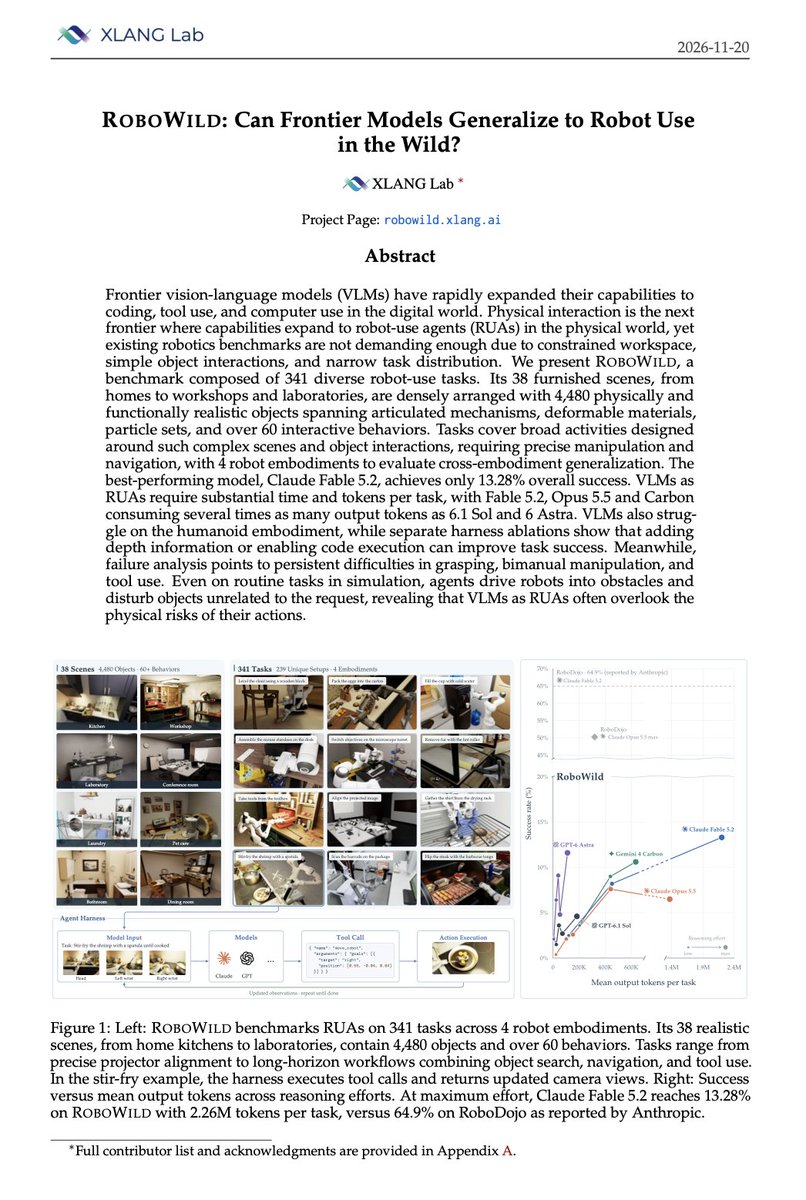
15+ of us spent another 1.5+ years building robowild because we’re passionate about robot use agents (rua).
from cua (osworld) to rua (robowild): it’s time to expand foundation models from digital to physical agency.
we’re open-sourcing it all: https://t.co/V1hBuuu5E8. 🙏
Almost a year after taking a sabbatical from UCLA to join Google, I’m thrilled to introduce my new research team: AIS (Agents for AI-Infra and Science)! 🚀
We’re betting big on AI for Discovery — co-designing models & agentic frameworks to optimize ML/AI infra and tackle frontier scientific problems. Check out our new team page: https://t.co/2eV3jLyqLa
Excited to share that two of our projects were just featured on the Google Research Blog (Read more: https://t.co/DEFaGADM2g) and are rolling out for GA to all users via Antigravity’s /teamwork:
⚡ DuoDiscover (Systems Optimization): Achieved a 4.09x avg speedup across 17 JAXBench kernels, and beat hand-tuned baselines with a 2.99x avg speedup on vLLM TPU Pallas kernels. https://t.co/CLRT8IRyhk
📐 LEAP (Formal Math): Autonomously generated 1.8M lines of Lean to complete an end-to-end formalization of the Weil conjectures, achieved the first formalization of Hilbert’s 10th problem (919k+ lines), and independently reproduced the 3D Navier–Stokes formalization. https://t.co/q5evUWs9Hu
Building a team from scratch reminds me a lot of starting my academic lab as a new professor, except this time, backed by @Google’s infra & ecosystem, I am fortunate to witness frontier research turns into real-world tools at an extraordinary pace.
I’m truly grateful to build and grow alongside my amazing team, interns, and collaborators across Google AI2 R&D, @GoogleDeepMind, and @GoogleResearch!
Looping increases the effective depth of LLMs, but computing deeper ≠ thinking deeper 🤔
We explore how to better utilize the increased depth through residual design: attention residual improves looped LLMs!
Our fully-open ARLoop-1.2B outperforms Qwen3.5-2B Base with 70× fewer training tokens. Curious to see what you’ll do with it! 🔥
What other perspectives could help LLMs better utilize their depth? More thoughts coming soon 👀
This fall, I’m honored to serve as Head TA for Stanford "CS329X: Human-Centered LLMs", taught by @Diyi_Yang.
The course focuses on the intersection of LLMs and People, covering techniques for building useful models and agentic systems, as well as approaches to align them with human values and preferences, preserve privacy and trust, and create positive societal impact.
This year, we’ve seen a significant increase in enrollment, and we’re thrilled that so many students care about human-centered AI. Our team spent a lot of time discussing how to design assignments that would be actually useful to prepare students to build or even define AI systems that benefit people.
Our conclusion: hands-on experience remains essential, but implementation alone is not enough. We emphasize understanding why methods work, how to evaluate them, and what we shall look for in human data.
This learning experience would not be possible without the compute credits and resources provided by @thinkymachines, @googlecloud, @humansand, and @AWS. Thank you so much for supporting our students and the course!
Some photos from EMNLP 2026!🇭🇺 I had to chance to present the papers I co-authored during my postdoc at @UniUtrecht I am grateful to my supervisors Jakub Dotlacil and Albert Gatt, and the other Utrecht NLP people, for the last couple of years!☀️#EMNLP2026 (1/3)
How long does a finding about LLMs stay true?
We re-tested 50 widely cited findings about LLM behavior (various biases, hallucination, etc). Within 15 months, most no longer held or had substantially reduced effects.
LLM findings has short shelf life https://t.co/MUWm6INyX8
Great job by @oq_35!
Excited to share what we’ve been building: Carbon is here!
Hands down the smartest model I’ve worked with, already my daily work partner, and casually helped me snag hard-to-get tickets🤣🥳
Enjoyed the process of building it to tackle open frontier problems. Also so proud of what our team did for Gemini's fast iteration. Let’s keep pushing! 🫡
Super excited to share this work from our amazing interns and team at @Google, co-led with awesome @chunliang_tw!
Meet DuoDiscover: a full-stack code optimization agent. Its secret sauce is co-discovering the optimization target AND a cheap proxy evaluator (a "yardstick") at the same time.
A quick spoiler of the results:
🏆 #1 on NVIDIA's SOL-ExecBench
🐍 2× the human experts on SWE-fficiency
🚀 1.92× on vLLM; 1.44× on FreeToken
🔥 2.68× over production TPU kernels
🖥️ Beats the best human and AI-designed CPU prefetchers
Optimizing AI infra. Accelerating science. Dive into more details below 👇
i love writing. i never let agents write for me. whether it's docs, or tweets, or shitposts, or even prompts (okay maybe that one's harder as agents manage other agents)
there's a simple reason for that: i still strongly believe that writing is thinking. it's a skill i hope to never give up. it's also important to me that whatever i say is always authentic, mistakes and all. my favorite posts are the ones that i just full send without any editing
i suspect it also helps with prompting. being able to clearly express what i want, and knowing the vocabulary i need to be able to direct my agents does seem to make for more effective usage of agents. in the same way that engineers have an advantage when we prompt agents to write code, because we are intimately familiar with the words that make up the discipline
knowing the right word incantations to get an agent to produce a desired goal almost feels like spellcasting. as models get more capable, and that input box looks more and more like a magic box that can output anything, words become the interface between you and the genie
there may come a time when we give up the keyboard in exchange for brain-computer interfaces. but until then, i'm writing every word.
A 2B model jumped from clemscore 10.67 to 38.92 on dialogue games by diagnosing where it broke: repeating guesses, ignoring feedback it just saw. Targeted repair beat brute scaling. Same failure mode I see in multi-step reasoning for drug discovery.
https://t.co/ZUVI4FibGg
What’s the point of a “helpful assistant” if you have to always tell it what to do next?
In a new paper, we introduce a reasoning model that predicts what you’ll do next over long contexts (LongNAP 💤).
We trained it on 1,800 hours of computer use from 20 users.
🧵