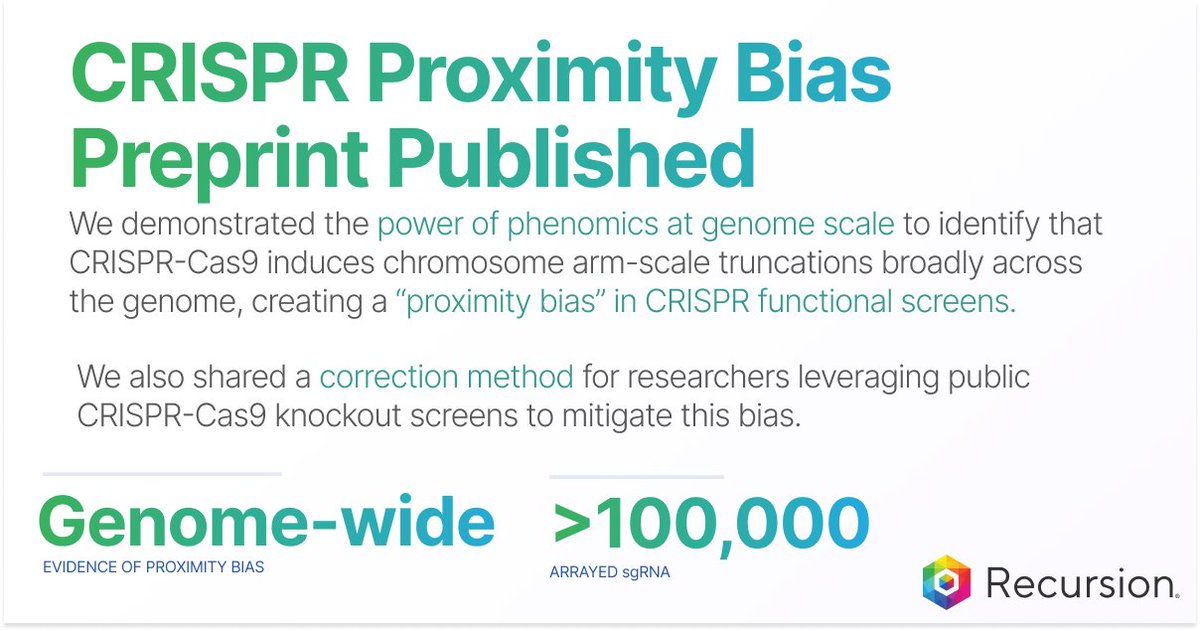
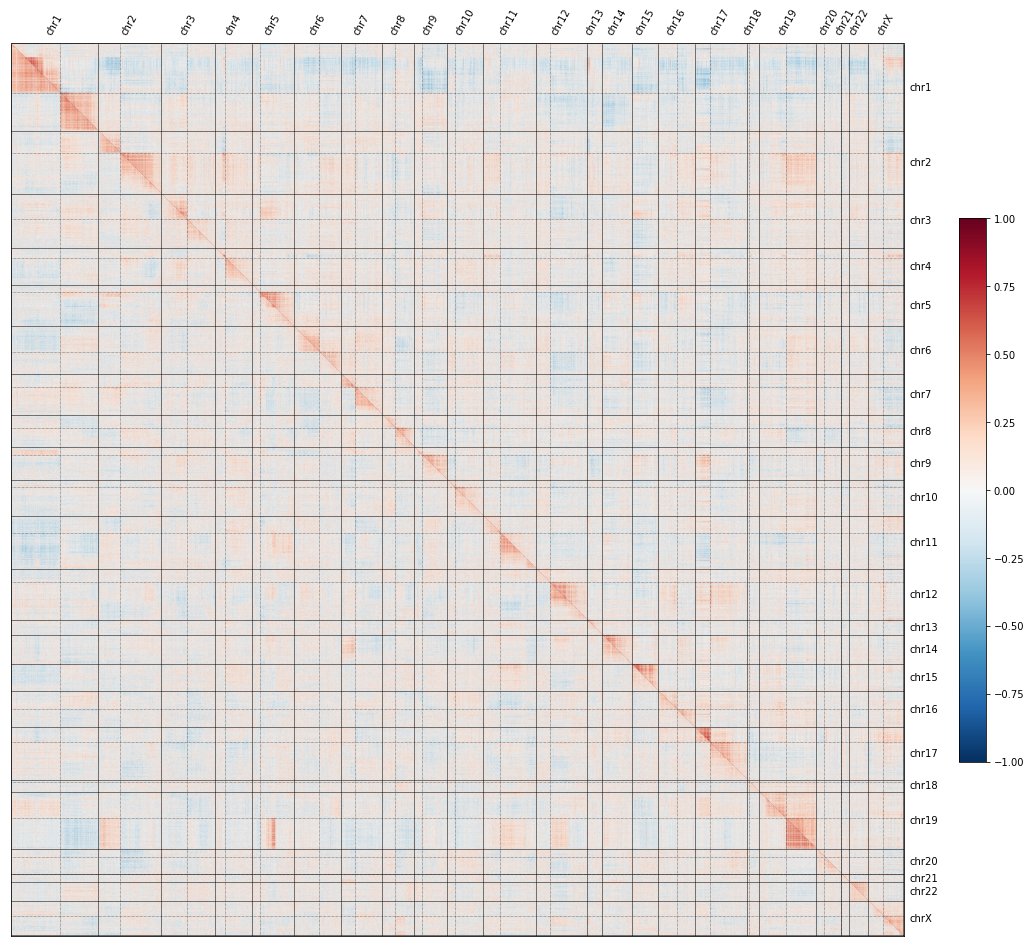
📣Published today in @NatureGenet: Through the power of the Recursion OS, we identified, at scale, evidence of a proximity bias in #CRISPR, traced its molecular cause, and proposed a debiasing algorithm.
Read it here! https://t.co/DDyJYFBfUf
#techbio#naturegenetics
Congratulations to Yoshua Bengio on being named one of @TIME 's most influential people. Yoshua has not only been an advisor to $RXRX, he’s a pioneer, a mentor and believes in the power of #AI to help industrialize #drugdiscovery.
#techbio#TIME100 https://t.co/Ic08hysZhg
Next stop: LONDON! 🇬🇧
We’re expanding our operations to Europe, at the epicenter of the rapidly growing #TechBio sector in #London.
Learn more at https://t.co/qhw07NKdUC and check out our new open positions at https://t.co/f7aGJTXkOe $RXRX #biotech#ai#ml
The future of drug discovery is here.
LOWE (LLM-Orchestration Workflow Engine) is a cutting-edge software designed to perform complex #drugdiscovery tasks using a natural language interface.
🎥 Discover what LOWE can do ⬇️
Learn more: https://t.co/jrM1OQPTvn
#JPM24#TechBio
At yesterday's standing-room-only #JPM24 talk by @nvidia, Kimberly Powell announced the release of our #phenomics foundation model, Phenom-Beta, on NVIDIA's #BioNeMo platform.
Learn more about the power of Phenom-Beta in our latest blog by @bmabey: https://t.co/IlJEVY0ITG
Excited to announce three exciting updates together with @NVIDIA, @Bayer and @TempusLabs, Inc to support precision medicine, translation and trial design in #oncology. See more in the thread ⬇️ or our press release: https://t.co/Nq8NAnFxvs
If you’re at #BostonDOT23, you have two chances to hear from our scientists about the power of our #AI drug discovery platform. Don’t miss these talks in the #genomics and AI-enabled discovery tracks. 🧬
Get the full agenda here: https://t.co/291s4EYf8C
With the unveiling of Valence Labs (@valence_ai), our new #ML research center, we are doubling down on our commitment to open science by dedicating this team to building the ML community through data, tool and infrastructure releases. And we are kicking things off by committing up to $1M to support academic research at the intersection of bio, chem and #AI.
Learn more: https://t.co/hD5diJOg9n
#BREAKING: We’re excited to announce we have entered into agreements to acquire @valence_ai and @Cyclica - two leading AI-enabled drug discovery companies - to bolster our chemistry and generative AI capabilities.
Learn more: https://t.co/shiHQX3Jmq
@purveshkhatri@ImranSHaque@RecursionPharma The JUMP CP and DepMap data are public. We've released images, embeddings and a compound exploration tool MolRec for the rxrx3 data, but most gene identities are masked at this time.
https://t.co/NoGhEP90iw
Tweetorial 3: how the “proximity bias” we found @RecursionPharma confounding #CRISPR screens affects widely used screening resources like the @CancerDepMap (spoiler: the image below!), and where it comes from.
Read along in the preprint: https://t.co/kkCNKqMeAa
@Unsubstantiated@ImranSHaque@RecursionPharma Generally the magnitude of the proximal effects is relatively smaller than intended biological effects, likely because it's driven by a sub-population of cells, but effect size can be hard to quantify in phenomics.
Thanks for the ref on yeast, really interesting!
@Unsubstantiated@ImranSHaque@RecursionPharma The rearrangement that we point out in U2OS is annotated in DepMap, we haven't done any confirmation experiments for that yet. But yea, this type of whole-genome k.o. data should be very interesting in more karotypically abnormal cell lines.
https://t.co/2DnP3ueliV
@M_L_Carpenter @ImranSHaque@RecursionPharma We've thought about it a little, but haven't done any work in that direction yet. Totally agree that that could be really interesting!
We haven't looked around for public Hi-C data in the cell types we analyze here (HUVEC and U2OS), do you know of any?
Tweetorial time! We @RecursionPharma mapped consequences of #CRISPR screening of >17K human genes, found a systematic bias confounding all CRISPR screens, traced its molecular cause, and propose a debiasing algorithm.
This week we released a #preprint detailing #genome-wide evidence of “proximity bias” in #CRISPR-Cas9 #gene editing.
For researchers leveraging public CRISPR-Cas9 knockout screens, we disclosed the correction method we have already deployed.
Learn more: https://t.co/aDB87bneNz
Excited to share an exciting preprint out from @RecursionPharma where we demonstrate the power of phenomics at genome-scale to show that CRISPR-Cas9 induces chromosome arm-scale truncations that we call “Proximity Bias” across the genome. Pre-Print: https://t.co/04cPwMhVZ5