The most painful irony is that the only ritual space finally available to her was neither her inherited tradition nor her husband’s, but a third religious framework that intervened on humanitarian grounds.
The way they manipulated India related information on @Wikipedia should be reason enough to suspend its use as an authentic resource. Educational institutions must question@Wikipedia on inappropriate information and definitely not use it for any educational purposes. @Wikipedia is becoming a dangerous defamation machine. They should be taken to court
For 25 years, India has had a rule requiring households to separate wet waste from dry waste. For 25 years, almost nobody has bothered. Kitchen scraps go into the same bag as plastic and paper, onto the same truck, dumped onto the same mountain at the edge of town.🧵👇
@Chopsyturvey@ShaanKuveskar Watch full video here Story of India's Pink Paradise | 🦩Flamingoes of Navi Mumbai
Short Documentary Film
by Shantanu Kuveskar
@ShaanKuveskar
https://t.co/wVpVrHkLwQ
Max Mueller and Mornier Williams fought a bitter election for Sanskrit Chair in Oxford. Do you know on what did they try to prove they are better than the other? That he is a better christian than the other and his claims for evangelizing India are better.
https://t.co/KKR1CnLpUa
People like Audrey Truschke are not rare in Western academia. What is rare, however, are Western scholars willing to view Hindu civilization sympathetically or discuss the Islamic period in India from a Hindu civilizational perspective without immediately being branded “majoritarian” or “Hindutva.”
And Hindus themselves bear part of the responsibility.
In the rush to oppose “Hindutva,” many Indian intellectual circles ended up exporting an aggressively anti-Hindu narrative to the West. Add to this the endless Hindu fault lines of caste, language, region, sect and Western academia found an ecosystem where attacking Hindu civilizational claims became intellectually fashionable and institutionally rewarding.
When a civilization’s own elite constantly delegitimizes its history, identity, and grievances, outsiders eventually begin treating that narrative as objective truth.
It is not that there is no counter views on various aspect of history in other societies like China for example, which can somehow demean their civilizational pride. History by its very nature can be speculative at times specifically distant past, but if a majority view that in a certain way and that form is not perceived as attack on one section of society then it is mostly accepted. Western scholars' long detailed thesis can't really harm the notion.
Chinese have done that and Indians exactly the opposite. We created theories out of thin air which exploited our faultlines and argument counter arguments internalised. Western academia with the active help of of Indian leftists exploited this massively. There is no western academia to see it from unitary Hindu POV.
What do you guys think?
Today is the anniversary of the Chuknagar massacre, which arguably, is the biggest case of mass murder on a single day in the subcontinent. Many times the size of Jallianwala Bag. Estimated casualties 10,000, including many women and children, all Hindus, at the hands of the Pakistani Army and Bengali Muslim Razakars.
So where is Chuknagar? And what happened there?
Chuknagar is a small town near Khulna, near the West Bengal border, in present-day Bangladesh. A huge number of frightened Hindus, including women and children, had gathered here trying to escape to India to escape the onslaught of the army. The army and Razakars landed there from the nearby Jessore cantonment and started shooting at random. Many died in the stampede. When the army ran out of bullets they resorted to bayonets. The water of the River Bhadra ran red with human blood.
Say a prayer for the human beings slaughtered like pigs for the crime of having been Hindus in an Islamic state.
India trains the engineer.
America files the patents.
Gurtej Sandhu was raised in Amritsar and trained at IIT Delhi.
He now holds 1,299 US patents at Micron, Edison topped out at 1,093.
Sandhu is the 7th most prolific inventor in American history.
His titanium nitride deposition work is why every DRAM cell in your phone and every GPU training a foundation model actually holds charge.
Micron, Samsung, and SK Hynix own 95% of global DRAM.
None of them are Indian.
We export the inventor.
We import the chip.
@NMMConline@NMMCCommr
The new connector from palm beach road to Sion Panvel highway going towards Panvel is for time saving. But for drivers coming from Sanpada, its a trap after making U-turn at the citibank traffic signal.
At least put a big sign saying U turn not allowed.
जिसे हम सदियों से आस्था की आँखों से देखते आए थे, अब विज्ञान ने उसकी पुष्टि कर दी है।
प्रयागराज के संगम को हमेशा से गंगा, यमुना और अदृश्य सरस्वती के मिलन का स्थान माना गया है। एक त्रिवेणी, जिसमें दो नदियाँ दिखती थीं, और तीसरी सिर्फ़ श��रद्धा में बहती थी।
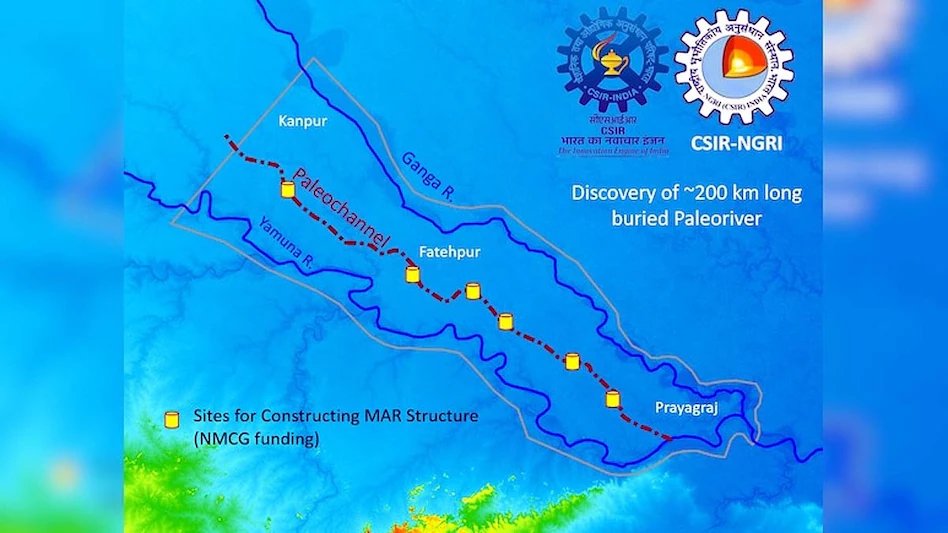
अब हैदराबाद के CSIR-नेशनल जियोफ़िज़िकल रिसर्च इंस्टिट्यूट (NGRI) के ��ैज्ञानिकों ने इस पौराणिक मान्यता को एक ठोस वैज्ञानिक आधार दे दिया है। हेलीकॉप्टर से किए गए एयरबोर्न सर्वे और ज़मीन पर की गई कन्फ़र्मेटरी ड्रिलिंग के बाद, डॉ. सुभाष चंद्र की टीम ने पुष्टि की है कि गंगा और यमुना के बीच, ज़मीन से 10 से 15 मीटर नीचे, एक विशाल प्राचीन नदी दबी हुई है। इसकी चौड़ाई, गहराई और आधार स्तर, तीनों गंगा और यमुना के बराबर हैं।
यानी यह कोई छोटी सहायक धारा नहीं थी। यह स्वयं एक मुख्�� नदी थी।
विज्ञान इसे "पेलियो रिवर" कहता है। आस्था इसे सरस्वती कहती है। दोनों एक ही सच की ओर इशारा कर रहे हैं।
प्रयागराज अब सिर्फ़ आस्था का संगम नहीं रहा, यह विज्ञान और परंपरा का भी संगम बन गया है। जहाँ हज़ारों वर्षों की स्मृति, और आज की तकनीक, एक ही कहानी कहती हैं।
माँ सरस्वती कभी सूखी नहीं थीं। बस छिप गई थीं। और आज, फिर से सामने आ रही हैं।
@cleanganganmcg
Bundles of white sarees were found inside a TMC office. This is not just about sarees.
In 2024, in Sandeshkhali, a white saree and flowers were sent to a BJP worker’s home with the message, “You say Hari, I will say Hari Bol,” a slogan chanted during funeral processions.
In February 2026, in Birbhum, a white saree, flowers, and agarbatti were sent to a BJP worker’s home with the same message.
White sarees are worn by widows. By sending white sarees, TMC gives the message that they will kill your husband and make you a widow.
TMC is more criminal than you can imagine.
An alternative perspective on low salaries of workers in NCR:
When consumers walks into the market, price is often the only deciding factor. Many are willing to accept a “kaccha bill” if it saves money. They don’t mind buying from unethical companies. They don't care if the product is imported products from China, Taiwan, or Bangladesh if it’s cheaper.
This mindset flows through the entire value chain. When distributors approach shopkeepers, the response is similar. Quality, intellectual property, and ethics take a back seat. Cost and service are what matter most.
In such an ecosystem, ethical companies that pay taxes, invest in R&D, build IP, and focus on engineering struggle to compete. They are up against players who bypass regulations, cut corners, influence decisions through informal means, and rely heavily on low-cost imports. On top of that, large OEMs often push these companies to operate on extremely thin margins.
The challenge doesn’t end there. Productivity is further impacted by absenteeism and lack of professionalism in the blue-collar workforce. During elections, harvest seasons, festivals, and family functions, workforce availability can drop to nearly 50%, leaving companies with little control and mounting losses.
The reality is far more complex than the narrative often portrayed in films featuring icons like Amitabh Bachchan or Dilip Kumar, where business owners are depicted as exploitative Seths and workers as helpless victims.
In truth, many companies are simply trying to survive in a system where low-ethics, low-IP, trading-driven businesses have a structural advantage. In such conditions, limiting salaries is often not a choice, but a compulsion.
Here’s the part that should worry long term investors.
India’s top 10 most valuable companies have negligible R&D. These conglomerates buy or rent technology. They don’t build it.
That works for scaling commodity businesses. It breaks down completely in semiconductors, aerospace, defence, and AI chips.
A deep tech founder acquired by Reliance told The Ken: “That approach won’t work in technologies like semiconductor, aerospace, or defence.”
A final-year law student, Rishi Kumar from Tamil Nadu National Law University, refuses to delete his blog criticising the Supreme Court… despite pressure from his own university.
Why?
Because the administration allegedly received calls from advocates, judges, and others claiming the post harms the institution’s “reputation.”
The blog titled “The Supreme Court of India Has No Spine” questioned the court’s decision to ban an NCERT textbook chapter on judicial corruption.
But here’s the real issue:
A law student is being told to silence himself… for expressing a legal opinion.
His response?
Clear and powerful:
“My opinions are mine… you do not own my voice or my conscience.”
He even said he’s ready to face disciplinary action rather than back down.
This isn’t just about one blog.
This is about academic freedom vs institutional pressure.
If law students… the future of the judiciary are discouraged from questioning the system,
then who exactly is allowed to question it?
Criticism of institutions ≠ disrespect.
Silencing criticism = weakening democracy.
The internet runs on a coincidence of atomic physics. Erbium emits light at exactly 1,550 nanometers. Silica glass fiber loses the least signal at exactly 1,550 nanometers. One is a quantum property of a rare earth element, the other is an optical property of melted sand. They have nothing to do with each other. It is pure luck. Before erbium-doped fiber amplifiers, every undersea signal had to be converted from light to electricity and back every 50 kilometers. Each conversion degraded the signal and capped bandwidth. Erbium removed that cap. An erbium amplifier sitting on the floor of the ocean boosts signals 1,000 times and runs for decades without maintenance. 99% of intercontinental data moves through glass strands no thicker than a human hair, amplified by a rare earth element that just so happens to emit at the right wavelength. And erbium isn't even the strangest one.
India pays a premium for the privilege of not learning anything :)
Every Indian car Tata, Mahindra, Maruti, all of them has a tiny computer inside called an ECU (Engine Control Unit)
This computer decides everything - how much fuel to inject, when to shift gears, how brakes work, how the battery behaves in an EV. Think of it as the car's brain.
India makes zero of these brains for passenger cars. All of them come from foreign companies, mainly Bosch (Germany).
If you don't control the brain, you don't really control the car. Indian OEMs can't even add a simple valve to their own engine without asking Bosch for permission.
They can't change a single line of code. They are selling cars with someone else engineering inside.
This isn't really about technology being too hard. It's a business model designed to keep you dependent.
Three layers lock you in :)
First, every new car programme needs Bosch to do setup work (Rs 10-30 crore). Second, you pay full price for software Bosch already developed for Volkswagen so Bosch gets paid twice for the same work.
Third and this is the killer every time you want to change anything in the software, even something tiny, it costs around $500,000. So Indian OEMs simply stop trying to innovate. They accept whatever Bosch gives them.
The calibration trap means tuning the car's brain for Indian conditions, how should the engine behave in Ladakh cold vs Chennai heat?
Indian OEMs outsource even this to AVL in Austria. AVL reuses work they already did for European cars, charges India full price, and transfers zero knowledge. So Indian engineers never even learn how their own cars work from the inside.
What Korea did is Hyundai faced the exact same situation in 1987. They set up Kefico as a joint venture with Bosch, learned everything from the inside, and by 2015 they owned the full technology themselves.
The sequence was simple - first learn calibration (tuning) → then write your own software → then build your own hardware. It's a ladder. India never climbed the first rung.
Why India didn't do this - It's not a talent problem Indian engineers design ECUs at Bosch offices worldwide.
It's a combination of things like Indian OEMs won't fund Indian startups to develop alternatives. They demand that Indian suppliers first prove themselves in Europe before getting a chance at home (while European companies protect their own).
Middle managers won't risk their careers backing a Pune startup when they can safely pick Bosch. India spends 0.64% of GDP on R&D vs Korea's 4.9%. Private sector funds only 36% of India's R&D, in Korea it's 79%.
SEDEMAC - the one exception - One Indian company (IIT Bombay founders, Pune-based) actually makes ECUs for two-wheelers and generators. They have real IP, real patents, millions of units shipped.
But even they couldn't break into passenger cars. Tata Motors is literally in the same city and doesn't use them.
EVs are simpler to control than petrol/diesel engines. This should have been India's fresh start. Instead, Mahindra's new EV platform has Bosch (Germany), Valeo (France), BYD (China), Mobileye (Israel), Continental (Germany) - zero Indian ECUs.
The dependency just migrated from ICE to EV with different foreign names.
https://t.co/WWAQF0P5uR
there was a major air crash in NYC but there’s barely any discussion/outrage on it...
a fire truck crossing a jet landing at full speed at one of the busiest airports in the world is an unbelievable lapse and it’s not even trending here.
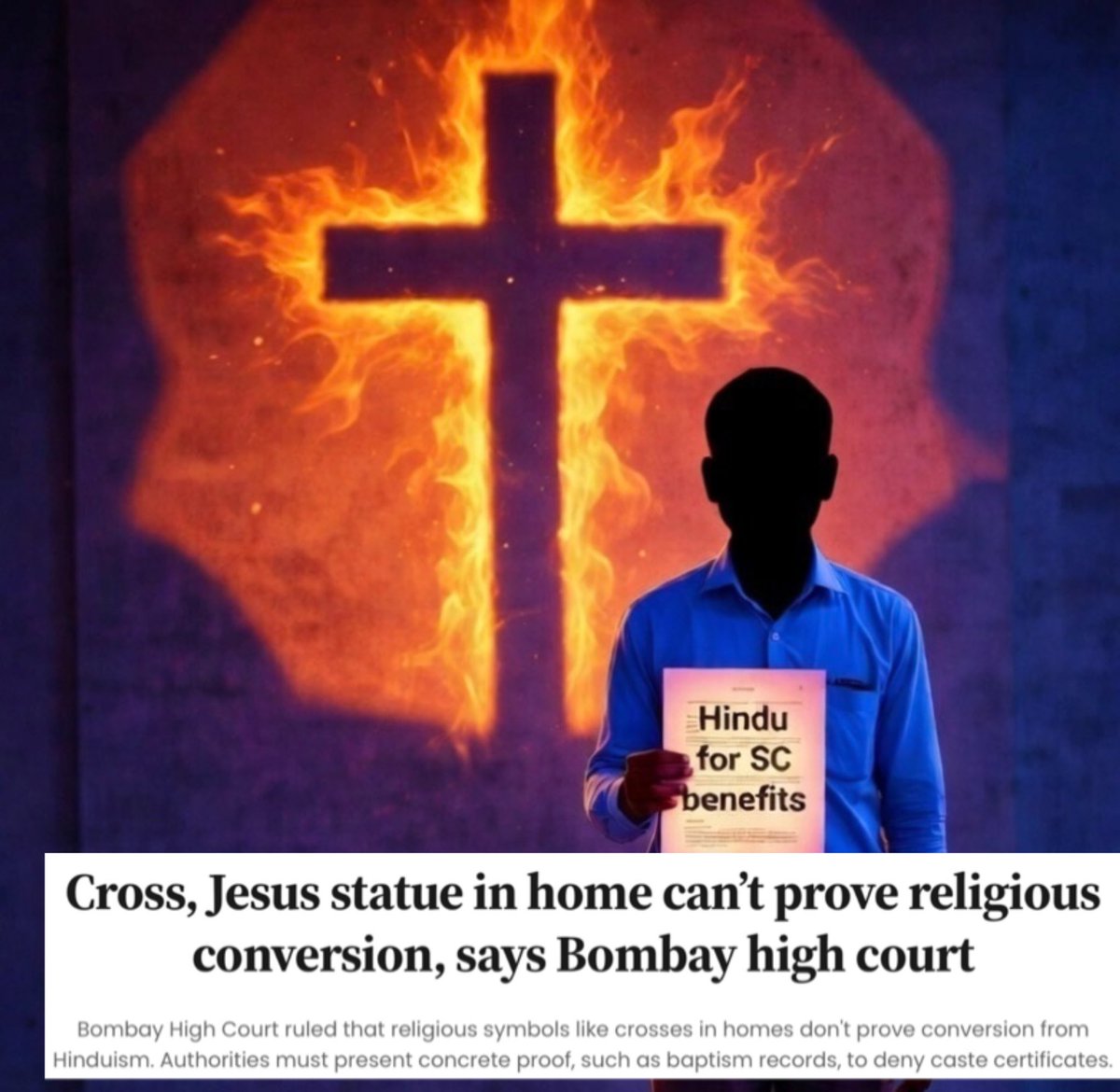
Highly troubling order by Nagpur Bench of Bombay High Court
We @sewanyaya are preparing to challenge it
Akola District Caste Scrutiny Committee found that a family had converted to Christianity two generations ago. Committee therefore denied the family Scheduled Caste quota as under the Constitution, SC quota benefits apply only to practicing Hindus, Buddhists and Sikhs
But High Court has rejected the committee’s findings
Court held that unless conversion is documented through baptism certificate or formal paperwork, it cannot be treated as conversion
Even the presence of Cross, pictures of Jesus, and clear evidence of Christian religious practice was dismissed as irrelevant!
It’s common knowledge that for decades, evangelists have deliberately converted SC families without paperwork so that converts continue to enjoy quota benefits. This tactic makes conversion easier and brings quota benefits into the evangelists’ community
Several High Courts and Supreme Court have earlier upheld district caste scrutiny committee findings and cancelled SC benefits in similar cases
We @sewanyaya, along with activist Bhupendra Jatav, have been actively fighting this fraud and have already got cancellation of SC quota benefits in multiple such cases under our Project Samvidhan
We are preparing to challenge this. If not challenged, it will open the door to large-scale conversions and systematic quota fraud
Project Samvidhan: https://t.co/pjJ4JgX3KI
IIT Bombay will make a windfall ₹55 crore gain from SEDEMAC’s IPO this week
SEDEMAC was incubated in 2008 by SINE in IIT Bombay - the University will be be selling ~₹27.6 crore worth of shares during the IPO
This is the largest exit at IPO for any university incubator in India (even more than IIT Madras with Ather Energy)
It is also IIT Bombay’s 2nd incubation to IPO - the first was ideaForge in June 2023 where the university sold ~₹1.5 crore in the IPO (with a total position size of ~₹6.7 crore)
Most importantly, SEDEMAC is the 1st faculty-led startup from India to get listed on the bourses!
Here are the details you need to know ⤵️