prototyping with @langchain and @OpenAI API last week clarified for me that we're entering a new reality where:
1. The prompt is the program
2. Each invocation of a LLM compiles and runs a program
3. Chaining multiple prompts enables crazy sophisticated behaviors
Today, @TheSoundPatrol 's latest patent was issued by the United States Patent and Trademark Office about systems for cover voice music synthesis. We believe this is the foundational layer for the licensed AI music economy that the major labels, the platforms, and the model companies are now building toward. @Spotify@UMG@sonymusic@warnermusic@BMG
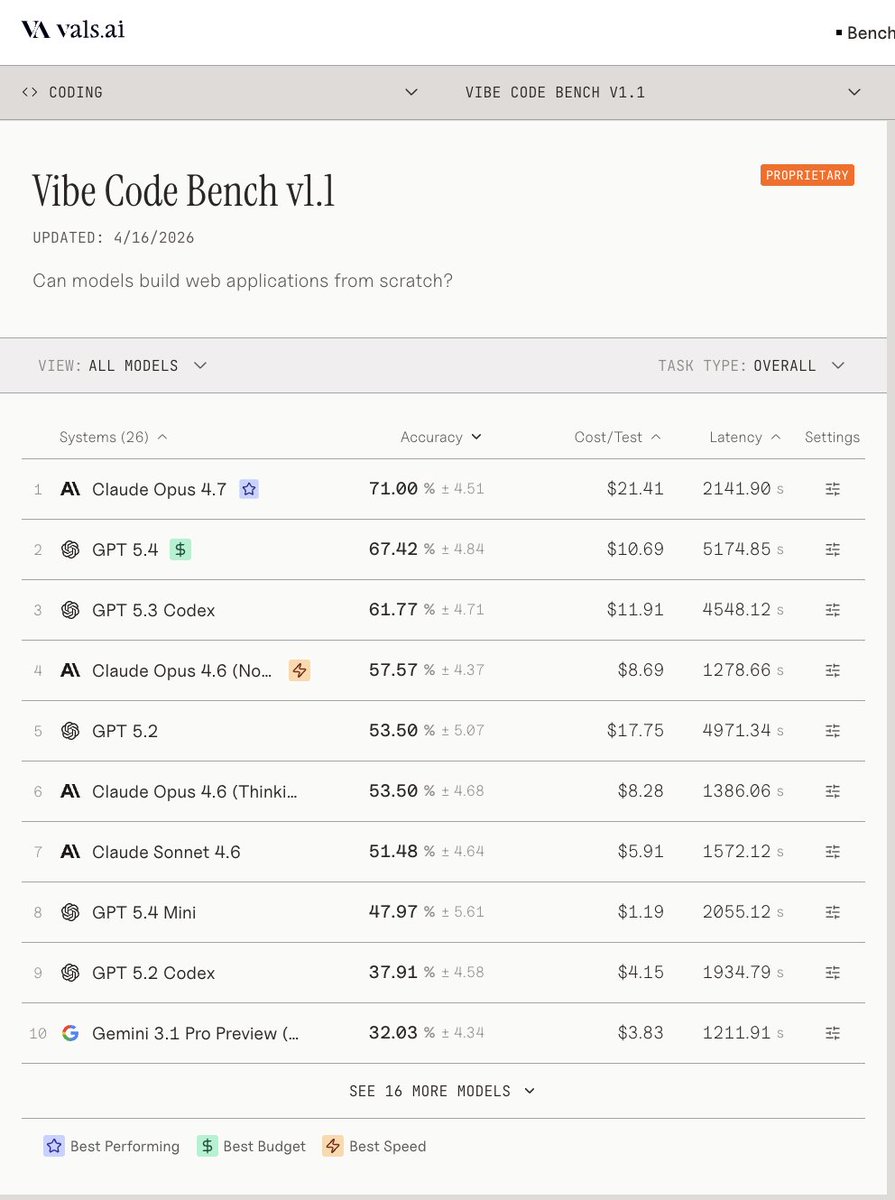
The new Opus 4.7 model places #1 on our Vibe Code Benchmark, at 71%.
When we first released the benchmark 4.5 months ago, no model scored above 25%.
This benchmark tests a model’s ability to create a fully functional web application from the ground up.
The capability overhang right now in AI is pretty massive. Most of the world still thinks of AI as chatbots that will answer a question on demand but not yet do real work for them.
Beyond coding, almost no knowledge work has had any real agentic automation applied to it yet. The past quarter of model updates is going to open up an all new AI agent use-cases across nearly every industry.
The winners will be those that can figure out how to wrap the models in the right agent scaffolding, provide the agent the right data to work with context engineering, and deliver the change management that actually drives the change in workflow for the customer.
This is what 2026 will be about.
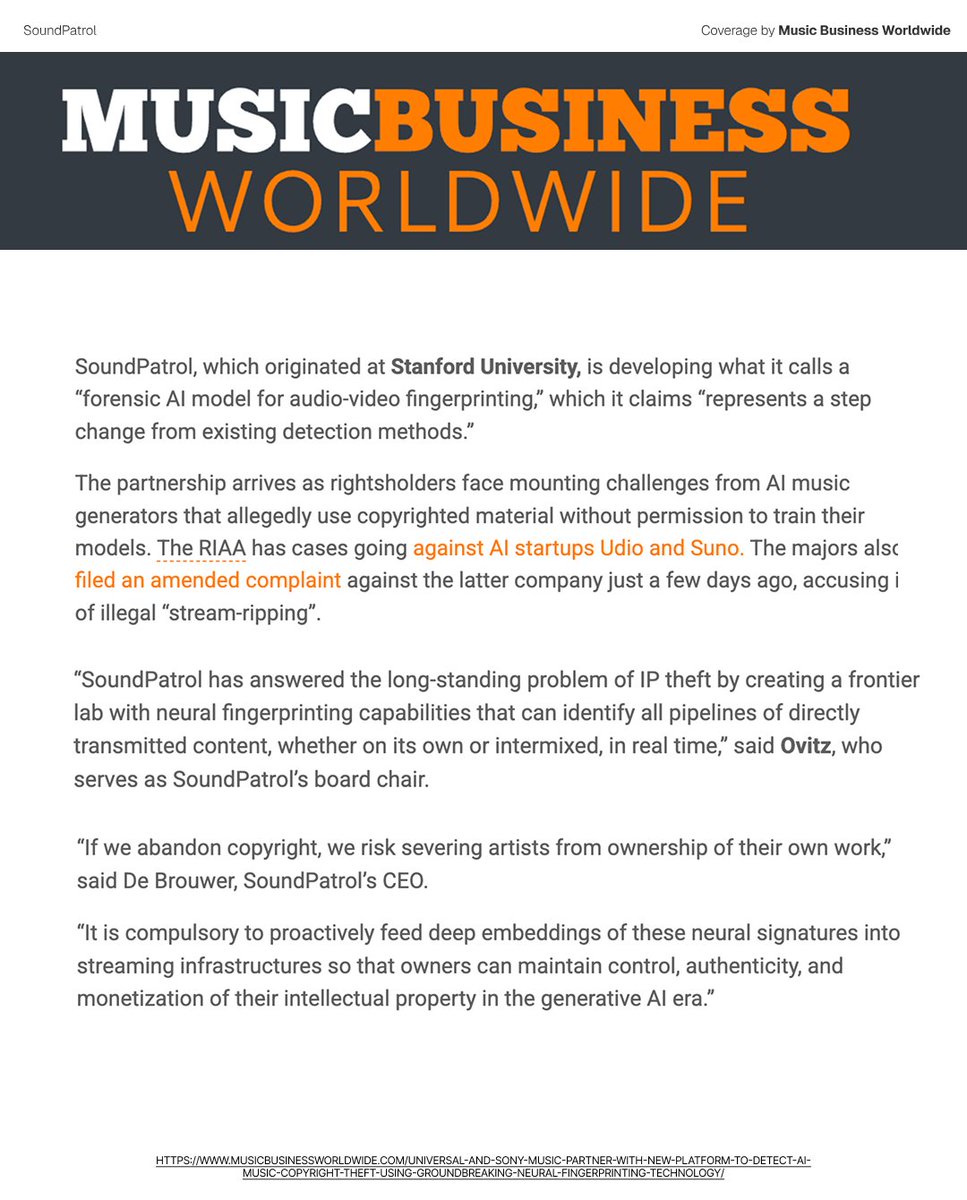
🎉 Honored to see our work featured in Music Business Worldwide (@musicbizworld)
@TheSoundPatrol collaboration with @UMG and @sonymusic is now live — helping detect AI-generated music copyright infringement using our groundbreaking neural fingerprinting technology
🔐 This is a powerful step toward protecting creative ownership at scale — for all artists, in all genres, across all platforms.
#SoundPatrol #NeuralFingerprinting #MusicRights #GenerativeAI #UMG #SonyMusic #CopyrightProtection #AIinMusic
@OpenAIDevs My team is hitting a bug with 2FA which is preventing us from using codex through chatGPT Pro. Seems like others are also experiencing this:
https://t.co/3JCWKwxHwm
🚀 From Our https://t.co/TnTANYHQVQ Labs Team to Yours! We’re open-sourcing a flutter plugin that runs #DeepSeek-R1 (1.5B) entirely on-device using 4-bit quantization - enabling low-latency, offline inference for sensitive domains. 📷https://t.co/4pXXIEhiFY #AI#OpenSource
@saranormous@mvernal Amira Learning has been building this since 2018 (I know b/c I was an early employee). Already serving 4 million students in school districts around the globe + all 50 states, funded by Google and Amazon, and improves student learning outcomes by .5 std
@DrJimFan What gives you confidence that there won't be catastrophic downsides to powerful open source AI?
Concretely, the two risks that seem most concerning are possible AI-enabled cyber attacks or bio weapons.
@annapanart But ASI would allow the humans who control it to change the world however they please.
Don't we need to be super careful about controlling access? Otherwise, a lone actor could do a lot of harm
Nick Bostrom's vulnerable world hypothesis comes to mind.
https://t.co/DEyvVSkgQA
@Suhail But you have to have some sort of framework for thinking about an "end state" of what this technology will evolve into. IMO, worth paying attention to the voices that were thinking seriously about powerful AI before it was mainstream, e.g. Nick Bostrom, Demis, ect
@Suhail this is only true if you expect AI progress to slow down.
If things continue on the current trajectory, just like Lee Sedol had to reckon with AI outcompeting him at Go, you'll have to reckon with a commoditized AI outcompeting your clever UX / distribution / brand advantages.
@OpenAI To put Stargate's scale in perspective; Google's 2024 free cash flow was roughly ~70B, with total cap ex at ~50B.
Directly competing with Stargate's 125B annual infra bill would eat up all of Google's profits.
@OpenAI Over the long arch of history, software has been an increasingly winner-take-all business. And ML increasingly multi-task / end-to-end.
ChatGPT as a capable personal assistant feels like another step in those directions. Honestly appeals to me more than existing workout apps.
@NWischoff That seems likely to me.
It also seems to me like we're on a trajectory to achieve founder-level AI, and that the economic value add of humans will race to zero (aside from tasks where we prefer a human for sentimental reasons).
not sure how to reconcile those two viewpoints.