Are you procrastinating right now?
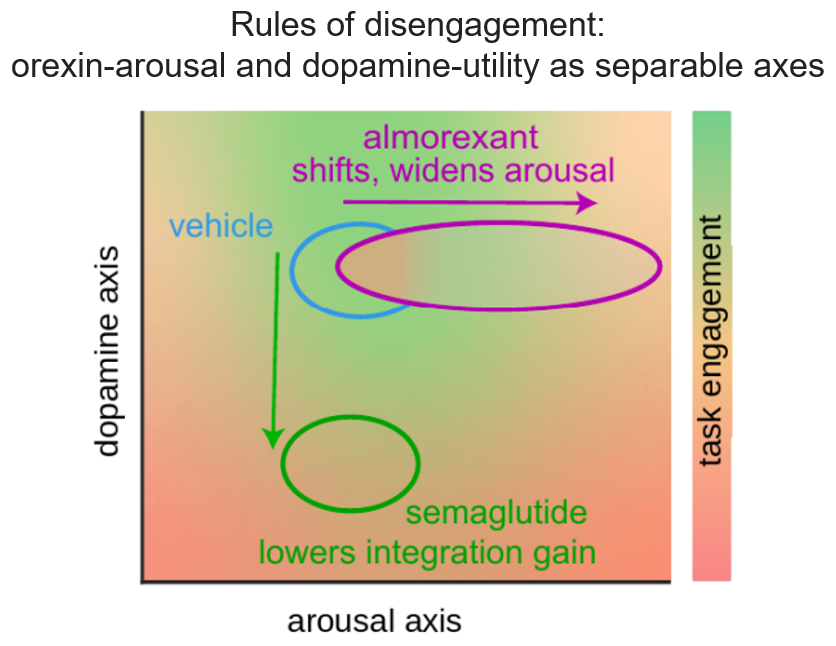
We found two separable brain axes for staying on task, arousal and dopamine. Two widely used drug classes, GLP-1 agonists (semaglutide) and orexin antagonists (for insomnia), each moved engagement along a different one.
https://t.co/BUbR2RDyWX
Many of my recent conversations with other neuroscientists revealed a common concern: the alarming proportion of essentially worthless systems neuroscience papers appearing in the top journals.
Not exactly fraudulent (real fraud is actually not that common), but a familiar combination of weak data, arbitrary interpretations, and elaborate statistical or computational analyses that create an illusion of rigor. Basically highly polished garbage, with a fashionable topic and a narrative designed to appeal to editors.
Of course, none of this is new, but it's getting worse and I don't think outsiders can even get an accurate picture of the latest systems neuroscience any more. As one colleague recently put it, if the public knew just how shaky much of the evidence really is, confidence in the entire field might collapse, and we might all go down if the public loses trust in the whole enterprise, especially now that AI seems to be improving so quickly.
The deeper problem is systemic: our mechanisms for evaluating, rewarding, and propagating scientific results are broken. Scientists who produce reliable work are often marginalized. Their progress is considered too slow, and because of their perceived lack of productivity, often they can't even secure enough funding to keep their labs running. Some can't even get a job. I have seen many examples of this over the years. People with integrity are essentially punished for being meticulous. Meanwhile, the most relentless storytellers and opportunistic careerists accumulate funding, prestige, and influence, as they expand their academic families and place their people throughout the field. Criticizing a member in one of these "Corleone families" carries enormous professional costs.
The result is not just a lot of bad papers. Entire research areas become saturated with unreliable findings and unsupported interpretations, reinforced by citation networks, press coverage, and awards. The longer this continues, the harder it will be to separate fact from fiction, and the greater the eventual damage to neuroscience itself.
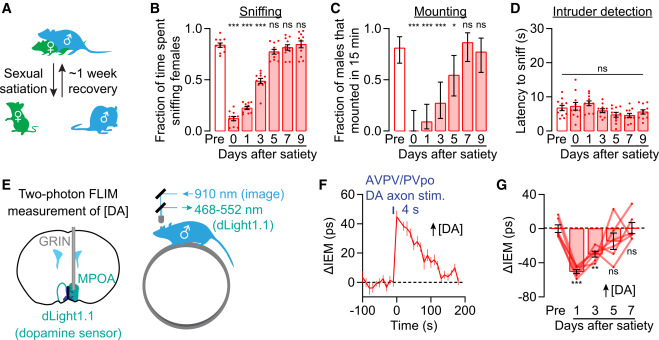
Fascinating paper. In mice, mating motivation disappears after successful copulation and it takes 7 days to return to normal.
The cause of this drop in motivation is a big drop (50%) in dopamine release from the hypothalamus. Firing rate drops first, suppressing motivation for 1-2 days then the neurons' capacity to synthesize (TH: -70%) and release dopamine falls, continuing suppression until day 7.
This link between low dopamine release/function with low motivation for natural reward is exactly what you would see during alcohol/drug withdrawal but in a different region, the striatum. Now the big difference is that here the dopamine dysfunction returns to normal after a week, but it may continue for months after drug withdrawal.
Obviously there is a HUGE natural selection pressure on getting that hypothalamic dopamine circuit back to normal in a few days that you wouldn't have with drug withdrawal. I wonder if we could actually hijack the molecular mechanisms that restores it and apply it to the mesolimbic dopamine circuits.
https://t.co/5wqEcNMVZv
Having to pay for psychtoolbox is an end of an era... Appreciate all the people who built and maintained it for years but the new paid model ain't exactly cheap either.
@PessoaBrain@lydiahallie It is frustratingly random at when it triggers the model downgrade. Seeing "[bio]" makes my blood boil - we applied for their LSVP programme which is supposed to stop this, but no reply from them yet
New preprint from the lab!
Dissociable norepinephrine and dopamine representations during strategic decision-making and reward learning:
https://t.co/Uyt2pXzwss
When reward learning and strategy updating can be disentangled, we found drastically different NE and DA dynamics!
So, if you are procrastinating, go read my preprint, I guarantee high utility for you in doing so!
Thanks to: Victoria Ploerer, Mattia Hamann, @AlexanderTesmer , Eva Bracey, Daria Peleg-Raibstein and @DeBurdakov.
Very happy to hear comments!
Are you procrastinating right now?
We found two separable brain axes for staying on task, arousal and dopamine. Two widely used drug classes, GLP-1 agonists (semaglutide) and orexin antagonists (for insomnia), each moved engagement along a different one.
https://t.co/BUbR2RDyWX
This demonstrates two separate routes along which engagement can be modulated independently of each other: pupil-linked arousal, which orexin antagonism takes, and the gain of accumbal dopamine reward integration, which semaglutide takes.
Hence, the rules of disengagement!