At least once a year I wish my mentor Dr. Gordon Shepherd were still alive and I could ask him about some obscure neuroanatomy question from the 80s or 90s.
Transitioning to being a PI in the age of AI
Computational biology is in a period of upheaval that is both exhilarating and terrifying. Rapidly, we are approaching a moment of “analytic abundance”, where basically idea you can think of (and several you didn’t) magically appear within minutes of you thinking of them. Of course, the central proximal challenge is the evaluation of the sheer volume results—how do we know they are right when we don’t have the time to check over every line of code?
I think it’s very telling that when I talk to AI-pilled faculty, they are exhilerated, but many trainees seem more cautious and far more ambivalent. I think that’s because faculty often have been removed from the details for a long time and probably haven’t checked over a line of code in years. They are used to managing (rather than doing) analysis. Over time, they usually develop a sense for whether things seem right or wrong. In this day and age, this is the skill that you, too, must develop.
How do faculty do it? I am guessing every faculty member has their own list of internal sanity checks, but here are a few of mine:
* Checksums. I look for things that should add up correctly (percentages add to 100, etc.). If it looks even a little bit off, I ask questions.
* Never let go. If something doesn’t make sense, I don’t let go until it does make sense. Never relent!
* Explain stray datapoints. Always dig into outliers in the data. How did they come to be? Often, they reveal some hidden assumption or something unexpected about the data.
* Do not tolerate warnings. If code gives you a warning, resolve it. Do not continue, do not pass go, until you either understand or eliminate the warning.
* Track the number of datapoints. Even a single missing row can be a sign of some fencepost bug.
And I’m sure many more that I’m forgetting right now. Basically, it’s a transition from a maker to an interrogator.
I also feel it worth reiterating that this is a highly unsetting period of time. I have been fortunate (?) to have 16 years of time to make a transition that people are now being asked to make in months. Again, exhilarating and terrifying, all at once!
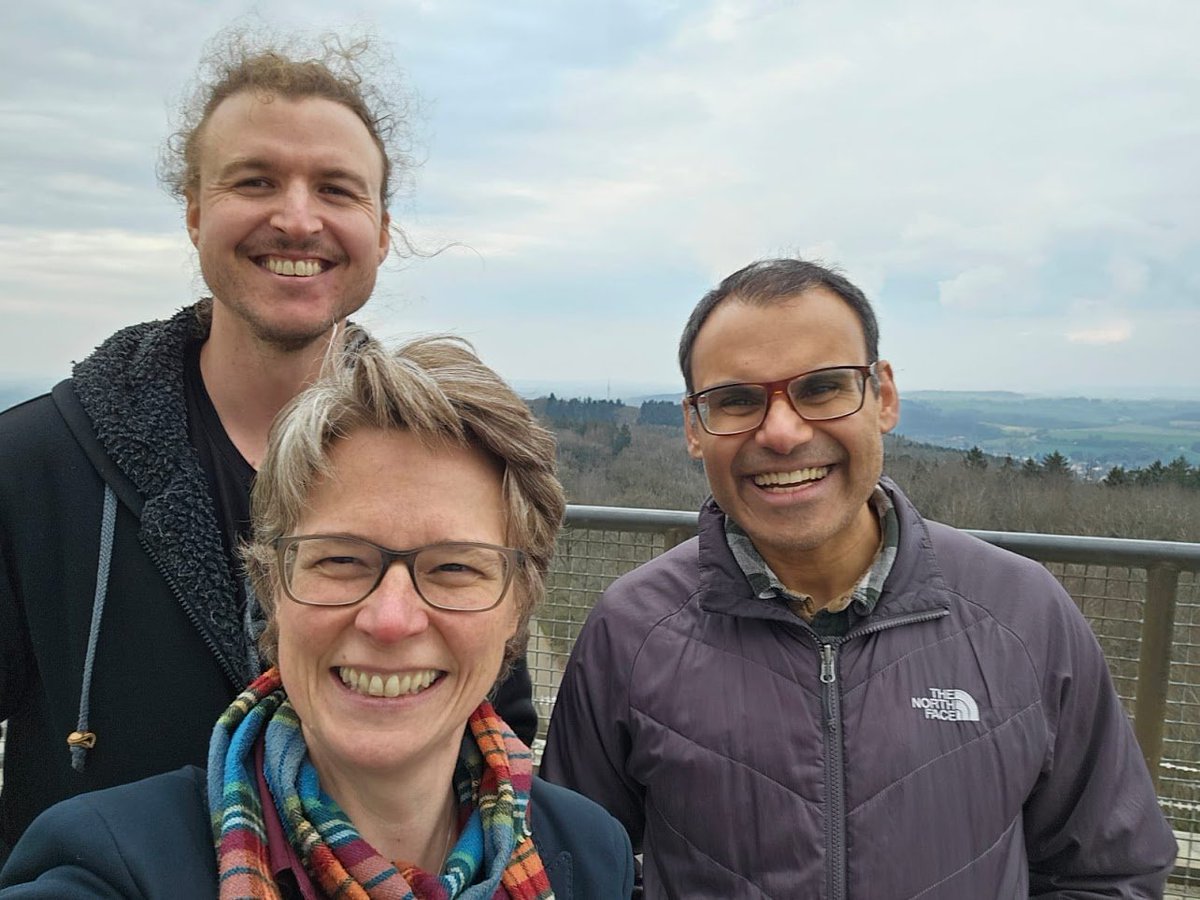
and huge thanks to all of the amazing collaborators on this, especially @LampertLabRWTH and Jannis Korner. They taught me everything I ever wanted to know about the peripheral sensory system, neuropathic pain, and more. Here's a photo of near Flanders Field, near Aachen, Germany
I'm so proud of our paper on the molecular signature of DRG sleeping nociceptors from mine and @LampertLabRWTH's groups, out today in Cell! https://t.co/wzcZoX2QiJ.
hope you read this paper and enjoy it half as much as I did while we were working on it. A couple special shoutouts: mine and co-first author Jannis's daughters were both born over the course of this work. Their impending births definitely catalyzed this.
I learned so much about splicing and long-read RNAseq while working on this. One of my many take homes is that I think 2026 is finally the year for long-read RNA sequencing at scale.
I'm super excited to share this recent preprint from my group, using ultra-deep @PacBio Kinnex long-read RNAseq to explore alternative splicing as human neurons develop. https://t.co/j9zbbBQrQx
this is the effort of many experimental and computational labs at @UofT, including the Lipshitz, Smibert, Lee, Calarco, Muffat, and Trost labs, and was led by the infinitely talented Nuo Xu and Katherine Rynard. And HUGE thanks to @SimonsFdn for funding this work.
What if we could record single-cell RNA levels and videos in the same cells? Our new VISTA-FISH assay links gene expression with neuron firing, lysosome movement, and neuron morphology. VISTA-FISH also detects sgRNAs, enabling live-cell CRISPR screens 🧵
https://t.co/KGuhHdGtGC
I'm really excited to announce that I've been awarded a super prestigious grant from @BrainCanada speaking to my promise as an emerging leader in neuroscience. I'm so grateful to my amazing lab, collaborators, and family. Canada is a great place to be a scientist.
Congrats to CAMH’s Dr. Peter Zhukovsky & Dr. Shreejoy Tripathy, recipients of @BrainCanada Future Leaders in Canadian Brain Research grant!
They join 22 researchers nationwide advancing bold ideas in brain health.
Learn more & see the full list here:https://t.co/jrSsuFloYe