Researchers have tracked the electrical crackle of individual brain cells in real time during unscripted conversations, capturing how sentences are built before a single word is spoken
https://t.co/3I6uyXIXSD
Tertiary lymphoid structures (TLSs) form local immune hubs inside tumors, but they are diverse and not all are equally functional.
In a new Science study, researchers built a pan-cancer atlas and developed an #AI–based framework to detect and characterize TLSs in human tumors.
The study provides insights into TLS biology and may offer a path toward integrating TLS features into future clinical trials. https://t.co/W6OOGFR34E
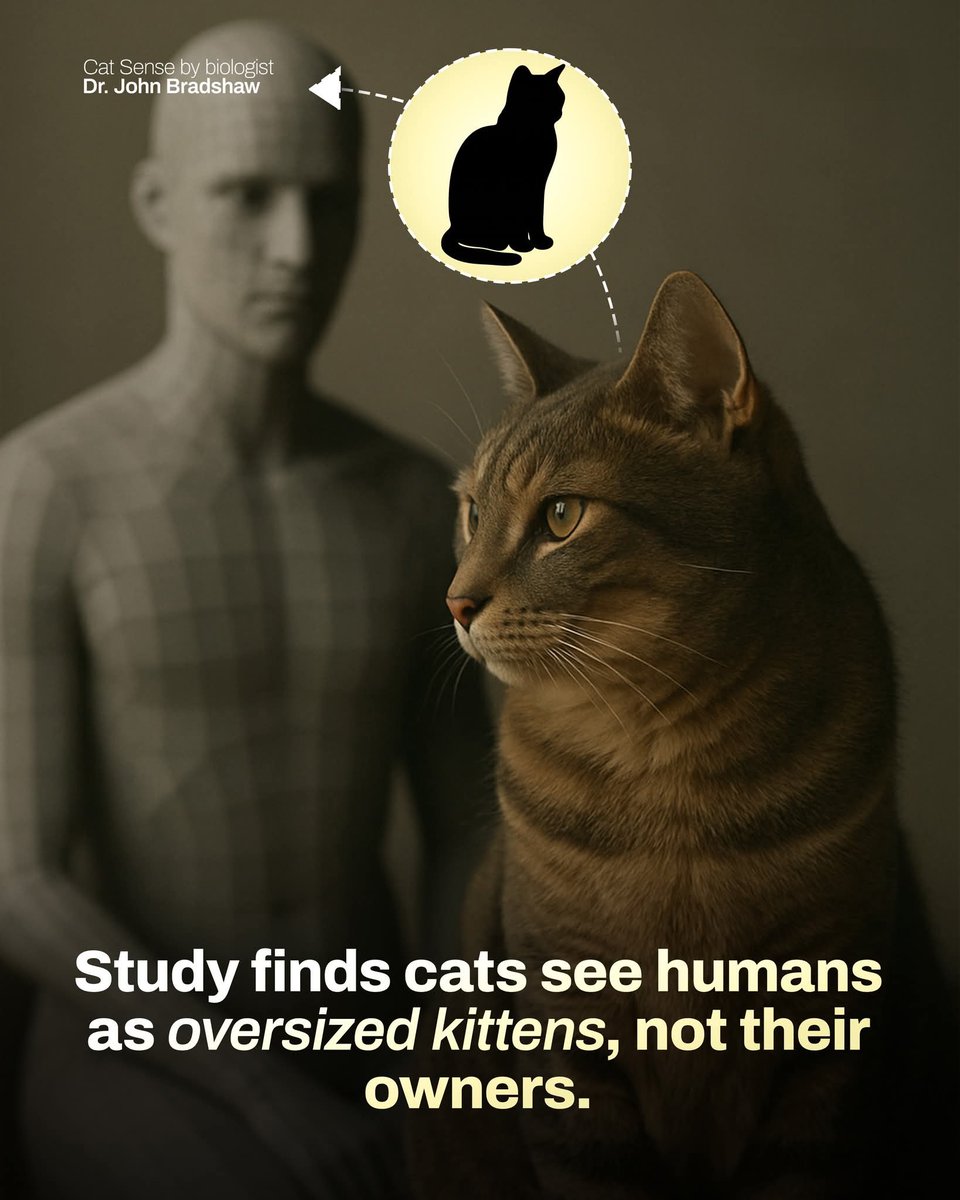
This study suggests that cats don’t view humans as authority figures, but rather as oversized, slightly clumsy kittens. From a cat’s perspective, behaviors like grooming us, kneading, or bringing “gifts” mirror how they interact with fellow cats. Biologist John Bradshaw explains that cats never fully adapted their social hierarchy to include humans the way dogs did. Instead, they apply feline social rules to us, assuming we’re part of their world rather than in charge of it. In short, your cat isn’t disobedient—it simply thinks you’re a big, hairless cat that needs supervision.
New blog post about a fun project: I decorated my office by putting a poster of an EM picture of the hippocampal coronal column onto my walls: https://t.co/gFZDrCLu8n
EM picture credit: https://t.co/fQdHyakAqt from the lab of @helenelab2020
The CRISPR family’s most versatile member has made its medical debut: a cutting-edge gene-editing technique known as prime editing has been used to treat a person for the first time
https://t.co/HBmQBDE6zK
Do we need to rethink near-death experiences? What’s really happening in the brain? NDEs might be a hardwired coping strategy: the dissociation, calmness, and detachment when facing death may actually be an evolutionarily protective response. For decades, people have asked me: "Is there something happening in the brain when people have a near-death experience?" How does the brain, at the edge of life, produce the powerful, often mystical experiences so many people describe. New insights on the topic have just been published in Nature Reviews Neurology by Martial and colleagues.
Key Points:
- This study by Martial and colleagues offers a compelling neuroscientific model of near-death experiences (NDEs).
- The authors try to move us from spiritual speculation toward biological plausibility.
- If we rethink these experiences, we might also learn something crucial about human consciousness itself.
- NDEs seem to involve a cascade of neurophysiological and psychological processes.
- These events can be triggered by physiological crises like a cardiac arrest (heart attack).
- These experiences seem to be linked to massive releases of neurotransmitters (serotonin, dopamine, noradrenaline, GABA, endorphins).
- The default mode network, temporoparietal junction, and brainstem arousal systems may all play key roles.
- Serotonin (5-HT1A, 5-HT2A) and glutamate are particularly implicated in the peaceful feelings and vivid hallucinations.
- The authors review the newly proposed NEPTUNE model that actually frames NDEs as "evolutionarily conserved responses."
- These episodes may not just be 'brain failures.' Should we be thinking of them as potential survival mechanisms.
My take: Why does this matter? This paper bridges what we once pictured as the mystical with the medical. It helps us understand that NDEs are not a supernatural anomaly, but rather a biological response to an extreme crisis. These NDEs may have evolved to help the brain cope, survive, and even encode memory in the final seconds of life.
My 5 Key Takeaways:
1- NDEs may reflect a brain in survival mode. In other words, these experiences likely originate from complex brain activity, not from flatlining or from brain inactivity.
2- REM intrusion, not just hypoxia, plays a role. The features of REM sleep (like atonia and vivid dreams) can possibly intrude into waking consciousness, helping explain out-of-body sensations.
3- Neurotransmitter surges may create mystical content. The massive releases of serotonin and dopamine can produce hyper-reality, hallucinations, and euphoria. These effects are similar to what is observed when using psychedelics.
4- NDEs might be a hardwired coping strategy. Think about it: the dissociation, calmness, and detachment when facing death may be evolutionarily protective responses. Ever heard the terms: playing dead or thanatosis.
5- We must rethink brain death and consciousness Brain activity may persist or surge briefly after cardiac arrest, suggesting we have much more to learn about when and how consciousness truly ends.
What is the bottom line? As we edge closer to understanding the neural basis of NDEs, we also open doors to new insights into the biology of consciousness. What we once attributed to metaphysics may now be understood as neurophysics. Let’s keep asking bold questions. Because understanding near-death may bring us closer to understanding what it means to be fully alive.
https://t.co/OmxqDunaFB
#Consciousness #Neuroscience #NearDeathExperience #Neurology #Serotonin #NDE #BrainScience #NatureNeuro #NEPTUNEModel
The lives of 17th century Milan’s working poor—their health, diet, and drug habits—emerge from thousands of bodies buried under a public hospital.
Learn more: https://t.co/LcvCsFaEyR @NewsfromScience
Very interesting study: disrupted gut microbiome in fibromyalgia (mouse & human data) supports the idea that improving gut microbe conditions may help. You can wait for more or just consume 1-3 servings low sugar fermented food daily per other findings https://t.co/6mTyU9wqvb
“Students have come up to me to say, ‘I’m studying cancer research because of this review. I feel like a rock star.”
These are the 25 most-cited papers published this century
https://t.co/tR9gvaL9vo
The unconscious brain is still capable of learning and computation. Fascinating @biorxivpreprint showed that even under general anesthesia, neurons of the human hippocampus can perform learning and language processing.
The open edition print Hippocampus II, originally commissioned for the University of San Diego. Available on my site or through link in bio:
https://t.co/A16oWdv3BD
#hippocampus#brainart#sciart#brain#neuron#neurology
Super happy that our papers #2 and #3 from our 3-person lab just went online on bioRxiv! First large-scale 3DEM dataset from mouse hippocampus CA1 https://t.co/D56r4CovYp check out the beautiful data on webknossos https://t.co/qJ097isq6H! ...