We know how to optimally learn Gaussian quantum states. But what about approximately Gaussian states?
https://t.co/C4sSP8Hvmw
Realistic noise can take us beyond the Gaussian setting. In our new work, “Tomography of approximately Gaussian mixed states”, we show how reliably moment-based tomography reconstructs such states, separating the intrinsic Gaussian approximation error from the statistical error due to finite data. We obtain sharper error guarantees in this #learning task and apply the framework to probabilistic schemes for reducing phase noise, including the cost of heralding.
Warm thanks to @Nibedit_A, Timothy C. Ralph and @nwalkthisway for the wonderful collaboration. And apologies for posting this late, I thought it would come out today.
Pack two circles of radius 1/2 into a circle of radius 1.
In the open space, insert the biggest circle possible. Then the next biggest. Repeat.
These circles will have radius
1/3 (twice), 1/6 (4x), 1/11 (4x), etc
The miracle: every circle forever will have radius 1/n.
🤯
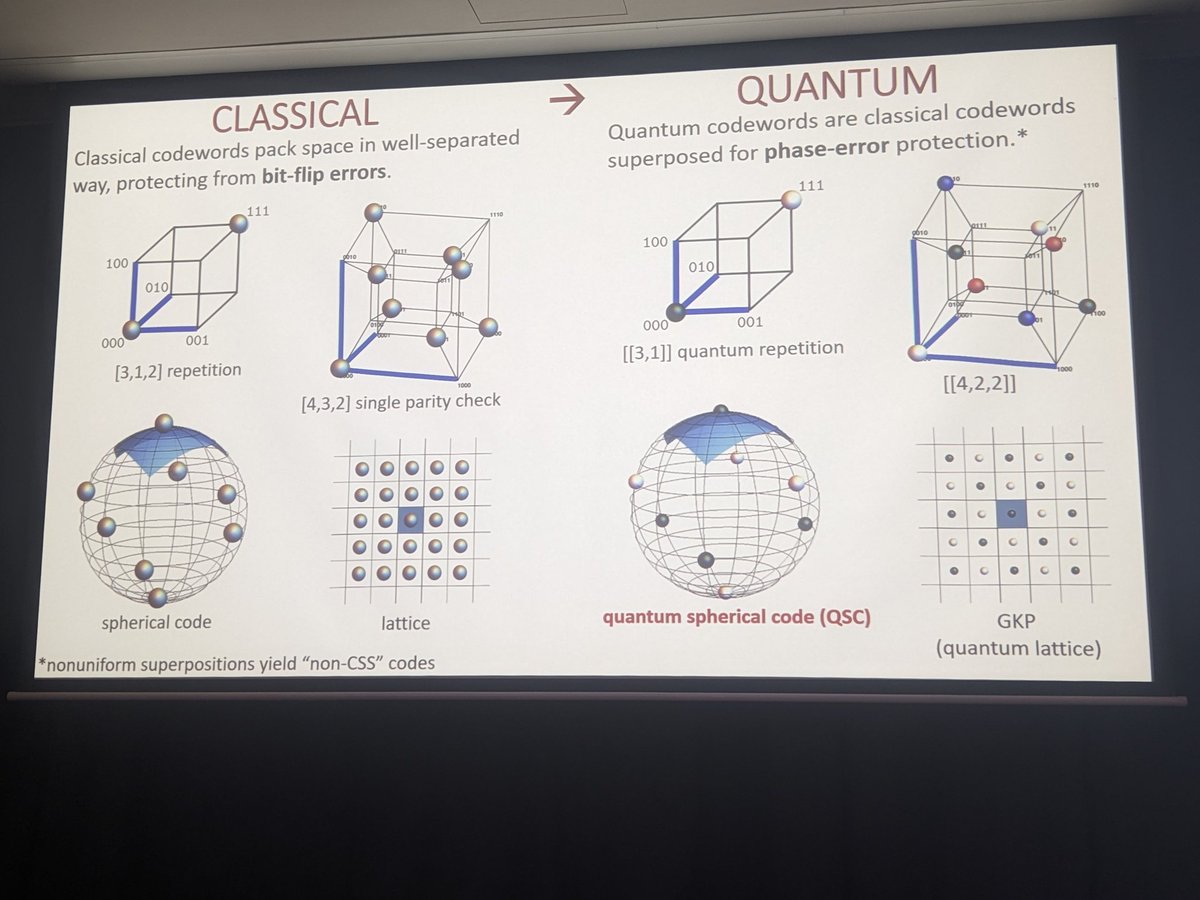
@victorvalbert presents quantum analogues of the spherical codes, which include new cat codes and new gadgets for concatenations of cats and CSS codes. Here is a geometric perspective on binary, real, and spherical classical and quantum codes.
Was reading about the Heisenberg group when I saw that a certain argument relied on 'abstract nonsense' which is apparently a real thing https://t.co/jyPGVMNnp7
A great mathematician named Madhava, working in Kerala, India, discovered the power series for sin(x) in the 1300s, hundreds of years before Newton, Leibniz, Gregory, Taylor, et al. In this video, master teacher @garyrubinstein shows how Madhava did it: https://t.co/8Biod55KqC
Summer School on Quantum Information and Quantum Technology - 2022
June 1- July 4, 2022
Registration Open at the following link.
https://t.co/7Z3TnG9879