DocuSign Personal: $10 to $15 per month.
DocuSign Standard: $25 to $45 per user per month.
DocuSign Business Pro: $40 to $65 per user per month.
A 10-person team on Business Pro pays $4,800 to $7,800 a year. To put signatures on PDFs.
A team of 50 pays $24,000 to $39,000 a year.
And there is a 100-envelopes-per-year cap on most plans. Send more contracts and you pay extra.
Need SMS delivery? $0.40 per send.
Need ID verification? $2.50 per attempt.
Need premium support? $5,000 to $50,000 per year add-on.
You are rationing digital signatures in 2026.
DocuSign is a $10 billion company built entirely on this pricing model.
Now meet DocuSeal.
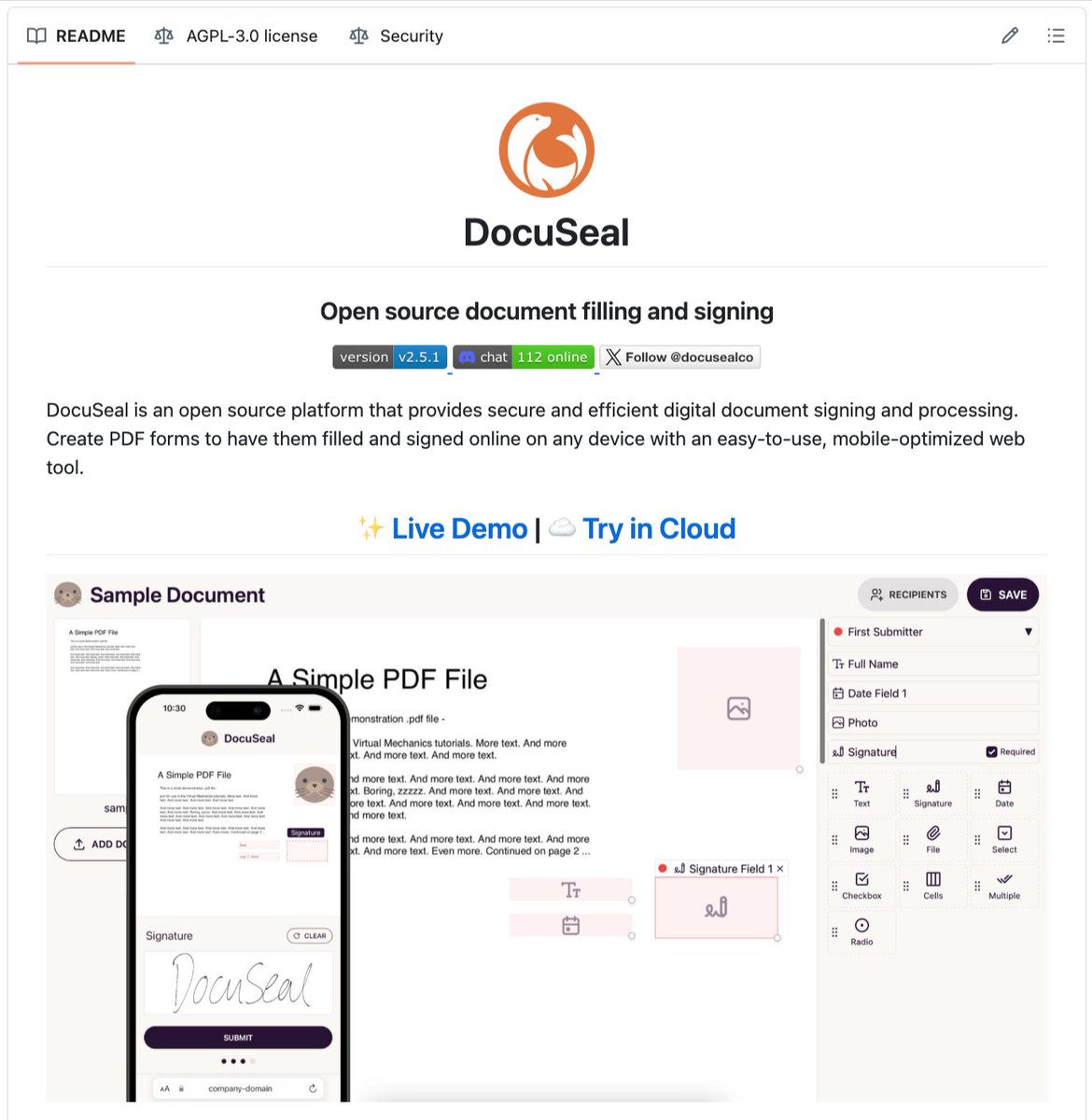
A free and open source alternative to DocuSign.
Created in 2023 by a Ruby developer named Alex who was simply trying to sign one document and realised every solution online was overpriced or required a subscription.
Three weeks later he had a working alternative. He pushed it to GitHub under the AGPL-3.0 license.
Today it has 11,800+ stars and over 1,000 forks. Bootstrapped. No VCs. No paywalls.
Here is what DocuSeal does:
- Upload any PDF and turn it into a fillable, signable form
- Drag and drop signature fields, dates, checkboxes, file uploads, and 13 field types
- Send to multiple signers with custom signing order
- Automated email reminders
- Mobile signing on any device
- PDF signature verification built in
- Audit trail for every document
- Bulk send and templates
- Full API access
- Self-host with one Docker command
Here is what DocuSeal costs:
Zero. Forever. Unlimited documents. Unlimited signers. Unlimited storage.
DocuSign limits envelopes. DocuSeal doesn't.
DocuSign charges per SMS. DocuSeal doesn't.
DocuSign charges for ID checks. DocuSeal doesn't.
DocuSign sees your contracts on their servers. DocuSeal doesn't.
Here is the wildest part:
The median DocuSign contract per Vendr is $17,250 per year. One Reddit thread has people saying "they want me to pay $4.80 per e-signature."
Self-host DocuSeal on a $5 cloud server and a 50-person team can sign as many contracts as they want without paying a single dollar.
Your contracts never leave your server. Your client lists. Your NDAs. Your employment agreements. None of it touches a third-party company.
For individuals who only sign a few contracts a year, you save $180.
For small teams of 10, you save up to $7,800 a year.
For a 50-person company, you save up to $39,000 a year.
Your documents. Your signatures. Your server.
100% Open Source. (Link in the comments)
this company is building a product for medium/large organizations that helps you map all your processes and pain points by interviewing employees with an AI.
This is what consultants from Accenture, BCG, Delloite, etc typically do to assess and provide insights. Great use of AI.
We've talked to hundreds of people inside large enterprises about how they work. The pattern is always the same: they know something isn't working, but they can't tell you exactly what process is broken, how much it's costing, or what to fix first.
Traditional consulting takes months to answer those questions.
We built Horizon AI(https://t.co/JQF0F6HBG9) to solve that.
The platform runs AI-powered conversations with employees across the entire organization, and each one surfaces what used to take weeks of interviews and consultants. When you do that at scale, you get a complete map of every process, inefficiency, prioritized, quantified, and ready to act on. Not a report. Not a dashboard. A system that goes from discovery to impact.
Here's what that looks like in 60 seconds.
Moon vs Mars isn’t about ambition—it’s about iteration speed. Every 10 days vs every 26 months. That’s the difference between a startup shipping weekly and one shipping every two years.
At this level of stakes, only one thing matters: how fast you can run build-measure-learn loops. The lean startup isn’t just a framework for building software —it’s the operating system for any problem worth solving. @ericries
And now with AI compressing iteration cycles everywhere, this way of thinking becomes even more critical. The winners won’t be whoever has the biggest vision. They’ll be whoever learns fastest
For those unaware, SpaceX has already shifted focus to building a self-growing city on the Moon, as we can potentially achieve that in less than 10 years, whereas Mars would take 20+ years.
The mission of SpaceX remains the same: extend consciousness and life as we know it to the stars.
It is only possible to travel to Mars when the planets align every 26 months (six month trip time), whereas we can launch to the Moon every 10 days (2 day trip time). This means we can iterate much faster to complete a Moon city than a Mars city.
That said, SpaceX will also strive to build a Mars city and begin doing so in about 5 to 7 years, but the overriding priority is securing the future of civilization and the Moon is faster.
Boil the Oceans
You know the phrase: “don’t boil the ocean.” Everyone’s said it in some overly ambitious meeting. It’s good advice in normal times. It keeps teams focused. It prevents scope creep. But we are no longer in normal times, and I think it’s time to retire saying it.
Artificial Superintelligence means it’s time to boil the ocean. We’ll start with a few lakes first.
I was recently with a university endowment’s head of private investing who told me their engineers were terrified for their jobs after seeing what Claude Code could do. And I get it — that’s the natural first reaction. But it’s the wrong one. It’s a zero-sum reaction to a positive-sum moment.
Instead of worrying about doing the same thing we’ve been doing for cheaper, why not focus on doing the thing we never even dreamed of doing? Why can’t that endowment achieve 50% net IRR instead of 10%? Why can’t a startup deliver a service that is 100x better than the incumbent? Why can’t we have fusion energy? Why can’t we talk to every single user and have a perfect understanding of every bug in our product?
These aren’t rhetorical questions anymore. They’re engineering problems with paths to solutions.
Here is what I think is actually going on with the fear: our fear of the future is directly proportional to how small our ambitions are. If your plan is to keep doing exactly what you’re doing, then yes, a machine that can do it faster and cheaper is terrifying. But if your plan is to do something dramatically bigger, then the machine is the best news you’ve ever gotten.
If you’re a worker — someone who trades labor for a living — this is the moment to become a builder. Start a business. And if you’re already management or capital, it’s time to go 10x more hardcore on what your aspirations could be. Not eking out 5% efficiency gains. Not increasing profit margins 2% by lowering cost and firing people. Those are the old games. The new question is: what would it look like to build a product or service so good that people would happily pay 10x what they pay now?
The net result of this is more jobs, not fewer. As Ryan Petersen likes to say, the human desire for more things is absolutely limitless. We can actually fulfill that desire now — if we have the agency to prompt it for ourselves.
Buckminster Fuller coined the term “ephemeralization” in 1938: doing more and more with less and less until eventually you can do everything with nothing. His entire vision of progress was about technology enabling radical expansion of human capability through dematerialization. He traced this from stone bridges to iron trusses to steel cables — each iteration stronger, longer, lighter, cheaper. He wasn’t describing job destruction. He was describing civilization getting better at being civilization.
This is Jevons Paradox for everything. When you make a resource dramatically more efficient, you don’t use less of it — you use vastly more. Steam engines didn’t reduce coal consumption. They made coal so useful that demand exploded. The same thing is about to happen with intelligence, with labor, with every service and product we can imagine.
But Jevons Paradox doesn’t activate on its own. It requires capital and management to actually raise their ambitions — to boil lakes and oceans instead of drowning them in committee
That’s what startups have always been good at: moving fast in the face of radical uncertainty, building for the 10x future while everyone else is optimizing for the 1.05x present.
Time to start.
someone should build a superhuman version for whatsapp.
- ai auto-draft replies
- snooze or set reminders for replies or follow ups
- ease up coffee chat scheduling back-and-forth
- integrate w calendar for meetings arrangements
- hotkey navigation between chats
- semantic search on chat and image history
- pre-established text snippets
- etc...
I'm Boris and I created Claude Code. Lots of people have asked how I use Claude Code, so I wanted to show off my setup a bit.
My setup might be surprisingly vanilla! Claude Code works great out of the box, so I personally don't customize it much. There is no one correct way to use Claude Code: we intentionally build it in a way that you can use it, customize it, and hack it however you like. Each person on the Claude Code team uses it very differently.
So, here goes.
Puentes is back.
We’re flying out 10 engineers from Latin America for 7 days to…
> eat dinner with @rauchg, @mejiasebas, and @tnm
> get hired at top sf startups
> move to San Francisco
reply and I’ll dm you a link to apply
Pequeña actualización:
Todavía faltan unos días para volver al ruedo, gracias a UIN por eso ❤️
Pero les quería contar que desde hace un tiempo estoy acompañando a algunas startups como Advisor, adivinen de qué? 🤣
Si les interesa, más información en [email protected]
Kids might actually be better at using lovable than adults. Unlimited creativity, no fear.
A software dev ran a "create with AI" for 8-12 year-olds.
Apparently kids skipped break because they were vibe-coding too hard, and kept working on their projects after school ended.
The future is bright!
Google Cofounder Larry Page: “I recommend reading things”
When asked in the clip below how he learned to run Google, Larry responds:
“I read a lot of books.”
He jokes:
“[When renaming Alphabet] I read like three books on naming—which is more than anyone else had read. So I decided I was the expert… and actually that was useful. I recommend reading things.”
I think this is a really important mindset that is often overlooked. One of the richest ways to learn something is reading things written by people who deeply understand their subject matter.
Even Elon Musk was able to teach himself about the fundamentals of rocket design and astrodynamics by reading books. He is often quoted on this topic:
“I read books and talked to people. I mean that's kind of how one learns anything. There's lots of great books out there and lots of smart people.”
Monday’s Startup Archive post cited the following quote from Naval Ravikant: “building a startup is an infinite set of problems that are being thrown at you.”
Next time you’re facing one of those problems, I’d recommend finding the best book or blog post you can on the topic and reading it. You don’t need an MBA to be an expert in marketing, sales, user research, strategy, management, product, etc. Most schools are really just thin wrappers on books.
The most valuable part of studying at an Ivy League?
@snowmaker from YC taking office hours with random students at a random Tuesday.
You know you are in the right place when the guy you watched on youtube for hours is giving you advice face to face.
Nobody in Silicon Valley understands consulting
The quality of research (& deckmaking/modeling) is 1% of the total competitive advantage of McKinsey/Bain/BCG