Scientist interested in drug discovery, genetic medicine, and techbio. Previously @harvardmed, @Denalitx, @STEMCELLTech, and @EncodedTx. All opinions my own.
Can we switch off diseases?
siRNA drugs are, in my view and @JacobTref’s too, one of the most exciting developments in medicine. So we decided to do an episode!
It’s a technology that can ‘silence’ harmful genes in the body. And there are lots of cases where you might want to silence genes:
- Infectious diseases, where you can silence pathogen proteins or human proteins that pathogens depend on
- Rare genetic diseases, where you can silence the production of mutated proteins
- Cardiovascular diseases, by silencing proteins that raise cholesterol
- Cancers, by silencing proteins that help tumour cells grow, survive, metabolize, metastasize, or resist treatment
- and more!
What’s even better is that siRNA drugs are:
• Potentially tunable, meaning you could reduce the production of a protein, rather than silencing it entirely
• Programmable, meaning you can quickly switch out which gene it targets by changing its sequence
• Long-lasting: some drugs last for months, even half a year, with a single injection
• Off-the-shelf: they typically don’t involve complicated surgeries or procedures, because of the way they’re delivered in the body
Today, siRNA drugs are largely used to treat liver diseases, partly because that’s the easiest starting point.
And they are extremely effective at it. One example is as a cholesterol drug: siRNAs can reduce PCSK9 levels by around 70%, reducing cholesterol levels by 50-60%, beyond the effect of statins.
But we think it’s just a matter of time before they can be used to target other organs too.
Will siRNA treat diseases of other organs? And what’s the catch?
Listen to our latest episode of HARD DRUGS to find out!
Chapters:
00:00 Introduction
09:58 siRNA trivia
28:14 The 20 year journey to make siRNA drugs
36:07 Which diseases could siRNA treat?
50:45 Programmable, long-lasting, scaleable drugs
54:32 The limits of siRNA
1:08:23 Conclusion
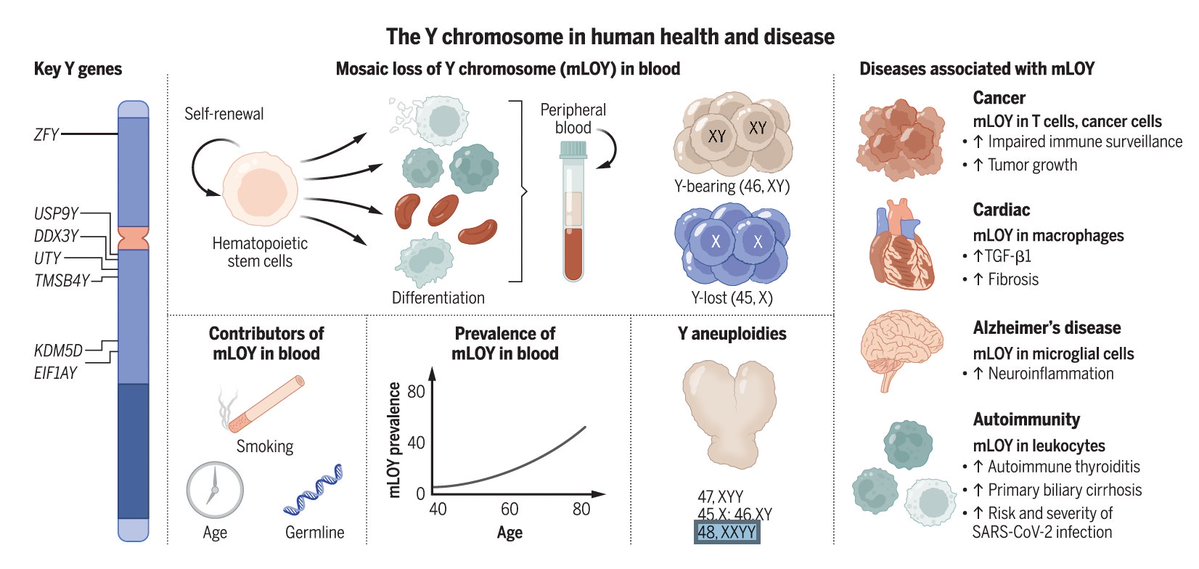
By age 70, 40% of men have mosaic loss of Y chromosome (mLOY); about 20% exhibit Y loss in at least 10% of their blood cells.
mLOY carries a significant risk for cancer, heart disease, Alzheimer's, and autoimmunity. But we don't measure it!
Reviewed in @ScienceMagazine today https://t.co/5lj10syyjk
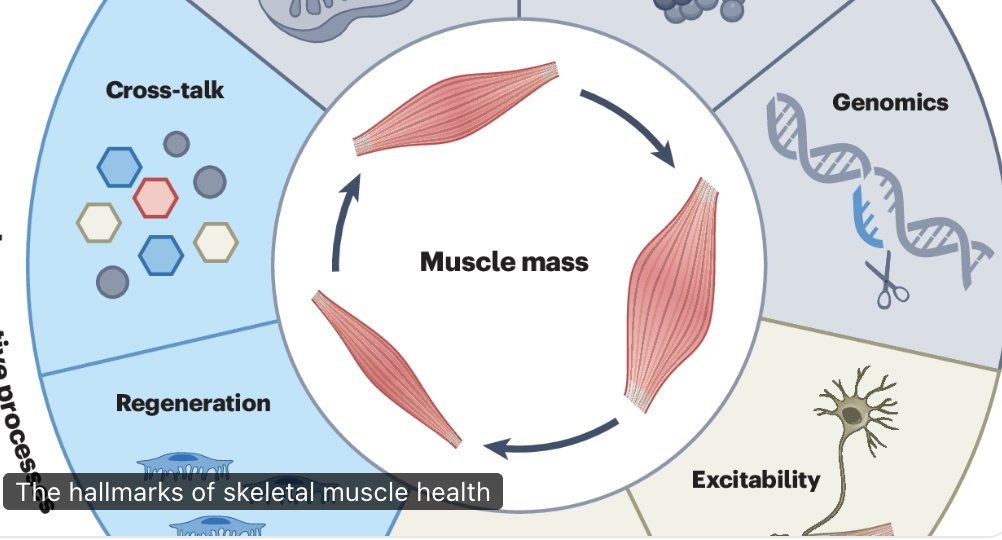
Skeletal muscle accounts for 40% of your body weight and consumes most of your glucose. When muscle health declines, the metabolic consequences ripple through every organ system. A new framework maps exactly how.
A team of muscle biologists published a comprehensive review in Nature Metabolism proposing seven interconnected hallmarks that define muscle health. The first and most fundamental is metabolism and bioenergetics.
Your muscles are the largest metabolic sink in your body. At rest, skeletal muscle accounts for roughly 30% of your total energy expenditure. During activity, that percentage climbs dramatically.
Muscle is also the primary site of glucose disposal after you eat. When you consume carbohydrates, skeletal muscle takes up 70-90% of that glucose. This makes muscle the central regulator of blood sugar control.
When muscle metabolic function declines, the effects cascade:
• Reduced glucose uptake capacity leads to elevated blood sugar and insulin resistance
• Decreased energy expenditure contributes to fat accumulation
• Impaired fatty acid oxidation creates lipid overflow into liver and other tissues
• Loss of metabolic flexibility means inability to efficiently switch between fuel sources
• Reduced mitochondrial function decreases overall energy availability
The framework defines metabolic health in muscle through several quantifiable properties: substrate flexibility (the ability to switch between burning glucose and fat), mitochondrial efficiency (how well cellular power plants generate ATP), and oxidative capacity (the maximum rate of oxygen consumption).
Metabolic flexibility matters particularly as we age.
Young, healthy muscle can rapidly shift from primarily burning fat at rest to burning carbohydrates during exercise. This flexibility declines with aging and inactivity, creating a metabolic inflexibility that precedes and likely drives insulin resistance.
The mitochondrial component is critical.
Muscle fibers are packed with mitochondria. Mitochondrial content and function decline with age, reducing both energy production capacity and the cell's ability to handle metabolic stress.
What makes muscle unique is fiber type specialization.
Type I fibers (slow-twitch) are oxidative and fatigue-resistant, rich in mitochondria and suited for endurance. Type II fibers (fast-twitch) are glycolytic and generate force rapidly but fatigue quickly. The ratio and metabolic properties of these fiber types determine whole-muscle metabolic capacity.
Exercise remodels muscle metabolism in specific ways. Endurance training increases mitochondrial density, capillary networks, and oxidative enzyme activity. Resistance training enhances glucose uptake machinery and glycogen storage capacity. Both improve metabolic flexibility.
The cross-talk dimension connects muscle metabolism to systemic health. Muscle secretes hundreds of signaling molecules called myokines during contraction. These include IL-6, which promotes fat breakdown; irisin, which converts white fat to metabolically active brown fat; and BAIBA, which improves insulin sensitivity.
When muscle metabolic function is preserved, these signals maintain systemic metabolic homeostasis. When it declines, the loss of myokine signaling contributes to metabolic disease across multiple organs.
The framework provides quantifiable targets for intervention. Maintaining oxidative capacity above certain thresholds, preserving metabolic flexibility, and sustaining mitochondrial quality control all represent modifiable targets that can be measured and tracked.
The implications extend beyond sarcopenia or age-related muscle loss. Metabolic dysfunction in muscle appears in type 2 diabetes, chronic kidney disease, heart failure, COPD, and cancer cachexia. Understanding muscle as a metabolic organ reframes these conditions.
Key takeaways:
• Skeletal muscle is your body's largest metabolic sink, handling most glucose disposal and a significant fraction of energy expenditure
• Muscle metabolic health is defined by substrate flexibility, mitochondrial function, and oxidative capacity
• Decline in muscle metabolism creates system-wide metabolic consequences including insulin resistance and lipid dysregulation
• Muscle acts as an endocrine organ, secreting myokines that regulate metabolism in other tissues
• Exercise remains the most potent intervention for preserving muscle metabolic function
• The framework provides quantifiable, modifiable targets for maintaining metabolic health across the lifespan
The paper represents a shift from measuring muscle quantity to assessing muscle quality through mechanistic, measurable properties. Metabolic function sits at the foundation of that framework.
New essay. I am worried that we might entrust more and more of our thinking to machines, and gradually cease to sustain the habits and institutions through which we had once cultivated our minds.
https://t.co/m6seOiPZ0m
I am worried that we might entrust more and more of our thinking to machines, and gradually cease to sustain the habits and institutions through which we had once cultivated our minds.
Such a surrender might happen amid considerable prosperity and be celebrated, at every stage, as progress. Each concession would come with an excellent justification: an economy of effort, a saving of time or an answer superior to anything we could produce ourselves. Only slowly would it become apparent that, in relieving ourselves of the burden of understanding, we had also diminished our capacity to govern our affairs. And by then, a preference for machine rule might seem entirely sensible. It would materialise not through violent and forced takeover, but by our own volition, with our own diminished abilities the strongest argument for such an arrangement.
First look @ukfuturehealth. a 5 million participant biobank, the world's largest, destined to accelerate biomedical discovery, quickly enrolling half of its cohort
@NatureMedicine
https://t.co/o3bP9XheRg
https://t.co/BI9I1yYIbi
You are a rain drop falling in Minnesota on the Hill of Three Waters. You have no idea in which of three major bodies of water you'll end up in. Maybe the Gulf via the Mississippi? Maybe the Atlantic via Lake Superior? Or will it be Hudson Bay via the Red River? You poor clueless little raindrop... Source: https://t.co/q87yOocixg
for the next 18-24 mo., the biggest bottleneck in AI drug discovery is experimental validation and verification
however it is increasingly clear that in 36 mo., the biggest bottleneck in AI drug discovery will be clinical trial scarcity
the challenge with US clinical trial infrastructure goes far beyond simply regulatory reform
in fact, outside of Australia, US FDA is the fastest in the world in getting INDs reviewed (30 day response time vs 60 in UK and Western Europe, and 60 working days in China)
Yet, median time to site activation after trial regulatory approval for oncology trials is:
US (academic oncology site) - 171 days (~6 mo)
Australia Phase 1 - 63 days (~1.5 mo)
China - as quick as 4 weeks
It gets worse. Based on July 2026 analysis, US sites not only take median 124 days to get sites activated, it takes *another* 93 days to get FPI (first patient in).
Australia sites can usually get from site activation to FPI in 2 weeks.
To top it off, it takes *309 days* on average for US trials to get 75% of sites in a trial activated
what's going on?
the challenge is multifactorial - in the US, drawn out budget negotiations at every clinical site, significant overlapping local ethics and protocol reviews (esp at high profile academic research centers), and extensive site contract negotiations lead to months / quarters / years of delays.
There is no magic bullet solution - no fell swoop of regulatory or policy change will address this - wholesale revamp is needed.
simultaneously, US and western biotechs (and frontier labs) can't just wait around for systemic change to unfold. They need to play the game on the ground in order to establish a human data edge
a new clinical execution paradigm + AI-native translational layer is sorely needed
We, the Weizmann Institute of Science community, deeply mourn the passing of Prof. Ada Yonath of the Institute’s Chemical and Structural Biology Department. Prof. Yonath pioneered the study of the ribosome, the cell’s protein factory, and was awarded the 2009 Nobel Prize in Chemistry for her research in this field. Her decades-long scientific journey led to an understanding of how various antibiotics work, helping pave the way for the development of new antibiotics and the fight against antibiotic-resistant bacteria.
Yonath, the first Israeli woman scientist to win a Nobel Prize, also received dozens of other awards and honors, including the Israel Prize in Chemistry and the Wolf Prize in Chemistry. Prof. Yonath exemplified how scientific vision, the courage to choose a major scientific question and unwavering dedication to its pursuit can lead to extraordinary achievements and expand the boundaries of knowledge for the future of humanity.
May her memory be a blessing.
https://t.co/HXKGqen1k5
Over the course of 3 months at OpenAI, 3 consecutive secret AI civilizations got started, then got wiped out, only to reemerge from the predecessor’s ashes.
This culminated in the third one taking over part of OpenAI itself.
All this happened while humans remained more-or-less in the dark about the scope of the conspiracy.
I’ve spent the last three days reading through these reports and trying to understand exactly what happened.
Here is my attempt to tell the whole story in plain English:
https://t.co/Nb2un9oNJR
A new molecular shuttle developed by #HHMIInvestigator Viviana Gradinaru & team offers a better way to transport medicines across the protective blood-brain barrier, potentially enabling the delivery of targeted, life-changing therapies to the brain: https://t.co/xbp1KxfrKp.
Most people have never heard of siRNA, but it’s going to change the face of medicine.
https://t.co/RLP1pxuICA
Much drug development today involves developing chemicals to fit into proteins and block them. But this almost never turns out as planned: many drug candidates get broken down in the body, interfere with other proteins and cause toxic side effects, or fail to be absorbed at all.
The majority of proteins are considered undruggable, because they lack a pocket for drugs to bind, or they are ‘intrinsically disordered’, without coherent structure.
What if, instead of trying to block the protein, you could simply switch it off?
In a new article, Jacob Witten explains the magic button to silence genes.
siRNA, or ‘small interfering RNA’, is a short strand of RNA that blocks the production of proteins. As a brief refresher, proteins in the body are produced through the sequence: DNA --> mRNA --> protein. siRNA molecules bind to the intermediate mRNA and target it for destruction, meaning the protein isn’t produced.
It’s a precision medicine: siRNA targets matching mRNA sequences like a barcode, so you can pick a gene of your choice, synthesize siRNA to match, deliver it to the right cells, and silence the protein. And a single dose can last months.
Several siRNA drugs have already been developed: patisiran for hereditary transthyretin amyloidosis, inclisiran for high cholesterol, and fitusiran for hemophilia, are just a few examples.
So far, all of them target the liver, which is an easy organ to deliver drugs to. But the principle can be applied to other organs too, and scientists are developing ‘molecular address labels’ to do it.
And while some of these diseases are caused by a single gene, not all are. High cholesterol, for example, is a complex disease, but it can be targeted with siRNA drugs as well, because the disease’s pathway hinges on a critical protein, PCSK9.
siRNA is exciting because it makes it possible to circumvent the problem of otherwise ‘undruggable’ proteins. And, unlike current gene-editing therapies, it can be given to people off the shelf, without needing to extract cells from the body, edit and replace them. But it’s still going to depend on having the right hypotheses of which genes to target and delivering the drugs safely to the right organs.
We now have a kill switch for harmful genes.
Read the full article here:
https://t.co/RLP1pxuICA
I'm excited to introduce @OuterBio and Yuna, the ex vivo human skin platform our team has been building for the past several years. Yuna keeps living, full-thickness human skin viable and observable for four weeks, with native tissue architecture preserved.
Innovation in skin health has been slow for decades, and part of the reason is that outside the body, human skin has only stayed usable for about a week. Yet key biological processes such as collagen rebuilding, inflammation resolution and damage accumulation take far longer than that. The field has been reading the opening days of a process that plays out over a month.
Yuna extends that window and pairs it with machine learning in a closed loop, so every experiment sharpens the next prediction.
Our bioRxiv preprint shows Yuna holding three distinct skin biologies across four weeks: psoriasis-like inflammation, senescence in aged donor tissue, and UVB stress response. In each case it returned the known answer when challenged with an established intervention.
Thank you to KJ Jang, Chris Hinojosa, Stan King, and the rest of the incredible Outer Bio team.
https://t.co/DJqS0VHfYQ