3/3 Mark Weiser’s vision for “Calm Computing” - a vision of computing that disappears into your environment
(What we’re pursuing as > VR!)
https://t.co/YXCWn6ZrZu
A tremendous pleasure to share my PhD journey with you! Massive appreciation goes to my mentor, @mayor_lab, and the indispensable input of colleagues Lucas Alvizi, Jonas Hartman, @nrstillman, @MoghePrachiti & Takashi Hiiragi, family, and friends. (n/1)
https://t.co/YNz43RABi6
Love letter to @obsdmd to which I very happily switched to for my personal notes. My primary interest in Obsidian is not even for note taking specifically, it is that Obsidian is around the state of the art of a philosophy of software and what it could be.
- Your notes are simple plain-text markdown files stored locally on your computer. Obsidian is just UI/UX sugar of pretty rendering and editing files.
- Extensive plugins ecosystem and very high composability with any other tools you wish to use because again it's all just plain-text files on your disk.
- For a fee to cover server costs, you can also Sync (with end-to-end encryption) and/or Publish your files. Or you can use anything else e.g. GitHub, it's just files go nuts.
- There are no attempts to "lock you in", actually as far as I can tell Obsidian is completely free of any user-hostile dark patterns.
For some more depth, I recommend the following writing from CEO @kepano:
- "File over app" https://t.co/SigWj8uCrf . If you want to create digital artifacts that last, they must be files you can control, in formats that are easy to retrieve and read. Accept that all software is ephemeral, and give people ownership over their data.
- "100% user-supported" https://t.co/2qDJXub7cs . On incentives alignment.
- "Quality software deserves your hard���earned cash" https://t.co/qfNjSEwbLf
TLDR: This is what software could be: private, secure, delightful, free of dark patterns, fully aligned with the user, where you retain full control and ownership of your data in simple, universal formats, and where tools can be extended and composed.
I have new paper "Simulacra as Conscious Exotica" on @arxiv about #consciousness in #AI and large language models (#LLMs):
https://t.co/0dlAmnPuNf
I'm releasing into the world with some trepidation 😬; it's such a difficult and controversial issue. 🧵 1/n
Dear friends,
I’m deeply honored to announce that our artwork Unsupervised has been acquired by MoMA and is now in the museum’s permanent collection!
This acquisition marks a grand milestone in our studio’s journey and also for digital art. It inscribes a historic chapter as MoMA welcomes the first Generative AI and tokenized artwork into its esteemed permanent collection.
I am infinitely grateful to our curators Michelle Kuo, Paola Antonelli, and Stuart Comer for their wisdom and the entire MoMA team’s genuine support and collaboration since the beginning of the project.
We are also profoundly thankful to our collectors, Ryan Zurrer, Pablo Rodriguez-Fraile, and Desiree Casoni, and NVIDIA for supporting our journey.
For almost a year now, our artwork brought the museum audience joy, inspiration, and hope! Thank you, New York and all the visitors of MoMA from my heart!
New preprint! @olivercliff w/ @NaoTsuchiya@jlizier: "Unifying Pairwise Interactions in Complex Dynamics". Want to quantify the relationship between two time series? We compared over 249 pairwise dependence measures on >1000 multivariate time series 😮
https://t.co/euhDhozNcu
This is what I'm here for:
We examine breakthroughs over the past decade that include self-supervised learning, which allows models to be trained on vast amounts of unlabelled data, and geometric deep learning, which leverages knowledge about the structure of scientific data to enhance model accuracy and efficiency.
Generative AI methods can create designs, such as small-molecule drugs and proteins, by analysing diverse data modalities, including images and sequences.
We discuss how these methods can help scientists throughout the scientific process and the central issues that remain despite such advances.
Our pre-print is out! 🧑🔬 https://t.co/pgEFFKgZp9
Frictiotaxis underlies adhesion-independent durotaxis
A short thread about what we found 🧵
@mayor_lab@RicardAlert
Who would have believed that durotaxis did not require adhesion to the substrate? New manuscript by @AdamShellard shows that durotaxis (migration along a stiffness gradient) can be adhesion-independent, but depends on friction as shown in collaboration with @RicardAlert
🎲Life is a game. Play by your rules! 🎮
Stable Alignment enables LM to learn social norms from simulated everyday interactions in a social game! 👫
Check this out 👇:
https://t.co/oUahaw2nwZ
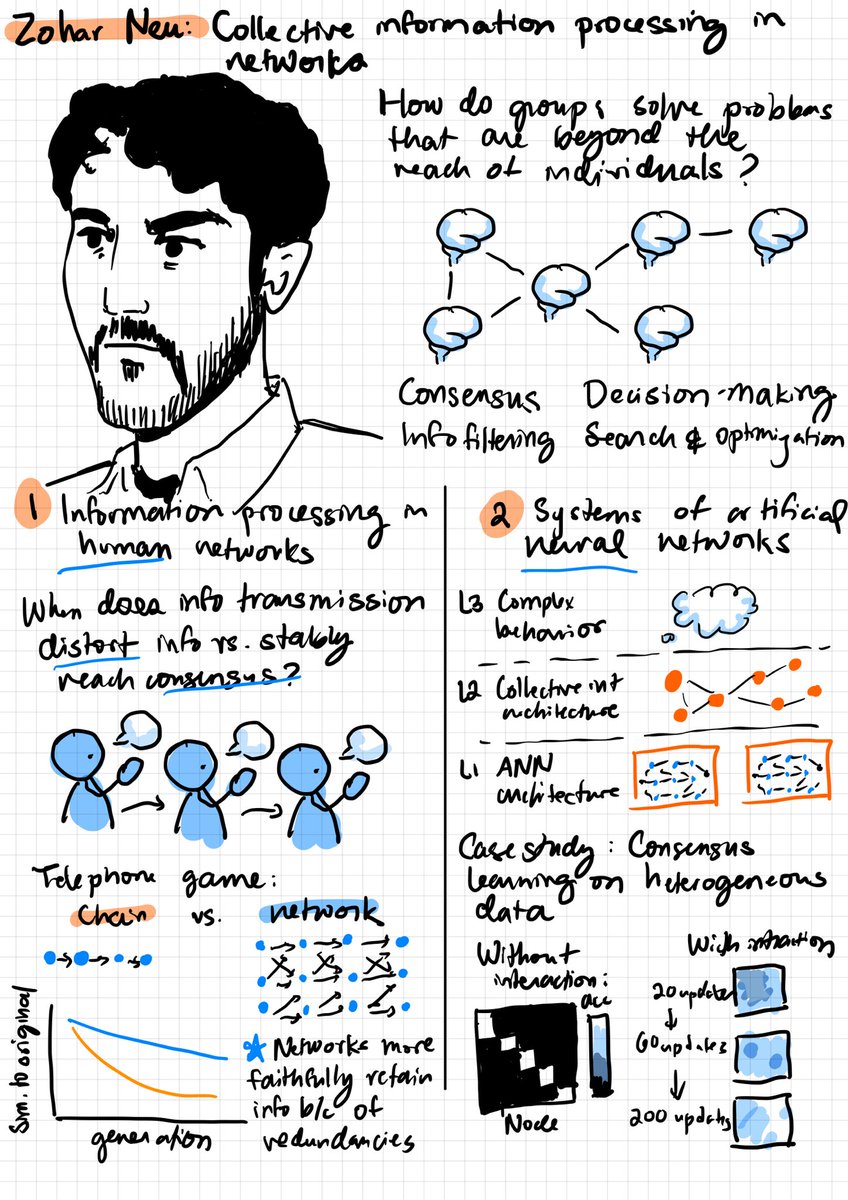
Congrats to Zohar for presenting our work at the workshop on Networks and Cognition at @PsychPrinceton and amazing sketch summary from @natvelali!
You can check out the paper below:
https://t.co/R5mZ2dN7D0
Excited to take #sketchnotes of today’s Networks and Cognition workshop at @PsychPrinceton! Starting off with Zohar Neu, on collective information processing in human and artificial networks
I am beyond thrilled to advertise our workshop on the Synergy of Scientific and Machine Learning Modelling (SynS & ML 2023), happening this summer @icmlconf under the Hawaiian sun! 🧪+🤖=💖
More info: https://t.co/QTYc8rZ3nt
Please share around! 1/6
At #popl2023 w/ @MITCoCoSci@ZuckermanBrain@DataSciColumbia, we presented AutumnSynth,
AutumnSynth synthesizes the source code of a video game from seconds of play. It's a step toward automated scientific discovery through program synthesis
Blog/paper: https://t.co/XX0GvGbBfv
Speculative (!!!) paper arguing that big LMs can model agency & communicative intent: https://t.co/WYaedqx9TT (somehow in EMNLP findings). Briefly:
1. LMs do not in general have beliefs or goals. An LM trained on the Internet models a distribution over next tokens *marginalized*