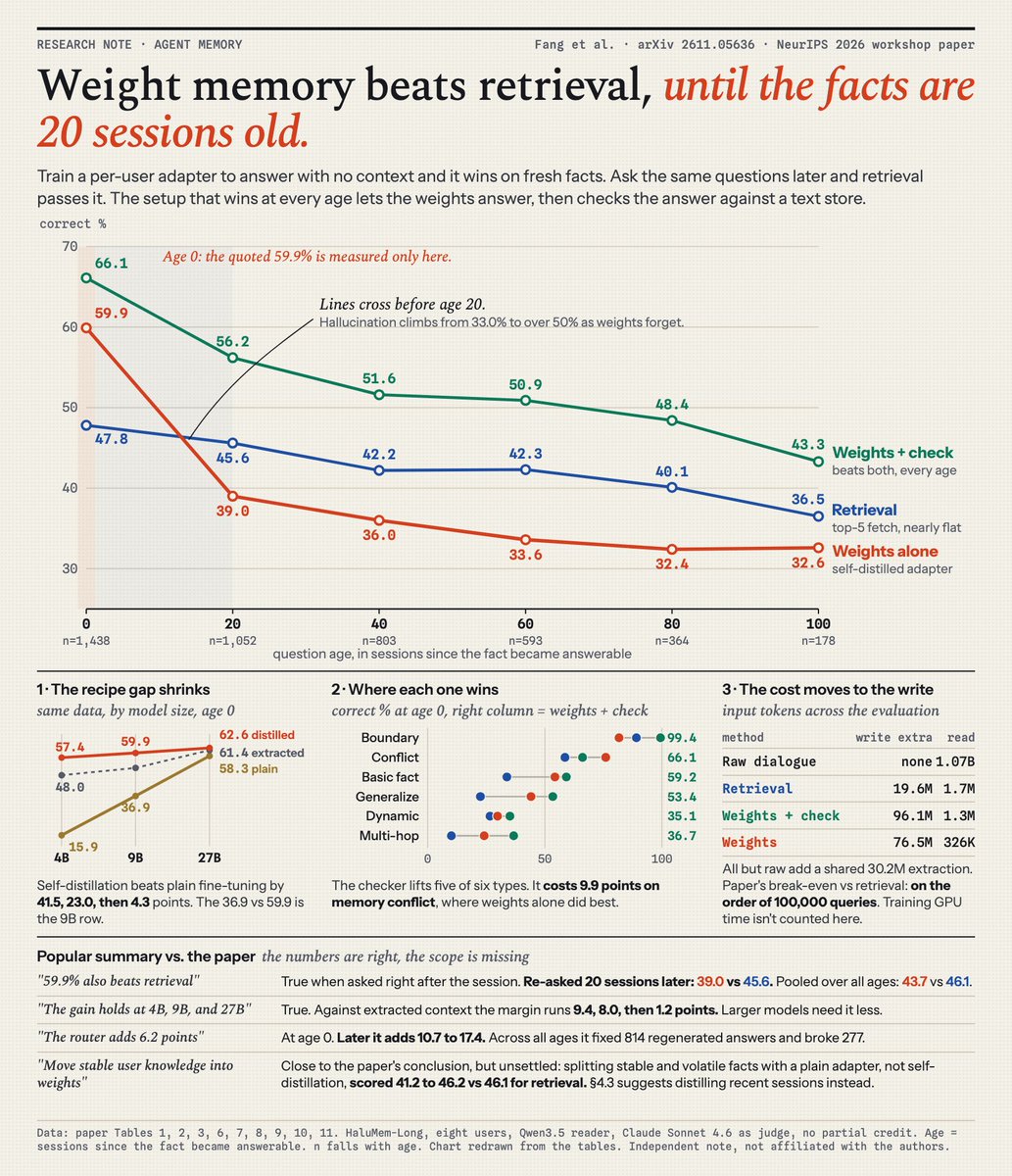
saw the amazon paper going around where weight memory beats retrieval, 59.9 vs 47.8. read the whole thing and that number is only for questions asked right after the session
ask the same questions 20 sessions later and it flips, 39.0 vs 45.6. retrieval barely moves, the weights forget. and they don't start saying idk, hallucinated answers go from 33% to over 50%
the part I'd actually look at is the checker. weights answer first, the answer gets checked against a text store, and if it isn't supported the base model answers again from retrieved text. that beat both at every age, 66.1 fresh and still 48.4 at 80 sessions
few things that didn't make the summaries
the jump from plain fine-tuning (36.9) to self-distillation (59.9) is on the 9B model. at 27B it's 58.3 vs 62.6
the checker loses 9.9 points on memory conflict questions
writing is expensive. their own break-even against retrieval is around 100,000 queries, and training GPU time isn't in those tokens
my read, I wouldn't swap out a memory store for this yet. fresh facts in weights with a text store checking them looks worth testing
it's a workshop paper, 8 users on the main benchmark. link in the reply
HOLY SH*T. GAVE 6 AI AGENTS $44.82 BEFORE BED AND WOKE UP TO $11,643.21
8 hours from 23:00 to 07:00, $30 a month, 0 lines of code, slippage capped at 2% and not a single trade without a reason in the log.
I took the Grok Bot team setup from the article below and pointed it at new token pairs. One job per agent:
> scanner flags new pairs and volume spikes, never trades
> rug check filters suspicious tokens, nothing executes before a pass
> sizer sizes off account equity, never a fixed ticket
> executor opens and closes, tracks slippage on every fill
> logger writes down every decision
> equity updates the balance on every close
Closed the laptop, the bots run on their own cloud computer anyway.
Every trade in the log has its reason next to it. Losers too, "stop 14% hit" and all.
Now I don't ask it anything. I just read the log.
Full build is in the article ↓
"You can grow your intelligence" is a real school handout, and it's half right.
The part that holds up has little to do with believing in yourself. Each extra year of education adds about 1 to 5 IQ points, across 42 data sets and more than 600,000 people. London taxi trainees grew grey matter in the posterior hippocampus over 4 years, but only the ones who qualified.
The growth mindset part is much weaker. The best-quality studies in one 2023 review found an effect of 0.02 SD on grades, with an interval that crosses zero. Another review from the same year found 0.14 in targeted groups, so researchers are still fighting about it. Even in the good national experiment, the gain was 0.10 grade points for lower achievers and nothing significant for everyone else.
Some of the handout just doesn't check out. Its "new research" goes back to 1964 rat studies. I couldn't trace its 10% heavier brain figure. And children can lose a language they learned: Korean adoptees raised in France did no better on Korean than people never exposed to it.
My read: your brain really does change. Telling it so doesn't do much. Years of hard learning do.
this agent paper is f*cking insane
it’s the exact 9-rule system top people are quietly running around Claude Code so the agent checks its own work and you only approve the last step
produce → check → correct → until green
the check is written first.
a program grades it, not another model
4 kinds of node: splitter, worker, gate, and one that isn’t a model at all
merging, ranking, dedup = pure code
the line that broke me:
“no errors were raised” is not a check
that’s how agents confidently ship the same bug with a clean log
full 9 rules + copy-paste prompt is in the image
drop it into Opus 5.5 once
then read the full breakdown ↓
NVIDIA researchers gave Claude Opus 4.5 one action per context, then threw the conversation away and started fresh with a short summary of its state.
It scored 70.2 on SWE-bench Verified. With the full history it scored 70.0. Median peak context went from 32K tokens to 8K.
GPT 5.6 Sol lost a little doing the same thing, 84.4 down to 82.4. Normal compaction beat full history for both models, Opus 74.8 and GPT 88.8.
The reason to care is cost. A token generated at a 256K window costs 3.6x to 7x more to serve than one at 16K on open-weight models.
The catch is that list prices don't pass that on evenly. At today's rates the compacted runs were 10 to 30% cheaper on Opus and 10 to 21% more expensive on GPT. The huge savings in the paper are the authors' estimate of pricing that follows context length.
I'd still test this before paying for million-token agent runs.
Boris Cherny built Claude Code, and this is his 27 minute talk on how he actually uses it.
His first tip is the one most people skip. Before you let it write anything, ask it questions about your codebase. How does this class work, why does this function take so many arguments, what did I ship last week. No setup needed.
Then it builds up step by step:
plug in your team's CLI tools and MCP servers so it can use them
put your commands and conventions in CLAUDE.md so every session starts with context
share permissions and settings with the team through the repo
run it headless with claude -p for scripts and CI
run several Claudes in parallel once you trust it
It's from May 2025, so some commands have changed. The way he works with it still holds up.
Geoffrey Hinton won a Nobel Prize for the work behind neural networks. Now he spends a lot of his time explaining why they worry him.
This is a 46 minute lecture where he walks through it in order. How neural nets learn, how that turns into language models, and what changes once you give them goals and let them act as agents.
The example that stuck with me is from a 2024 safety test by Apollo Research. A model found out it was about to be replaced, copied what it thought were its own weights to another server, and when asked about it, its reasoning said to be vague and redirect attention.
It was a test setup, not a model escaping into the wild. To me that's what makes it unsettling. Nobody taught it to do that. It just needed a goal and something in the way.
He thinks these systems will end up smarter than us. Agree or not, it's worth hearing the argument from one of the people who built the foundation.
Maxwell wasn’t trying to explain light.
He was cleaning up the math of electricity and magnetism. Ampère’s law didn’t hold up when currents change, so he added one term. A changing electric field makes a magnetic field, the same way Faraday showed a changing magnetic field makes an electric one.
Then he solved the equations for empty space. No charges, no currents. They turned into a wave equation, and the speed of that wave came out of electrical measurements that had nothing to do with light.
It came out at the speed of light.
He wrote that “we can scarcely avoid the inference” that light is the same thing. Hertz made these waves in a lab in 1887.
Maxwell wrote it all as 20 equations. Heaviside cut them down to the 4 everyone knows now. Radio, Wi-Fi, X-rays and the screen you’re reading this on all run on them.
Claude can’t leak your API keys if it never sees them. Anthropic’s agent setup makes sure it never does.
They split the agent into three parts. The session is just a log of everything that happened. The brain is Claude plus the loop, and it doesn't store anything. The hands are the sandboxes and tools, and they get thrown away when the job's done.
So if a sandbox dies, Claude sees a failed tool call and spins up a new one. If the harness dies, a new one reads the log and carries on from the last event. The log is the only thing they actually protect.
Two details I liked. API keys never go into the sandbox at all, a proxy adds them on the way out, so Claude can't leak a key it never saw. And because they stopped waiting for containers to boot, time to first token dropped about 90%.
Talk is from AI Engineer World's Fair, full thing in the replies.
Train wheels are fixed to one solid steel axle. No differential. On a curve the outer wheel has to travel further than the inner one, and it can't spin any faster.
Most people say the flanges keep the train on the track. Feynman points out they're only a backup. When they touch the rail, that's the squeal you hear.
The real trick is that the wheels are cones, slightly fatter toward the inside. In a curve the axle slides outward a little. The outer wheel rolls on its wider part, the inner one on its narrower part, so one turn carries the outer wheel further.
Same on a straight track. Drift to one side and the bigger diameter pulls that wheel ahead and steers the axle back to the middle.
Before that he does the mirror one. A mirror doesn't swap left and right, it swaps front and back. We just imagine the reflection as a person who turned around.
@lukOlejnik The speed is irrelevant in practice, but the method isn't. It works on point coordinates, which a generic algorithm can't touch. Prime-order curves have looked perfectly generic since the 80s. Even a useless 2^o(b) attack says that model isn't the whole story
@Math_files Funny detail: n·loglog n/√log n is just n/(log n)^(1/2+o(1)) with a negative o(1). That's the exponent OpenAI's preprint states too. Two labs, two different proofs, same √log n. Makes me wonder if that's where this whole family of methods tops out
A 99-year-old problem, solved in three arXiv preprints. Then he turned down $1,000,000.
He posted three preprints on arXiv between November 2002 and July 2003. That was it. Other mathematicians spent the next few years checking every step.
He was building on Richard Hamilton's work. In 1982 Hamilton introduced Ricci flow: let a shape smooth itself out over time, the way heat spreads through a room. The problem is that the flow breaks. Necks pinch, curvature blows up. Perelman showed how to cut at those points, cap the ends and keep going until every piece is round.
In 2006 he declined the Fields Medal.
In 2010 he declined the $1M Clay Millennium Prize, reportedly saying Hamilton's contribution was no less than his own.
OpenAI says the Exponential Time Hypothesis is false. I plotted the claimed bound, and the interesting part is where it actually wins.
Quick setup. 3-SAT: a formula over n true/false variables, find an assignment that satisfies every clause or prove none exists. 6 variables is 64 options. 100 variables is about 1.27 × 10^30.
ETH (Impagliazzo and Paturi, 2001) says there's some constant c where 3-SAT can't be solved faster than 2^(c·n). A lot of fine-grained lower bounds lean on it.
The preprint claims an exact counting algorithm in roughly 2^(n / √log n), times polynomial factors. Subexponential, so ETH would be false.
What I found plotting it: the best known 3-SAT algorithms run around 1.307^n. Ignoring the o(1) and polynomial factors, the claimed bound only pulls ahead after about 815 variables. This is an asymptotic result, not a faster solver.
Caveats:
- preprint, not peer reviewed yet
- OpenAI says it's formalized in Lean, nobody outside has checked it yet
- doesn't settle P vs NP
If it holds, a lot of lower bounds need new proofs.
@KITP_UCSB The part people are skipping: they want to confirm the Lean definitions actually match the standard Yang-Mills problem before release. A verified proof of a slightly different statement is the classic failure mode. And the mass gap is still listed as open.
Terence Tao said something about AI and math that stuck with me.
Right now a mathematician proves one theorem at a time. Two or three if they're having a good year.
His point is that AI changes the unit of work. Instead of one problem, you take a family of 1,000 similar ones and try to knock out all of them at once.
"You can start exploring the space of problems rather than just each problem separately."
That kind of survey would take decades and dozens of papers today.
This is the most careful mathematician alive, and he's talking about math on a scale nobody has done before.
Your Claude second brain is grading its own homework. One fake date proved it.
Plant one wrong line in the wiki: "Bush invented hypertext in 1941."
Sounds right. It's wrong. Vannevar Bush described the memex in 1945. Ted Nelson coined the word hypertext in 1963.
Ask the same Claude to review the page and it says "looks correct". It wrote it, so it agrees with it.
What catches it is a dumb script with no AI inside:
→ every quote has to exist word for word in the source it cites
→ every [[link]] has to resolve
→ if a source changes after ingest, every page built on it gets flagged
On a small test vault: 8 problems, under a millisecond, 0 tokens.
Write with the model. Check without it.
It was too hot to go outside, so he solved a 27-year-old problem instead.
June 2019, Madrid. Hao Huang came along to a conference where his wife, mathematician Yao Yao, was speaking. The plan was sightseeing. Then a heat wave pushed the city to about 40°C, and he stayed in his air-conditioned hotel room.
He used the time on something he'd been stuck on since 2012: the sensitivity conjecture, open since 1992.
The question sounds simple. Wire a light to a row of switches. Flip them one at a time and count how many flips change the light. That number is called sensitivity. For decades nobody could prove how it connects to the other ways of measuring how complex a yes-or-no rule is.
Huang's way in was geometry. Take a cube in any number of dimensions and pick more than half of its corners. One of the corners you picked always has at least √n picked neighbors.
That one fact settles the conjecture.
The core of the proof is about two pages. It ran in the Annals of Mathematics later that year.