Intelligence alone doesn't determine financial success.
Behavior does.
Money amplifies who you already are.
If you are impulsive, it magnifies risk.
If you are disciplined, it drives growth.
This is why two people with the same knowledge have opposite bank figures.
One builds wealth while the other loses it.
In trading and investing, I’ve seen the same behavioral patterns appear again and again 👇
Identity
Your financial decisions reflect how you see yourself.
If you see yourself as someone who “gets lucky,” you chase opportunities.
If you see yourself as a disciplined professional, you manage risk first.
Identity shapes behavior, which creates results.
🕹️ Emotional Control
Markets reward patience.
But emotion pushes people toward the opposite.
They start chasing fast gains, selling during fear and doubling down on mistakes.
Emotional reactions destroy more capital than bad strategies.
⚠️ Risk Discipline
Professionals focus on protecting capital.
Amateurs focus on maximizing returns.
The order matters.
Without risk control, growth doesn't happen.
💭 Long-Term Thinking
Most people think in weeks.
Successful investors think in years.
Growing requires time and patience.
And patience requires emotional stability.
Financial mastery is more endurance training than intelligence testing.
The key is to be disciplined, patient, and in control of your emotions.
Over time, that behavior will become your greatest financial asset.
So here is a question worth asking:
If your portfolio reflected your habits, what would it say about you?
Most traders track profits.
But professionals track behavior.
That’s where the real edge lives.
If you want consistent growth, define your personal KPIs.
You are the CEO of your capital (financial, mental, and emotional).
If you don't track it, you'll never improve.
Average performers track results.
High performers track behavior.
And if you don't define your metrics and have a structure, you'll drift.
👉 Because structure creates clarity.
👉 Clarity creates discipline.
👉 Discipline creates growth.
Here is a simple framework you can follow to create structure:
1️⃣ Trading KPIs
Focus on execution, not P&L.
→ Rule adherence rate
Did you follow your plan?
→ Risk per trade consistency
Did you stay within limits?
→ Average R multiple
Are winners larger than losers?
→ Overtrading frequency
How often did you break your edge?
→ Journal completion rate
Did you review your session?
With strong discipline comes great results.
2️⃣ Personal Finance KPIs
Trading income can be unreliable.
Your structure should not be:
- Savings rate percentage
- Emergency fund coverage
- Debt-to-income ratio
- Investment contribution consistency
- Net worth tracked monthly
Financial freedom is built on a predictable structure.
3️⃣ Personal Development KPIs
Most people say they want growth, but few measure it:
- Hours of deliberate practice per week
- Skills developed per quarter
- Learning applied and consumed
- Weekly mistake reviews
Learning without application is consumption.
4️⃣ Peak Performance KPIs
Energy determines decision quality:
- Sleep consistency
- Workout frequency
- Screen time outside work
- Recovery days scheduled
- Emotional trigger awareness
A tired mind makes expensive decisions.
If your trading improves but your sleep collapses, it will not last.
If income rises but savings stay at zero, stress remains.
If you study more but execute less, confidence declines.
Tracking leads to awareness, which creates improvement.
Without measurement, you guess and justify instead of improving over time.
The question is not: Are you motivated?
It is: What are you tracking?
If someone audited your life like a business, what would your KPIs say?
Let me know in the comments.
THE BARBELL METHOD OF RISK MANAGEMENT
Most traders overlook that for every unit of risk you take trading, you need to take proportionally less risk elsewhere.
Failure to do so ruins the careers of so many. I explain here:
https://t.co/NByYP8vzRu
Determining trend and having a ruleset to do so is one of the most important exercises you can do.
The actions and strategies that make you money in an uptrend are exactly the ones that ruin you in a downtrend.
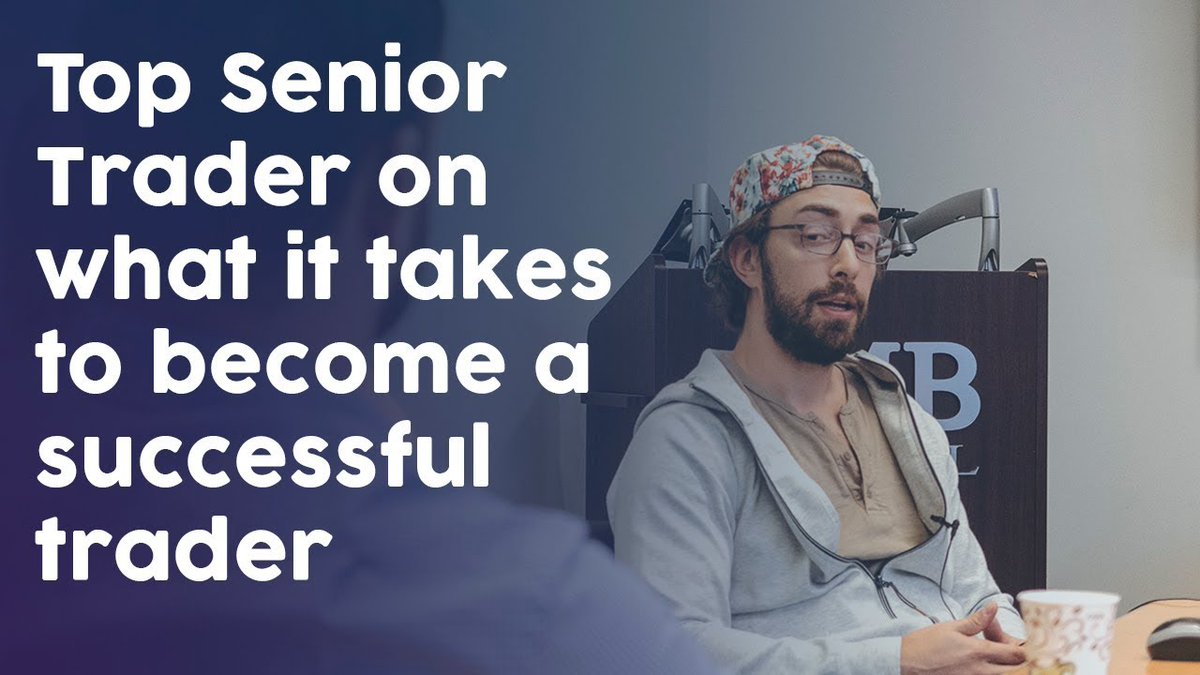
The man who became one of the youngest billionaires by trading Natural Gas:
John D. Arnold.
He was dubbed "king of natural gas", with returns of 150% in 2005.
He was recently interviewed and revealed what it takes to become a great trader and 3 other lessons:
My conversation with John Arnold (@johnarnold).
Few people I've spoken with have as wide a view of the global system as John.
He was one of the most successful energy traders of all time, and after stepping away from markets he built a foundation devoted to solving America's most critical systemic problems in a principled way.
John's recent trip to China was the catalyst for this conversation, and I feel lucky we all get to learn from him.
We discuss:
- His trip to China and what it taught him about robotics, AI, and EVs
- What it takes to be the best (and what it costs)
- Building the best seat in the market
- The state of energy markets today
- NIMBYism as the impediment to progress
- What he thinks about the wave of nuclear startups
- Fixing America's broken systems: healthcare, criminal justice, education, and journalism
Enjoy!
Timestamps:
0:00 intro
0:45 China’s Rapid Transformation
3:53 Lessons from the Chinese EV Market
6:12 Robotics
11:22 The Discipline of an Elite Trader
15:42 Leveraging Scale and Proprietary Data
17:36 Lessons from the Baseball Cards
21:15 Trading Natural Gas and Market Dynamics
25:34 Innovation in the Modern Energy Sector
27:02 High-Level Goals of the U.S. Energy System
32:59 Overcoming NIMBYism
36:10 The Challenges of U.S. Transmission Lines
37:55 The Future of Nuclear, Fusion, and SMRs
44:00 The Economics of Solar and Battery Storage
48:28 Data Center Demand
50:28 Housing Reform
53:32 Rethinking the Role of Philanthropic Foundations
57:05 Improving the Criminal Justice System
1:01:58 Privacy and Security
1:05:03 Education and Life Outcomes
1:06:41 The Promise and Pitfalls of EdTech and AI
1:09:12 Identifying Market Failures in Healthcare
1:12:10 The Role of Regulation Across Different Systems
1:14:06 Journalism as the Fourth Estate
1:16:41 The Kindness of Hard Truths
FEB 2026 @SMBCAPITAL TAKEAWAYS
1. It was universally agreed that February was a slower month versus most of 2025. Traders rightfully pulled back risk considerably.
The big distinction to make is that the market has been rangebound. As a result market plays, swing momentum, and similar need to be reduced.
Where traders deployed risk was in the opportunities moving idiosyncratic from the market like the crypto and SaaS melt.
So so important to recognize when to pullback risk, where to pullback risk, and where to keep swinging the bat.
2. Something happened over the last month where traders are now utilizing Claude and AI at a much higher level than previously seen.
It’s becoming more and more apparent that traders who don’t will face a widening gap in knowledge, speed, and productivity.
3. Now with the Iran war in full-swing, gameplanning is coming to the forefront.
What could the big headlines be? What would be the first and second order impacts of those headlines?
Traders that didn’t have futures access during gold and silver learned their lesson the hard way, but hopefully now are prepared for the extra market access for crude and nat gas which futures provides.
4. Despite the slowdown, traders interestingly weren’t struggling like many did in late 2025. Many have moved to shorter timeframe scalps, hitting singles, and increased selectivity.
Off to NYC for the @smbcapital conference this weekend ✈️🙏
Most people work for money.
Very few know how to make money work for them.
After years of trading and teaching thousands of traders how to manage their money, I've learned this:
Financial stability isn't about luck or loopholes.
It's about having a system.
The same discipline that makes a good trader makes a financially secure person. Track your numbers, plan ahead, and make decisions based on data, not emotion.
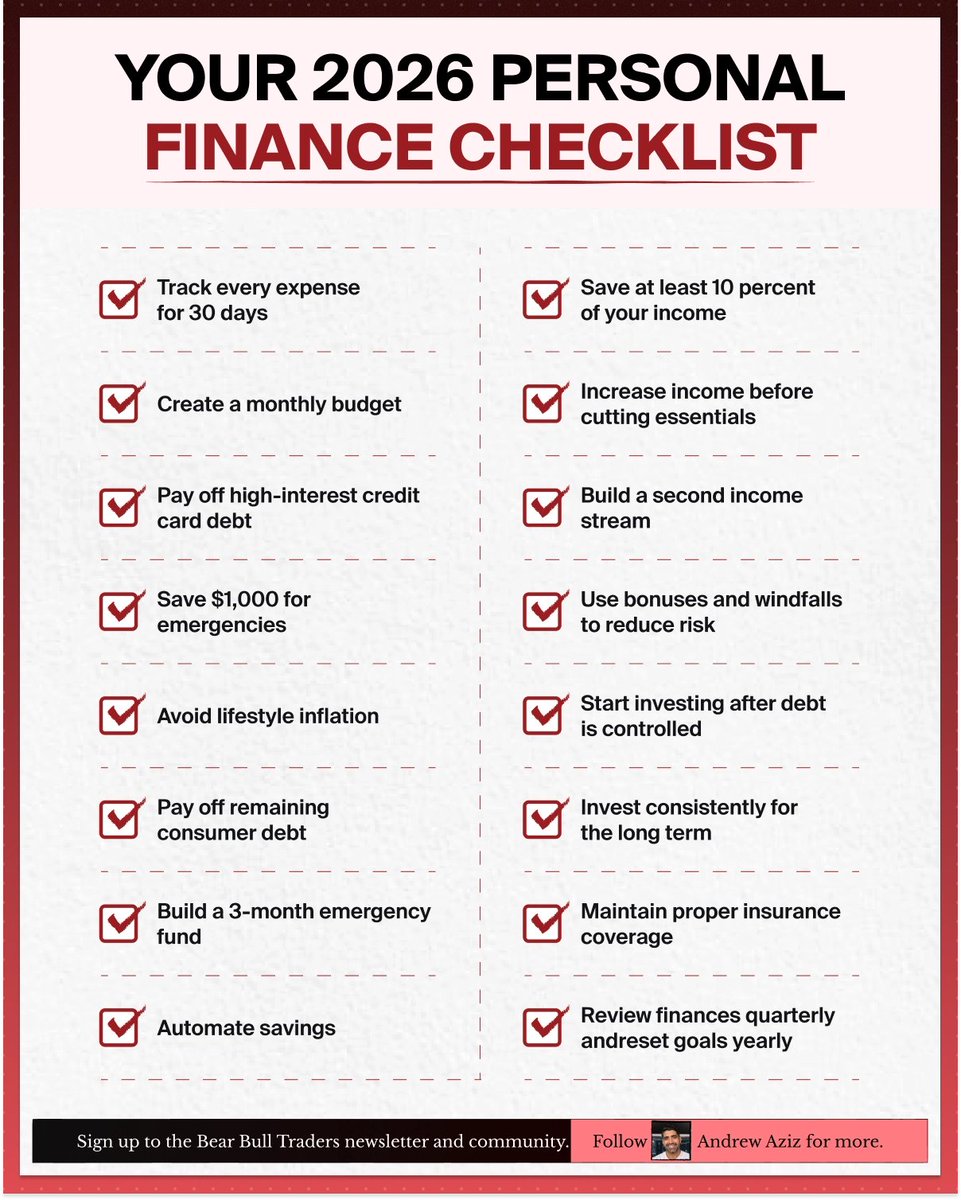
If you're not sure where to start, here's a 16-point checklist I use to stay on top of my finances year-round:
Build Your Foundation:
→ Track every expense for 30 days.
→ Create a monthly budget.
→ Pay off high-interest credit card debt.
→ Save $1,000 for emergencies.
→ Avoid lifestyle inflation.
→ Pay off remaining consumer debt.
→ Build a 3-month emergency fund.
→ Automate savings.
Grow Your Wealth:
→ Save at least 10 percent of your income.
→ Increase income before cutting essentials.
→ Build a second income stream.
→ Use bonuses and windfalls to reduce risk.
→ Start investing after debt is controlled.
→ Invest consistently for the long term.
→ Maintain proper insurance coverage.
→ Review finances quarterly and reset goals yearly.
How many of these are you ticking off right now?
Free and fair elections are the cornerstone of our democracy. But right now, they’re under attack.
Several Republican-controlled states have redrawn their congressional maps to give themselves an unfair advantage in the midterm elections.
Now Virginia has a chance to help level the playing field. If you live in the Commonwealth, early voting begins March 6, and Election Day is on April 21. Vote YES.
BREAKING: THE IRAN WAR STACK
These are the names most people will miss and who will benefit
PRIME DEFENSE
$LMT - Missiles & fighter jets $NOC - Advanced bombers & ISR $RTX - Missile defense systems $GD - Submarines & land systems $LHX - Military communications
DRONES / AUTONOMOUS SYSTEMS
$AVAV - Tactical combat drones $KTOS - Autonomous combat aircraft
SPACE / SATELLITE INFRASTRUCTURE
$RKLB - Defense launch services $ASTS - Space-based connectivity $IRDM - Global satellite network
AI & CYBER WARFARE
$PLTR - Defense AI analytics $CRWD - Cyber threat protection $PANW - Enterprise cybersecurity $NVDA - AI compute backbone $SMCI - AI server infrastructure
POWER / GRID / NUCLEAR
$CEG - U.S. nuclear generation $OKLO - Advanced modular nuclear $VRT - Data center power systems $ETN - Electrical grid equipment
$PWR - Grid engineering / infrastructure
OIL / VOLATILITY
$INDO - Small-cap oil beta $HUSA - Headline oil runner $OXY - U.S. shale producer
$CVX - Global integrated oil $XOM - Integrated energy major
@MikeBellafiore Focus on one goal at a time , and practice till that goal becomes muscle memory for instance you want to practice Tape reading , review your trading tape everyday and also practice using the tape on your demo account everyday