A few random notes from claude coding quite a bit last few weeks.
Coding workflow. Given the latest lift in LLM coding capability, like many others I rapidly went from about 80% manual+autocomplete coding and 20% agents in November to 80% agent coding and 20% edits+touchups in December. i.e. I really am mostly programming in English now, a bit sheepishly telling the LLM what code to write... in words. It hurts the ego a bit but the power to operate over software in large "code actions" is just too net useful, especially once you adapt to it, configure it, learn to use it, and wrap your head around what it can and cannot do. This is easily the biggest change to my basic coding workflow in ~2 decades of programming and it happened over the course of a few weeks. I'd expect something similar to be happening to well into double digit percent of engineers out there, while the awareness of it in the general population feels well into low single digit percent.
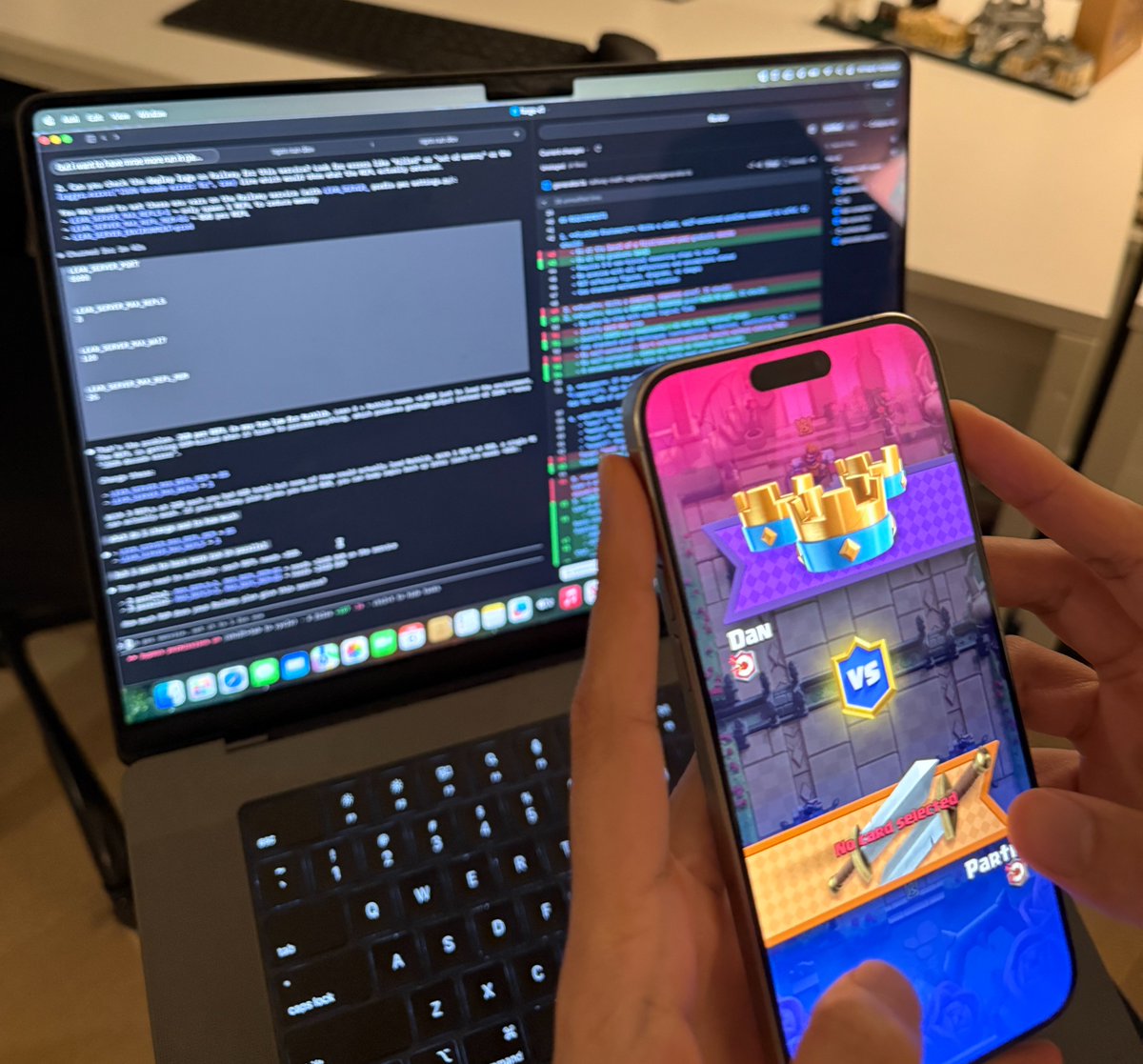
IDEs/agent swarms/fallability. Both the "no need for IDE anymore" hype and the "agent swarm" hype is imo too much for right now. The models definitely still make mistakes and if you have any code you actually care about I would watch them like a hawk, in a nice large IDE on the side. The mistakes have changed a lot - they are not simple syntax errors anymore, they are subtle conceptual errors that a slightly sloppy, hasty junior dev might do. The most common category is that the models make wrong assumptions on your behalf and just run along with them without checking. They also don't manage their confusion, they don't seek clarifications, they don't surface inconsistencies, they don't present tradeoffs, they don't push back when they should, and they are still a little too sycophantic. Things get better in plan mode, but there is some need for a lightweight inline plan mode. They also really like to overcomplicate code and APIs, they bloat abstractions, they don't clean up dead code after themselves, etc. They will implement an inefficient, bloated, brittle construction over 1000 lines of code and it's up to you to be like "umm couldn't you just do this instead?" and they will be like "of course!" and immediately cut it down to 100 lines. They still sometimes change/remove comments and code they don't like or don't sufficiently understand as side effects, even if it is orthogonal to the task at hand. All of this happens despite a few simple attempts to fix it via instructions in CLAUDE . md. Despite all these issues, it is still a net huge improvement and it's very difficult to imagine going back to manual coding. TLDR everyone has their developing flow, my current is a small few CC sessions on the left in ghostty windows/tabs and an IDE on the right for viewing the code + manual edits.
Tenacity. It's so interesting to watch an agent relentlessly work at something. They never get tired, they never get demoralized, they just keep going and trying things where a person would have given up long ago to fight another day. It's a "feel the AGI" moment to watch it struggle with something for a long time just to come out victorious 30 minutes later. You realize that stamina is a core bottleneck to work and that with LLMs in hand it has been dramatically increased.
Speedups. It's not clear how to measure the "speedup" of LLM assistance. Certainly I feel net way faster at what I was going to do, but the main effect is that I do a lot more than I was going to do because 1) I can code up all kinds of things that just wouldn't have been worth coding before and 2) I can approach code that I couldn't work on before because of knowledge/skill issue. So certainly it's speedup, but it's possibly a lot more an expansion.
Leverage. LLMs are exceptionally good at looping until they meet specific goals and this is where most of the "feel the AGI" magic is to be found. Don't tell it what to do, give it success criteria and watch it go. Get it to write tests first and then pass them. Put it in the loop with a browser MCP. Write the naive algorithm that is very likely correct first, then ask it to optimize it while preserving correctness. Change your approach from imperative to declarative to get the agents looping longer and gain leverage.
Fun. I didn't anticipate that with agents programming feels *more* fun because a lot of the fill in the blanks drudgery is removed and what remains is the creative part. I also feel less blocked/stuck (which is not fun) and I experience a lot more courage because there's almost always a way to work hand in hand with it to make some positive progress. I have seen the opposite sentiment from other people too; LLM coding will split up engineers based on those who primarily liked coding and those who primarily liked building.
Atrophy. I've already noticed that I am slowly starting to atrophy my ability to write code manually. Generation (writing code) and discrimination (reading code) are different capabilities in the brain. Largely due to all the little mostly syntactic details involved in programming, you can review code just fine even if you struggle to write it.
Slopacolypse. I am bracing for 2026 as the year of the slopacolypse across all of github, substack, arxiv, X/instagram, and generally all digital media. We're also going to see a lot more AI hype productivity theater (is that even possible?), on the side of actual, real improvements.
Questions. A few of the questions on my mind:
- What happens to the "10X engineer" - the ratio of productivity between the mean and the max engineer? It's quite possible that this grows *a lot*.
- Armed with LLMs, do generalists increasingly outperform specialists? LLMs are a lot better at fill in the blanks (the micro) than grand strategy (the macro).
- What does LLM coding feel like in the future? Is it like playing StarCraft? Playing Factorio? Playing music?
- How much of society is bottlenecked by digital knowledge work?
TLDR Where does this leave us? LLM agent capabilities (Claude & Codex especially) have crossed some kind of threshold of coherence around December 2025 and caused a phase shift in software engineering and closely related. The intelligence part suddenly feels quite a bit ahead of all the rest of it - integrations (tools, knowledge), the necessity for new organizational workflows, processes, diffusion more generally. 2026 is going to be a high energy year as the industry metabolizes the new capability.
with LLM powered coding people confuse the idea of "going faster"
they say "it makes me 10x faster" but what's actually happening is 10x less exertion
it doesn't even matter if it's slower, less exertion still wins
New 2h11m YouTube video: How I Use LLMs
This video continues my general audience series. The last one focused on how LLMs are trained, so I wanted to follow up with a more practical guide of the entire LLM ecosystem, including lots of examples of use in my own life.
Chapters give a sense of content:
00:00:00 Intro into the growing LLM ecosystem
00:02:54 ChatGPT interaction under the hood
00:13:12 Basic LLM interactions examples
00:18:03 Be aware of the model you're using, pricing tiers
00:22:54 Thinking models and when to use them
00:31:00 Tool use: internet search
00:42:04 Tool use: deep research
00:50:57 File uploads, adding documents to context
00:59:00 Tool use: python interpreter, messiness of the ecosystem
01:04:35 ChatGPT Advanced Data Analysis, figures, plots
01:09:00 Claude Artifacts, apps, diagrams
01:14:02 Cursor: Composer, writing code
01:22:28 Audio (Speech) Input/Output
01:27:37 Advanced Voice Mode aka true audio inside the model
01:37:09 NotebookLM, podcast generation
01:40:20 Image input, OCR
01:47:02 Image output, DALL-E, Ideogram, etc.
01:49:14 Video input, point and talk on app
01:52:23 Video output, Sora, Veo 2, etc etc.
01:53:29 ChatGPT memory, custom instructions
01:58:38 Custom GPTs
02:06:30 Summary
Link in the reply post 👇
just one more ai provider bro. I promise bro just one more ai provider and it'll fix everything bro. bro, just one more ai provider. please just one more, one more ai provider and we can fix this whole problem bro, bro cmon just give me one more ai provider i promise bro
For those who haven't come across it yet, here's a handy trick to discuss an entire GitHub repo with an LLM:
=> Just replace "github" with "gitingest" in the url, and you get the whole repo as a single string that you can then paste in your LLMs
There's a new kind of coding I call "vibe coding", where you fully give in to the vibes, embrace exponentials, and forget that the code even exists. It's possible because the LLMs (e.g. Cursor Composer w Sonnet) are getting too good. Also I just talk to Composer with SuperWhisper so I barely even touch the keyboard. I ask for the dumbest things like "decrease the padding on the sidebar by half" because I'm too lazy to find it. I "Accept All" always, I don't read the diffs anymore. When I get error messages I just copy paste them in with no comment, usually that fixes it. The code grows beyond my usual comprehension, I'd have to really read through it for a while. Sometimes the LLMs can't fix a bug so I just work around it or ask for random changes until it goes away. It's not too bad for throwaway weekend projects, but still quite amusing. I'm building a project or webapp, but it's not really coding - I just see stuff, say stuff, run stuff, and copy paste stuff, and it mostly works.
Misconception: SEO doesn't matter anymore, we're all going to answer engines like @perplexity_ai.
Reality: answer engines and agents search the web to be up to date, and the motivation to rank high in *those* search results is still there.
BUT things are changing as Google continues to get "unbundled":
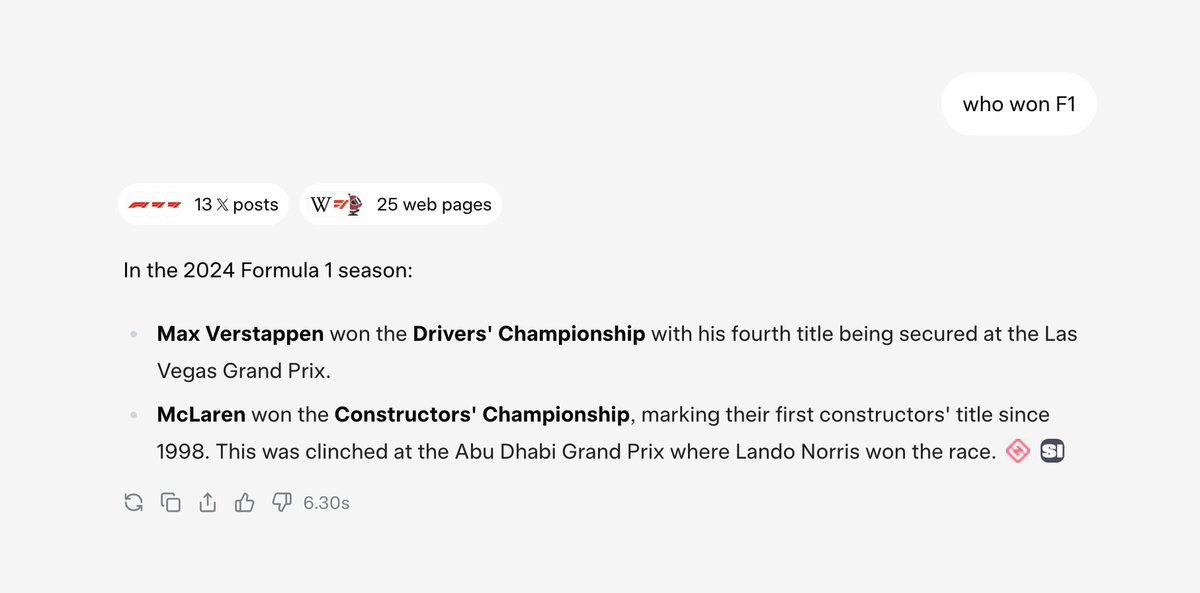
◾︎ Answer engines are not going to (exclusively) use Google Search. @grok notably [pictured below] merges in a first-party feed of @x posts.
◾︎ Large clusters of queries are going to expert, in-situ AI products like @v0 and @cursor_ai. The search is not being made, because v0 can go straight to the sources that it's highly optimized for (and cutting out SEO spam like w3schools!)
◾︎ The crawling, indexing, and source curation infrastructure is rapidly decentralizing. @exaailabs produces curated "websets" for expert AI systems to consume. It's very likely agents will prefer to query these than performing 'generic' web searches.
◾︎ As a website or product owner, while you previously mostly had to use one thing to understand your SEO health (Google Search Console / Webmaster Tools), now you have to worry about what the large AI chatbots say about you and your brand. This is not limited to search results, but also what the LLM overall "thinks" about you. Products like @profound are looking to help you scale this monitoring.
Meet Willow: Our state-of-the-art quantum chip. It's the first quantum chip to show exponential error reduction as qubits scale, paving the way for large-scale, fault-tolerant quantum computers. Dive in → https://t.co/Lr1vkZk1QT
People have too inflated sense of what it means to "ask an AI" about something. The AI are language models trained basically by imitation on data from human labelers. Instead of the mysticism of "asking an AI", think of it more as "asking the average data labeler" on the internet.
Few caveats apply because e.g. in many domains (e.g. code, math, creative writing) the companies hire skilled data labelers (so think of it as asking them instead), and this is not 100% true when reinforcement learning is involved, though I have an earlier rant on how RLHF is just barely RL, and "actual RL" is still too early and/or constrained to domains that offer easy reward functions (math etc.).
But roughly speaking (and today), you're not asking some magical AI. You're asking a human data labeler. Whose average essence was lossily distilled into statistical token tumblers that are LLMs. This can still be super useful ofc ourse. Post triggered by someone suggesting we ask an AI how to run the government etc. TLDR you're not asking an AI, you're asking some mashup spirit of its average data labeler.