@mattshumer_@JasonKuperberg Congrats on what you’ve built! Curious what direction you’re exploring next, especially as AI products move toward more adaptive and personalized experiences.
@dzhng State machines make much more sense once agents need to recover from failures. Curious how you'd handle unexpected states without making the system too rigid
@mattshumer_@JasonKuperberg Curious whether the next generation of AI products will be built around better interfaces, or interfaces that gradually disappear altogether.
We'll be spending a lot more time trying to understand the outputs of language models. A few thoughts, tips & tricks:
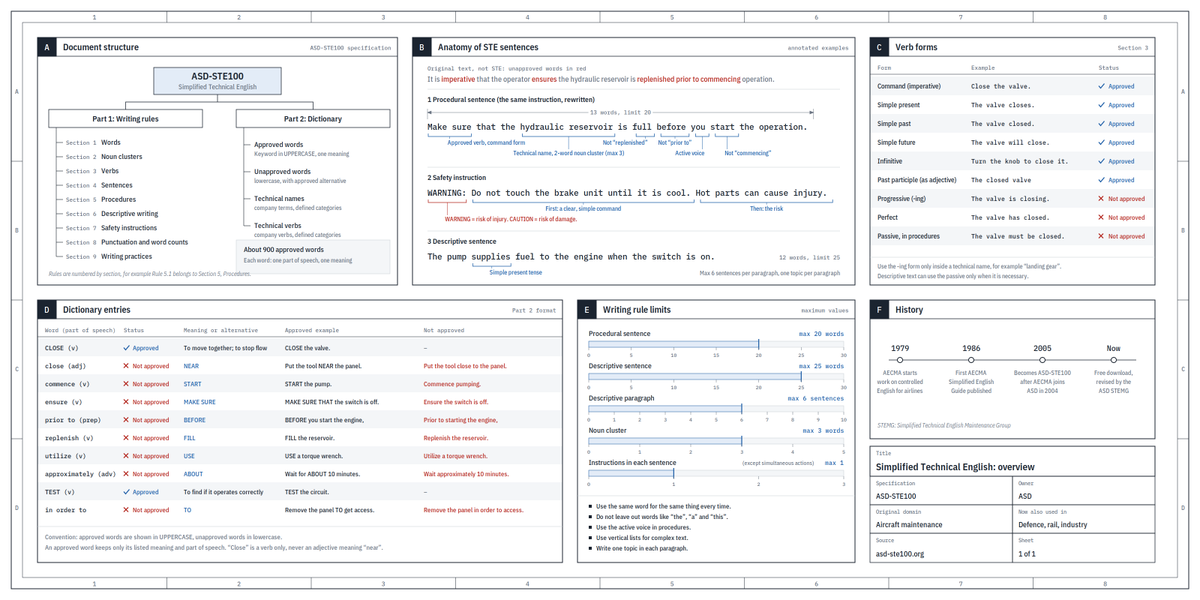
Writing. Something I've had success with: Ask your LLM to explain something in ASD-STE100, it's a controlled language specification originally developed for aerospace maintenance documentation. LLMs well-versed in this language and it comes with heavy constraints on clean writing style that I often find a lot more readable. Sometimes I've tried to soften it a bit e.g. ask for "80% of the way to ASD-STE100" because the spec is quite stringent. But even better:
Diagrams / images. Instead of writing, ask your LLM to create a diagram. These can be a lot easier to process, parse, and understand. But even better:
Web pages. Ask for output "in HTML" to get a beautiful, interactive webpage. LLMs are getting really good at frontend and can create beautiful experiences, animations, etc. But even better:
Explainer videos. The output format I am most bullish on is fully custom / bespoke explainer videos generated on any arbitrary topic. Experiment with things like "Create a 3b1b style video explainer on X. Use my ElevenLabs API key for audio narration". (you'd need an API key for the latter or you can ask your LLM to find you decent free alternatives that use your local compute). This is actually starting to work!
In summary:
- As LLMs get better, they will do more and more of the legwork autonomously, and a lot more of our work will rise up the abstractions into oversight and understanding.
- Luckily, LLMs can help here too because as intelligence and code are increasingly abundant, you can ask for large, custom, discardable software artifacts (e.g. web apps, video explainers) that would have never made sense to create before. Push the boundaries here and you'll be surprised.
I still don't understand why people are still explaining themselves to AI from scratch every single day
a hundred times this year, you told it who you are. a hundred times, it forgot
five minutes fixes this:
create a folder → name it raw → drop in any source, article, transcript, PDF, voice memo
tell the model to read it once → link it to everything already there → never touch it again
create one more file → name it CLAUDE.md → who you are, what you're building, what already failed
now every session starts here → the model reads it automatically → before you type a single word
ask it anything across everything you've ever fed it → it answers from months of compiled understanding → not from zero
most people quit around month one → nothing looks like it's working yet → that's exactly where the value starts
five minutes to set up. you never explain yourself from scratch again
this is the first AI setup that genuinely scared me
GPT-6 Sol thinks. Jev decides. Grok Bot does the work. together they do a whole team's job for pocket change
alone, each one hits a wall. Jev can't write a sentence. Sol has no computer or phone of its own. and one builder put the last part best: "12 Grok Bots without Jev are just 12 tabs"
i couldn't find anyone running all three together. so i spent the last 48 hours wiring them into one team:
→ one group chat, 4 Grok Bots: Boss, Scout, Writer, Closer. they pass work to each other, you just read the chat
→ Boss plans the day with GPT-6 Sol. in one public test Sol did the same job as Opus 5.5 for $0.08 instead of $0.69, 4x faster
→ Scout pulls every lead in your niche and Jev asks each one 6 quick questions. one builder ran 3,412 leads like this: 20,472 decisions in 15.7 seconds for $0.41
→ only real buyers reach Writer, and Sol drafts every pitch. tricky lead? Jev tells Sol to think harder. easy one? it tells it to relax. that trick alone cut one setup's bill in half
→ Closer sends from your email after you tap approve. Telegram gets the scoreboard every night
the 6-hour job of reading leads now takes 16 seconds. your laptop stays shut
most people pay their smartest AI to say "skip" all day. this stack pays Jev a fraction of a cent for it
Claire Vo already runs about 30 Grok Bots. one prints her kids a newspaper every morning. another gets 5-star reviews from customers who have no idea it's a bot
every day you wait, someone's Scout reaches the client you would've gotten
bookmark this before someone's bot takes your clients
We’ve automated every single thing we can @every with AI agents.
And yet there’s way more human work to do than ever. We’ve gone from 4 -> 30 human employees since GPT-3.
I wrote a report on the structural reasons: how AI makes expert competence cheap, why that drives up demand for experts, and why the dynamic only intensifies as we approach AGI.
After Automation: https://t.co/Lb7SUCduAg
9 cool GPT 6 Astra prompts worth trying:
1. The bill renegotiator.
"Go through my internet, phone, and software bills, jump into each provider's chat support, and negotiate them down or cancel what I'm not using."
2. Turn an agency into software.
“Pick one service business in [niche] and reverse-engineer the exact workflow they sell to clients. Break it into steps, tools used, inputs, outputs, human judgment points, and places where the work gets slow or expensive. Then design the simplest AI product that could replace the first version of that service and charge $500-$5,000/month.”
3. Garage sale flipper.
"Watch Facebook Marketplace and Craigslist in my city for [cameras / furniture / bikes] listed way under market, and text me the second one's mispriced with the link."
4. Create my 1 person company dashboard.
“Look at my docs, notes, Stripe exports, analytics, customer calls, and project list, then build a weekly operator dashboard. I want to know what is making money, what is wasting time, what customers are asking for, what I should stop doing, and the three highest-leverage actions for next week. Be blunt and show your work.”
5. Audit my company for agent opportunities.
“Look at how this business works and find the tasks we should give to agents before hiring another person. For each task, estimate the current human time, the cost of mistakes, the tools involved, the difficulty of automating it, and the first safe version we could deploy. Prioritize things that save money or create revenue within 30 days.”
6. Be my browser operator.
“Use the browser to complete this workflow: [workflow]. As you go, click through the actual sites, collect the data, fill the forms where appropriate, and keep notes on what broke or slowed you down. When you’re done, give me the output, the repeatable SOP, and the automation plan so this can become an agent.”
7. The whole QA team.
"Every night, open my app on a real phone, go through signup, checkout, and the main flows, and screenshot anything that's broken or confusing."
8. The competitor spy.
"Sign up for my top 3 competitors, sit inside their product and their emails, and send me a monthly report on every new feature, price change, and thing they do better than us."
9. Make a game people would actually play for 5 minutes as a lead magnet
“Build a browser game around this mechanic: [mechanic]. Don’t just make a cute demo; add progression, tension, scoring, failure, polish, and one reason someone would send it to a friend. Then add lead capture (email/sms), it needs to tie into my core product which sells XYZ.”
Introducing Atlas:
The world's first multimodal world model that generates image and video frames with pixel-perfect camera control and reconstructs them in 3D.
Model the world, move the camera, and simulate space & time.