Dana-Farber launches new platform co-developed with @nyulangone to bring its cancer treatment expertise directly to oncologists’ clinical workflow. @DanaFarber
Read more here: https://t.co/EjcT0ybWHx
It could be unsustainable for a practice in its current structure. Imagine if LLMs list out 20 questions/trial options/treatment options for a patient query, and the MD is asked to decipher/personalize a response in a 20-30 min visit! Also All current LLMs are biased to agree with the reader and the MD has the burden to disprove the claim/recommendations, which is onerous.
Need actionable MRD assays, hope prospective validation allows confirmation of these results. Key challenge is post op ctDNA pos pts(6 in this small trial), need effective adjuvant therapy (?Tdxd) to impact RFS. Current use of pCR is repeatedly proving a poor surrogate endpoint in isolation. great trial! @adawaksmd@DFCI_BreastOnc@PTarantinoMD
The ctDNA analysis of DAPHNe was the first project I had the chance to work on when I moved from 🇮🇹 to Boston 🇺🇸 in 2021.
Ada Waks (@adawaksmd) had led the clinical study at @DFCI_BreastOnc, showing that approximately half of patients with (mostly) stage II HER2+ breast cancer achieve pCR with THPx12, and that virtually all physicians feel comfortable with omitting further adjuvant chemo if the patient experienced pCR
We had the clinical data and the plasma samples prospectively collected. We lacked a ctDNA assay to test MRD. Here’s where serendipity took place.
Salt Lake City, 2022, cancer conference. A feisty guy approaches me with a bold pitch. “We recently developed one of the most sensitive MRD assays out there. We plan to take it to the clinic, and we’d love to partner to make it happen”. Music to my ears.
We eventually established a collaboration with @PersonalisInc which proved instrumental to successfully conducting the MRD analyses in DAPHNe.
Thanks to this partnership, we uncovered several interesting findings:
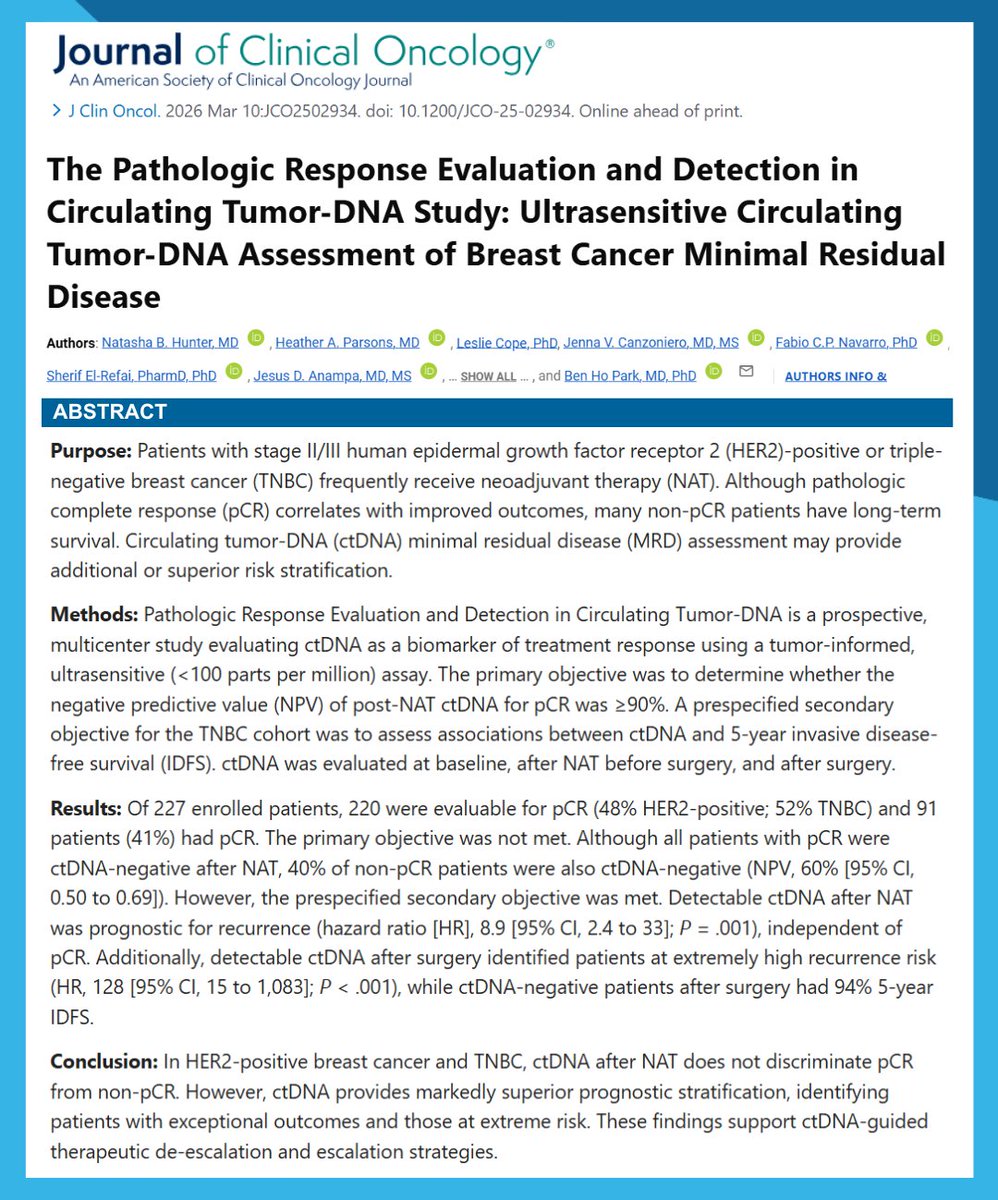
- >90% of patients with mostly stage II HER2+ breast cancer have detectable MRD at baseline if using an ultrasensitive assay — which is higher to what previously reported with less sensitive assays
- virtually all patients clear MRD during neoadjuvant THP treatment
- MRD clearance is not associated with pCR, however…
- the rate of MRD clearance appeared very consistent with long-term outcomes, i.e. no patient developed distant recurrence (despite only half experiencing a pCR)
- at the time of the only local recurrence observed, the patient had detectable MRD, which cleared after resection. Less sensitive assays have historically been suboptimal to detect local recurrences.
This DAPHNe analysis was only a small step in the direction of understanding how to leverage the promise of MRD for tailoring breast cancer treatment. But it did show the promise of ultrasensitive assays, a promise to be validated in dedicated studies.
And, to me, it proved the importance of serendipitous connections, reminding me to remain open to spontaneous encounters and to partnerships.
Thanks to all the team at @PersonalisInc for being great collaborators, and to the @DFCI_BreastOnc translational and statistical teams for all the hard work on the analysis.
https://t.co/QdOcNQ8eMq
Cautious optimism for OPTIMA trial at #ASCO2026. Thx investigators for this pragmatic, Prospective, RCT as unmet need to de-escalate chemo.
• Prosigna (PAM50) ROR-guided, in high-risk HR+ HER2- eBC
. met NI. Low ROR subgroup (~68%): 5-y IBCFS 94.8–94.9% v 93.6–93.7%; HR ~1.06
• Included ≥40yo w/ up to 9 LNs or LN-neg >3cm tumor; 37% premeno w/ OFS; 73% pN1, 19% pN2
👉🏻 IMO- Not YET ready for practice change
• Only ~4yr median FU (many premeno still on OFS to yr 5)
• ER+ long natural history → late recurrences possible; 1-1.5% abs diff may grow
. not powered for superiority. ~ 280 events so far.
• ❌Caution in <40yo - higher-risk biology
• N2 premenopausal subgroup not powered (~7% of total pts)
• >50% eligible for adjuvant CDK4/6 in RW. await mature data #ASCO2026 #OPTIMAbstudy
@AbiSivaMD@PathologyPat@muschollings Might help select I/o sensitive disease in this otherwise cold histology. Especially seeing mPIK3Ca enriched! Tissue based TMB still ideal. Nice correlative study!
In met Prostate Ca, darolutamide is FDA-approved for M0 (non-metastatic) CRPC with the goal of preventing clinical progression — i.e., bone mets. These are pts with only biochemical progression (M0 disease) who have an approved drug whose endpoint is radiographic PFS.
Is a similar rPFS benefit meaningful in breast Ca ?
Potential breakthrough for metastatic pancreatic cancer - DARAXONRASIB (Revolution Medicines): Ph3 RASolute‑302 in previously treated PDAC showed median OS 13.2 vs 6.7 months with chemo (HR 0.40, p<0.0001); met all PFS/OS endpoints and was well tolerated. Oral RAS(ON) inhibitor targets active mutant KRAS (mutated in ~90% PDAC) , driving tumor initiation, growth, metastasis and therapy resistance by hyperactivating MAPK/PI3K signaling. Targeting oncogenic RAS could finally turn a central tumor driver into a therapeutic vulnerability @DanaFarber_Hale@ASCO@PanCanResearch
Thanks Sarah, very helpful & imp to include these in guidelines for therapy change. Esp critical in bone only Mets & assessing ADC or I/o responses. Integrating radiology +tumor markers+clinical+ctDNA with rising TF helps(when scans equivocal)
In mBC, not all imaging changes mean your therapy has stopped working and switching too early is a real risk.
1/ RECIST 1.1 sets a clear bar for progression: ≥20% increase in the sum of target lesion diameters (with ≥5mm absolute increase), unequivocal progression of non-target lesions, or new lesions. Not every change on imaging meets this threshold.
2/ Three scenarios commonly and incorrectly flagged as progression: new asymptomatic sclerotic bone lesions, small mm asymptomatic changes in known lesions, and increased SUV on PET without corresponding size change. None of these, in isolation, trigger a therapy switch for me.
3/ Sclerotic bone lesions deserve particular attention. When effective therapy kills tumor cells in bone, the body lays down new bone matrix appearing dense and white on CT. This is a healing response, not new disease.
4/ The consequences of switching too early are real: loss of disease control from a working regimen, premature exhaustion of sequencing options.
5/ My approach: I integrate clinical symptoms, tumor markers, and serial scans together before making any decision to change therapy.
6/ Bottom line: confirm true progression before changing course. When in doubt, a short interval rescan is almost always preferable to an unnecessary switch.
#BreastCancer #MedOnc
Thnx for pointing out Mark! This should include trial mandated frequency of scans and testing, ex: on Herceptin, echo monitoring q3 mths in the absence of symptoms, makes no sense, especially if LVEF impact is reversible in all! We all have pts getting these ‘surveillance’ echocardiograms for years!
@dr_yakupergun@PTarantinoMD Agree with Paulo, it’s the best PFS of 44 mth in her2 positive disease so far! Destiny 09 was 40.7 mth in front line. Palbo is so well tolerated & low likelihood of neutropenia leading to infections, again manageable with dose mods if needed.
PATINA@nejm. Since 2015 approval of palbociclib, we now finally confirm benefit in HR+Her2 pos mBC after a decade of use in HR+Her2neg mBC! unprecedented 44.3 mths PFS now possible in ~10% of all mBC
Real world implications of PATINA, HER2C05 & DB09:
🔆 post induction THP -> HP + palbo /AI now SOC.
🔆 Her2C05 likely SOC in HRneg. But in select pts as tolerability - GI tox concerns if frail, low volume disease, where HP alone is easier.
🔆 Even in “exceptional” responders to THP, we should add Palbo early as better systemic control likely improves CNS PFS as already a signal in this subgroup. Significant absolute diff in CNS PFS of 6% at ~36 mths( ~13% vs 19%).
🔆 Brain Mets- if asymptomatic brain Mets at baseline ( ~12% in HER2CLIMB05, vs ~4% in PATINA) even in HR+, prefer Tucatinib as well established CNS efficacy even though it’s a shorter follow up of ~23 mths
🔆 Next ? Can we combine Tucatinib/Palbo/AI/HP for maintenance esp in Brain Mets? Barring payer coverage issues, there is at least some safety data in Ph 1b/2 trial that Palbo/Tucatinib combo is tolerable, although Palbo dose needed reduction to 75 mg for neutropenia.
🔆 TDxd induction might be ideal in brain Mets, followed by Tucatinib/HP/AI +/-Palbo in maintenance in HR+@NEJM@SABCSSanAntonio@DFCI_BreastOnc@breastcancer
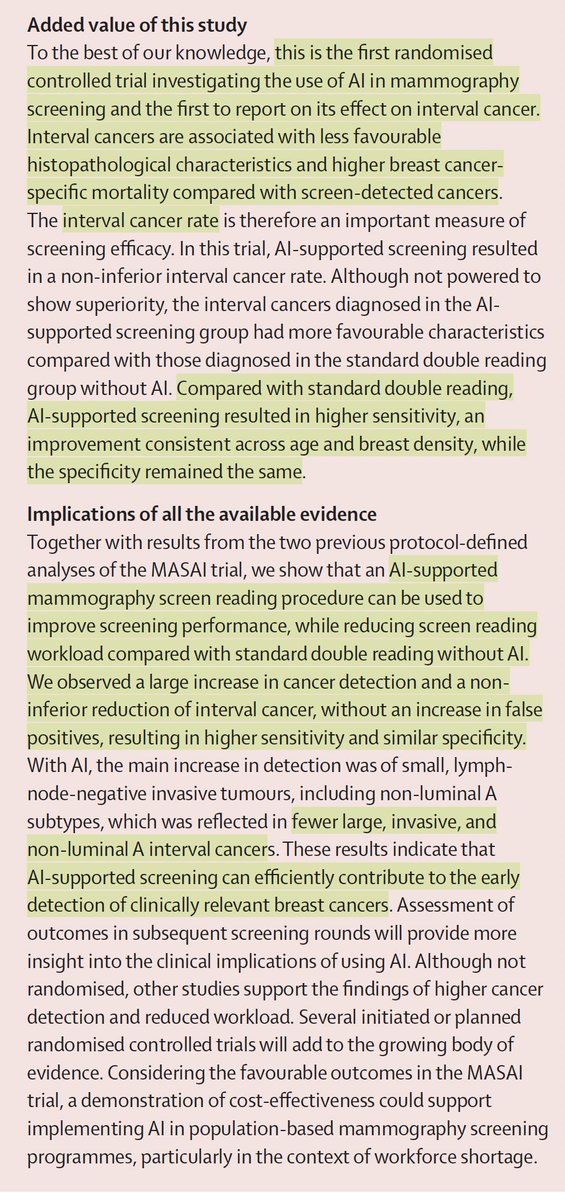
The largest randomized trial of medical A.I.
—Over 100,000 women in Sweden
—radiologist + AI vs 2 radiologists, in follow-up
—AI added led to 29% more cancer detected, 44% reduced workload, and
—Less cancer dx in subsequent 2 years, and, when found, less aggressive
https://t.co/e1hY3F0cGo
PATINA is now out in @nejm. Among pts with HR+/HER2+ MBC progression-free after chemo induction, adding palbociclib to 1L ET+HER2-blockade maintenance prolonged PFS from 29 mo to an astonishing 44 months (HR 0.75, p=0.02). Congrats @Otto_DFCI & coauthors! https://t.co/YoE3Pje9Be
Intrinsic subtyping in HR + Her2 neg, especially Luminal B which may be more endocrine resistant might help clarify risk. We need better agents for Lum B & not sure if adjuvant cdk4/6 alone is sufficient
• Early TNBC: 74.3%
•Non–high-risk HR+/HER2−: 91.2%
⚠️~60% of monarchE-eligible patients did not receive adjuvant abemaciclib
Underuse most evident in N1 disease and older patients
📌 N1 ≠ Low risk
N1 + Grade 3 or tumor ≥5 cm = true high-risk biology
ET alone is insufficient
• Early TNBC: 74.3%
•Non–high-risk HR+/HER2��: 91.2%
⚠️~60% of monarchE-eligible patients did not receive adjuvant abemaciclib
Underuse most evident in N1 disease and older patients
📌 N1 ≠ Low risk
N1 + Grade 3 or tumor ≥5 cm = true high-risk biology
ET alone is insufficient
Micrometastatic axillary disease after neoadjuvant treatment - The Lancet Oncology https://t.co/tehAplGG9M
Post NACT, ypN1mi.
Study asks if ALND reduces axillary recurrence at 3 yrs.
Current SOC- SLND, targeted axillary dissection (TAD) + Regional Nodal Irradiation (RNI) if ypN1mic
Key takeaways
✅ 3 y Axillary Recurrence (Primary endpoint) 2.0% (low)
✅ 1.7% with ALND vs 2.3% w/o ALND (P=0.92)
✅ overall safe to omit completion ALND in most, NOT ALL!
❌ in TNBC. 8.7% risk of recurrence at 3 yr (without ALND) vs 2.4% (with ALND), P=0.018. HR 3.83
❌ omission of Nodal XRT in all HR 2.62.
🔆Practice affirming - in Non TNBC, safe to omit ALND but favor RNI.
In TNBC clearly need RNI, and caution in omitting completion ALND.
🔆 Large sample size(1585 pts), multicenter, diverse groups of histology, stages included.
🔆limitations -retrospective ? possible bias if low risk pts selected for omission of ALND. Short f/u especially HR+ve pts with potential late recurrences. @breastcancer, @TheLancetOncol@ASCOPost@MontagnaGiacomo@SABCSSanAntonio