Brian on why pure people managers won't survive AI:
"I don't think people that only manage people will have any value in the future.
Everyone's going to have to be a hybrid people manager or manager IC.
In other words, even the managers need to code. You can't just be these managers where you're people's therapists and you're just doing meetings, just one-on-ones.
People who have lots of recurring one-on-ones are not going to survive.
That kind of leadership style is not gonna work. You need to have context.
I hear about heads of design, they don't actually manage the design. Johnny Ive manages the design. He designs and he leads people. A design leader who only manages the people that's crazy to me.
The way Frank Lloyd managed his design team is through the work. You don't manage the people, you manage the work.
I think a lot of people will survive this age of AI.
The two types of people that will not survive are pure people managers, and people that are rigid and don't want to change and evolve."
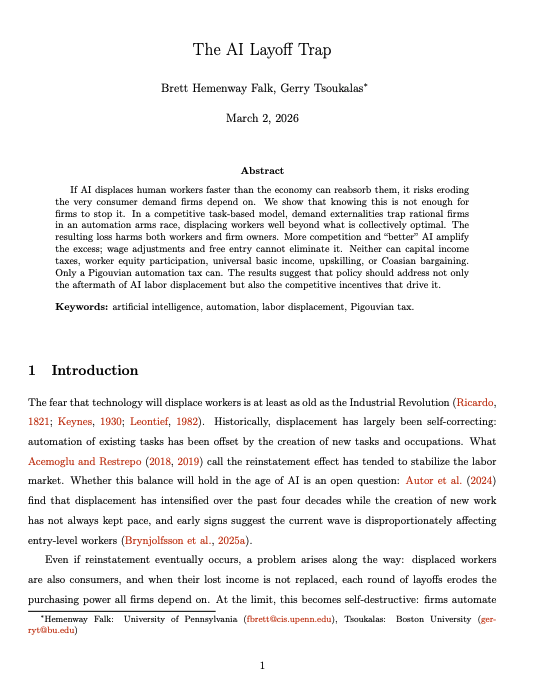
🚨BREAKING: Two researchers from UPenn and Boston University just published a paper that should be uncomfortable reading for every CEO automating their workforce right now.
The argument is straightforward. Every company replacing workers with AI is also eliminating its own future customers. Laid off workers stop spending. Enough of them stop spending and nobody can afford to buy anything. The companies that fired everyone end up selling into an economy with no purchasing power left.
Every executive can see this. The math is not complicated. But here is why nobody stops.
If you do not automate, your competitor does. They cut costs, lower prices, take your market share, and you collapse anyway. So every company automates knowing it is collectively destructive because the alternative is dying alone while everyone else survives. The researchers proved this is a Prisoner's Dilemma playing out in real time.
The numbers are already moving. Block cut nearly half its 10,000 employees this year. Jack Dorsey said AI made those roles unnecessary and that within the next year the majority of companies will reach the same conclusion. Salesforce replaced 4,000 customer support agents with AI. Goldman Sachs deployed a coding tool that lets one engineer do the work of five. Over 100,000 tech workers were laid off in 2025 and AI was cited as the primary driver in more than half those cases. 80% of US workers hold jobs with tasks susceptible to AI automation.
The researchers tested every proposed solution. Universal basic income does not change a single company's incentive to automate. Capital income taxes adjust profit levels but not the per-task decision to replace a human. Collective bargaining cannot hold because automating is always the dominant strategy.
They also identified what they call a Red Queen effect. Better AI does not solve the problem, it accelerates it. Every company chases faster automation to gain market share over rivals but at the end everyone has automated equally, the gains cancel out, and the only thing left is more destroyed demand.
The one thing the math says could work is a Pigouvian automation tax. A per-task charge that forces companies to account for the demand they destroy each time they replace a worker.
The conclusion is that this is not a transfer of wealth from workers to owners. Both sides lose. Workers lose income. Companies lose customers. It is a deadweight loss with no market mechanism to stop it on its own.
(Link in the comment)
I didn’t understand good execution until I saw how bad it can get. Good read on what good execution actually looks like | Yusuf Aytas https://t.co/imWdGDW4au
Happy Earth Day! 🌎 🌍 🌏
To mark this special day, we’re tuning in to @sen, the world’s first continuous 4K video livestream from space.
Sen’s cameras are hosted on our Columbus module of the International @Space_Station, with data delivered via the @AirbusSpace platform.
Streaming in real time, it shows breathtaking views of our planet as the International Space Station passes over cities, oceans and deserts.
Watch Earth from above, just like our astronaut @SophieAdenot does on the #εpsilon mission.
📹 Sen
today’s amazing new AI-designed artifacts will look like slop in a month, once everyone learns to recognize the patterns the model falls back on. like AI-generated writing, the output isn’t objectively “bad,” (in fact it is often technically quite good), but once it becomes predictable, it reveals itself as recognizably “AI.”
this is undesirable because it exposes two separate skill issues:
1. the person lacks the design (or writing) taste to realize their work reads as obviously “AI”
2. they also lack the prompting skill to steer the model away from its default patterns
this is why there will always be a signaling arbitrage opportunity in keeping a human in the loop for creative and many kinds of knowledge work, no matter how good the tools/models get
Sky full of stars.
Following a successful lunar flyby, the Artemis II astronauts captured this breathtaking photo of our galaxy, the Milky Way, on April 7, 2026.
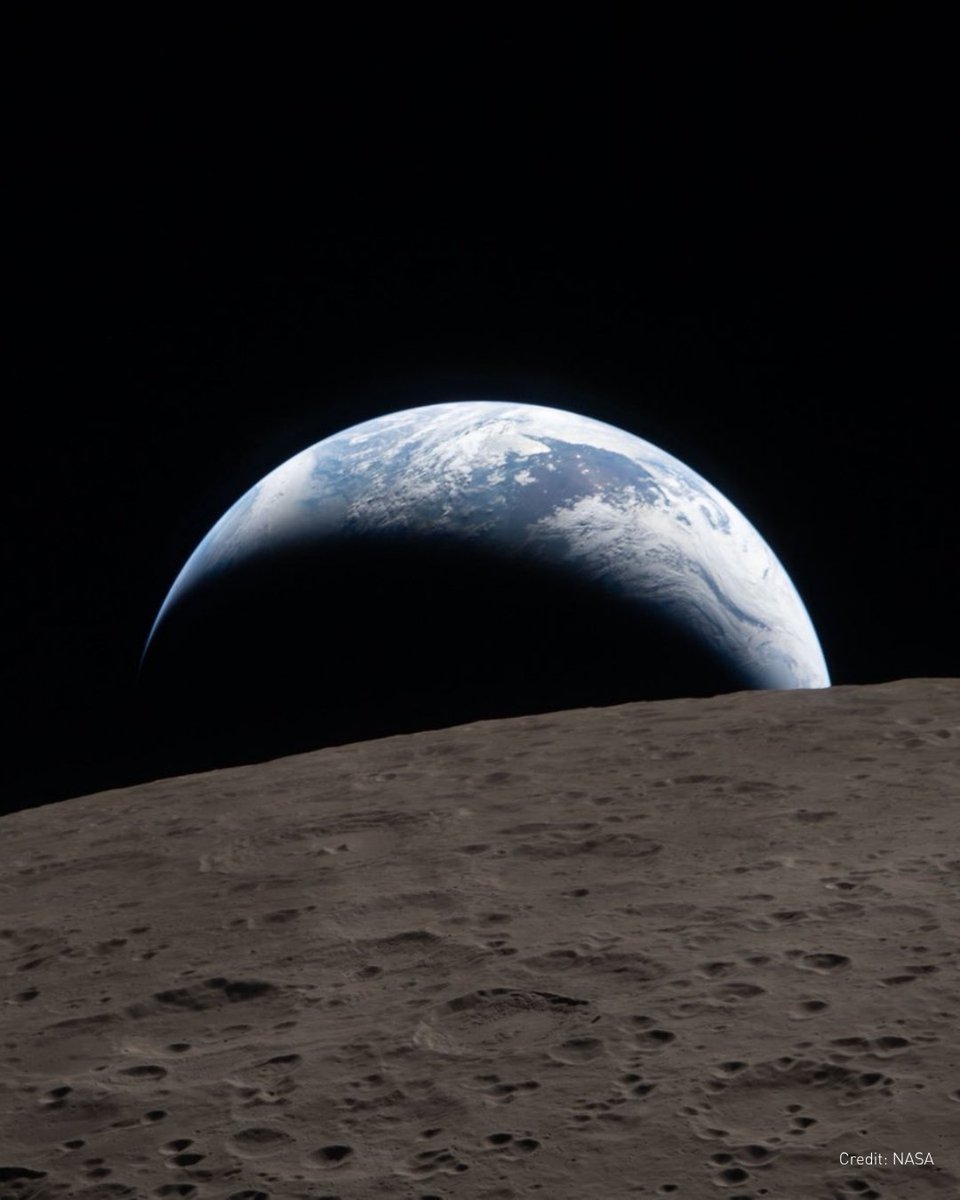
An Earthset and a solar eclipse for the Artemis generation. 🌒
@NASA's Orion spacecraft, carrying four astronauts on an historic journey into deep space, returned from its communications blackout yesterday and delivered stunning views of the Earth and all of humanity from the Moon.
They said it would save time.
They didn’t say I’d spend it maintaining it.
The Last Quiet Thing | Terry Godier https://t.co/3dw8XnTbGi
This one struck a chord, good read.
We see our home planet as a whole, lit up in spectacular blues and browns. A green aurora even lights up the atmosphere. That's us, together, watching as our astronauts make their journey to the Moon.
The 5th Design Systems Report is here 📔
Design systems are now critical infrastructure—but they’re getting harder to sustain.
Buy-in is dropping. Teams are stretched. Adoption is still the biggest challenge.
Explore the report → https://t.co/elJZX2YHUM
it’s wonderful to bring your teammates in for a design crit session. right? RIGHT??
or does it usually just feel like… noise?
one person starts suggesting new ideas. another tries to choose a direction. someone else is already adjusting spacing in website's navbar.
when everyone is running a different kind of critique at the same time, things get messy fast.
at @IDEO I learned that teams who name the critique mode upfront get dramatically better feedback. sharper eyes, fewer ego collisions.
so here’s a simple way to bring your pals on board for an in-house design critique (packaged in a Swiss design style poster I designed with @Framer).
1. INSPIRE
pull this when the work feels stuck, flat, or you’re looking for fresh angles.
ask:
→ what real-world work out there scratches a similar itch?
→ what feeling are we trying to evoke that we haven’t
visualized yet?
→ what adjacent fields could influence this idea?
what you might post in team Slack:
“hey everyone, this one is more of an inspire session; I’m not looking for judgment yet, just new directions we could explore.”
2. PROVOKE
use this when the work is fine… but safe. you want edges, friction, surprises.
ask:
→ how would this look if it were way more extreme?
→ what would a competitor never dare to do?
→ where are we playing it too safe?
what this might sound like:
“can we go into provoke mode here? assume this is too safe — what’s the bold version?”
3. DECIDE
this is the crossroads mode. the work has promise, but the direction isn’t clear yet.
ask:
→ which direction best supports the project objective?
→ what would we regret not pursuing?
→ what should we edit down or remove?
what this might sound like in a meeting:
“hey everyone, I think we’re in decide mode — which of these concepts actually aligns with the goal?”
4. NUDGE
pull this when the concept is working and you’re improving it, not reinventing it.
ask:
→ where could this be refined or pushed further?
→ what does the audience need that isn’t clear yet?
→ what part of this feels inconsistent?
what you might write in the calendar invite:
“this one is more of a nudge critique — let's assume the concept is right, what would make it stronger?”
5. NIP & TUCK
when the ship date looms and the work needs final polish.this isn’t generative critique anymore. it’s fine-tuning.
ask:
→ if we had one more day or week, what would we perfect?
→ what tweak would elevate the whole piece?
→ what can we remove to make this clearer?
what this might sound in a work session:
“we’re basically in nip & tuck mode, just looking for the small things that make this cleaner before shipping.”
most painful critiques happen because the room is in five different modes at once.
so before your next design crit, try simply saying:
“thanks for coming! today we’re in nip & tuck mode.”
it changes the entire conversation. good luck!
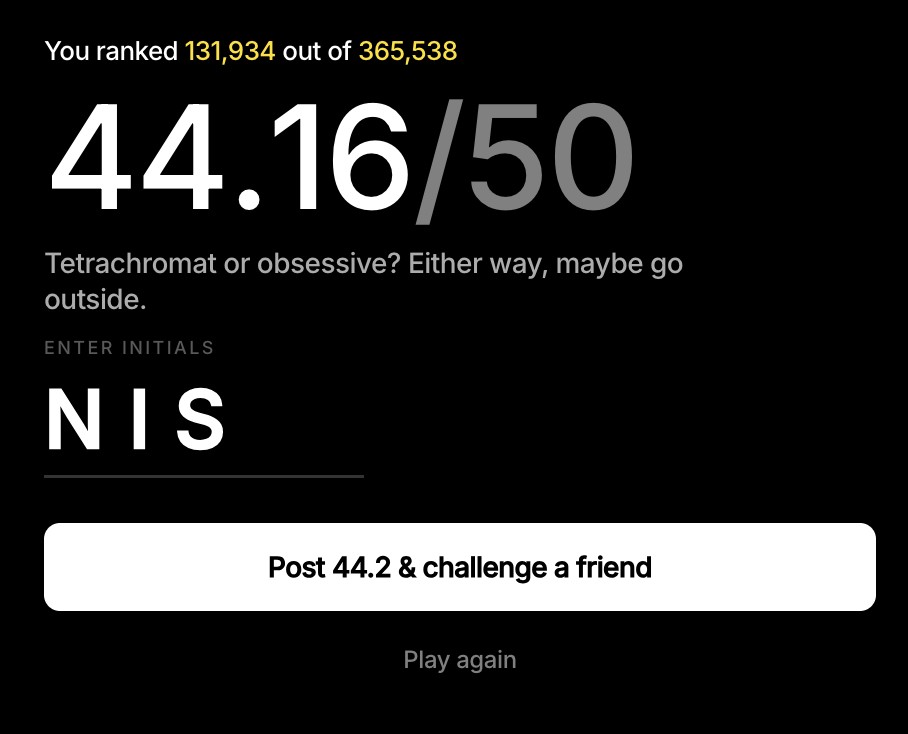
Playing with Cursor today and made a dumb game that illustrates how bad humans are at recalling color.
Give it a try. Best score by the @lightspark Design team so far is 45.6.
https://t.co/h3wqZASUJ4