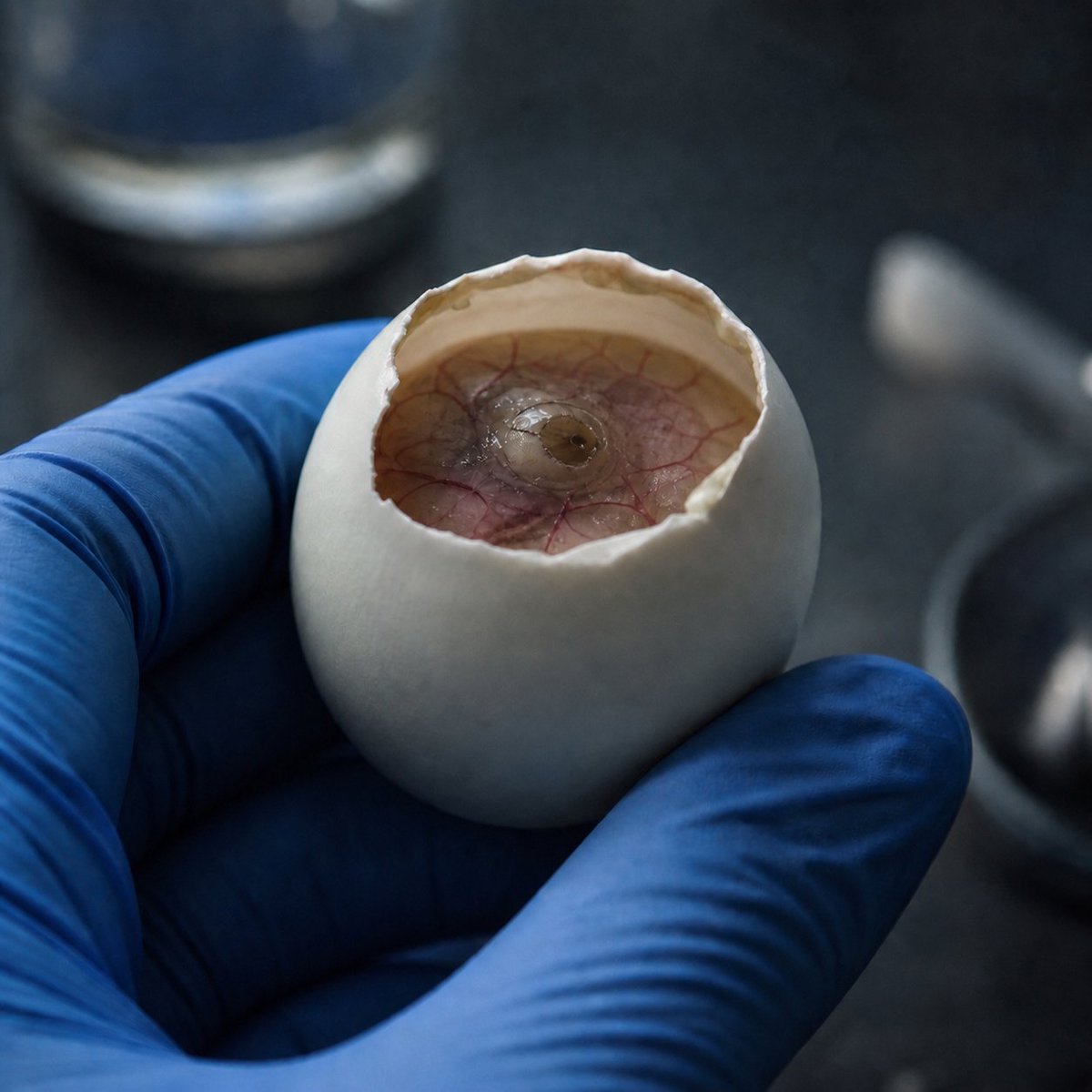
🇳🇱 New Dutch biotech startup Triple Bio is emerging from stealth with €1.5m pre-seed to increase milk yield and reduce enteric methane emissions
• 500x dose reduction achieved for existing methane inhibitors
• 97% decrease in methane production
• 28% increase in volatile fatty acid (VFA) production (great!)
• 5-10% more milk per cow
Their product can provide a 5x return on investment for the farmers
Let's do the math:
1. A high-yielding dairy cow in Northern Europe produces 30-40 litres of milk a day. Delivering a 5% yield increase represents 2 additional litres per cow per day, which amounts to 1 euro of extra revenue per cow per day at a minimum.
2. Current methane-inhibiting solutions on the market cost farmers the same per cow per day as a litre of milk (€0.45)!
In livestock farming, those types of numbers can deliver a very big impact.
Triple achieves that by nudging the cow’s microbiome to redirect energy away from methane towards milk production, improving digestion and supporting higher yields.
GPT-4 was trained on ~13T tokens. We are building a clinical AI foundation model with ~27T visual tokens of GI endoscopy data, and counting.
This is the path to solving gut-mediated diseases like IBD, colorectal cancer, pancreatic cancer, and more
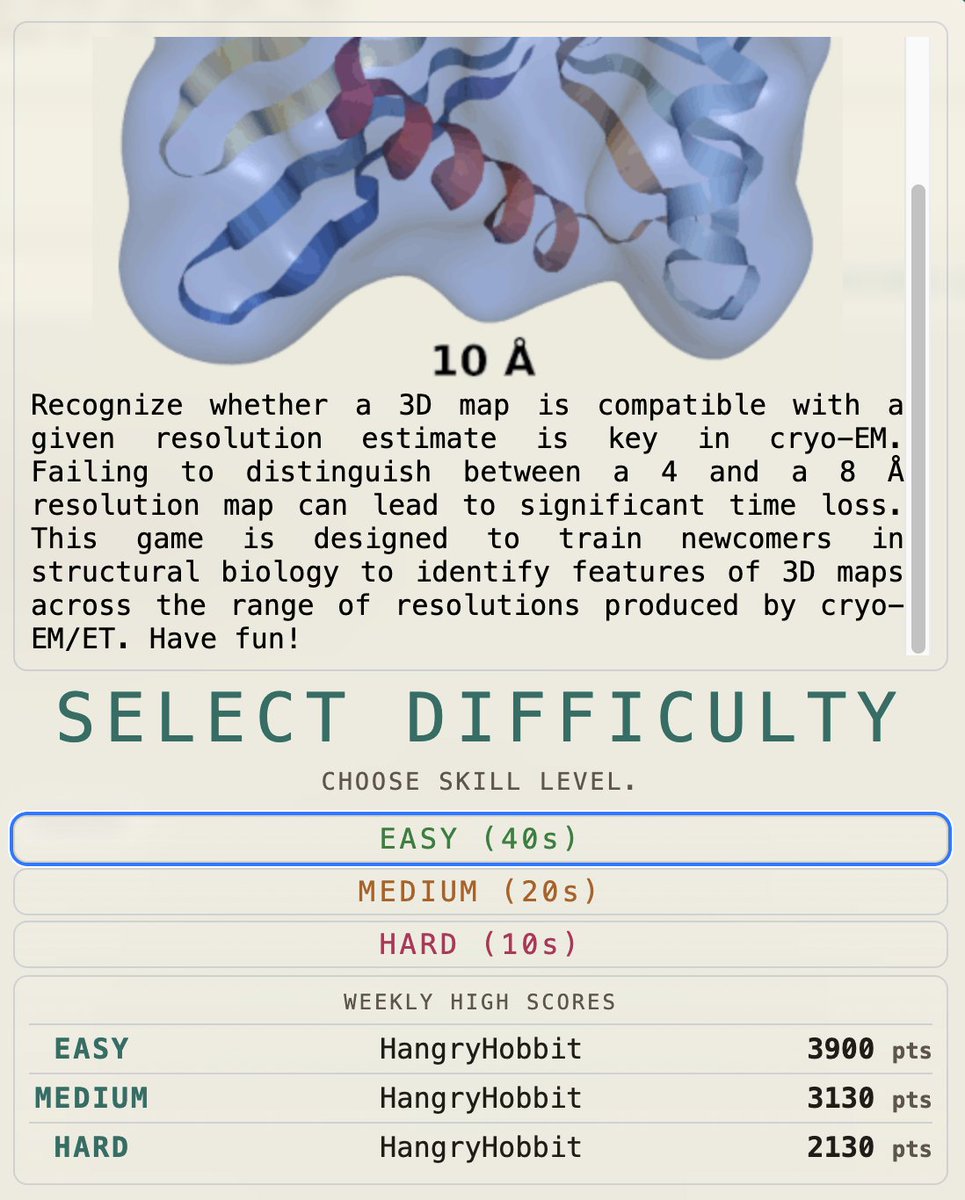
Try this new online training game from Leandro F. Estrozi designed for newcomers in structural biology, with a focus on cryo-EM and cryo-ET map interpretation: https://t.co/gxhQXmRPWL
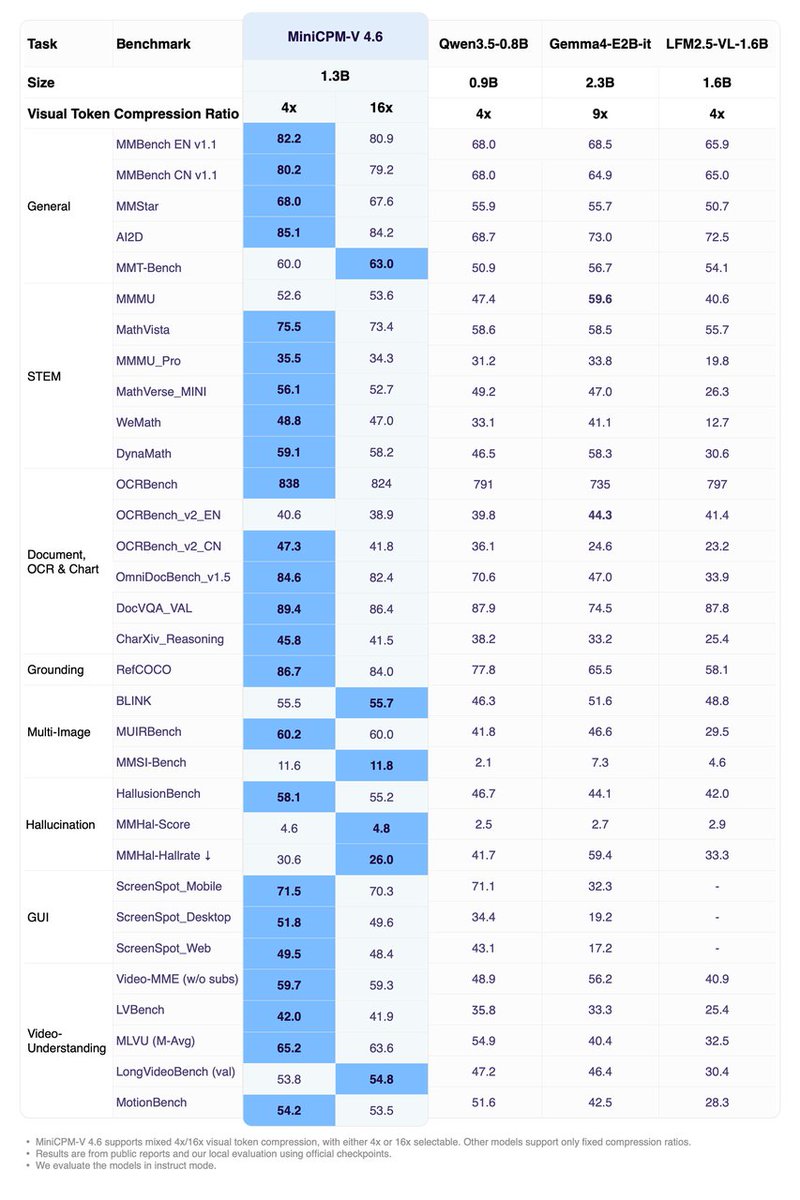
1/5 MiniCPM-V 4.6 (1.3B) is now live 🚀🚀
High-res visual processing, optimized for consumer-grade and mobile hardware. We’ve leveraged the latest LLaVA-UHD v4 technique to cut vision encoding costs by 55%, enabling native edge deployment with extreme efficiency.
🔥 Beats Gemma4-E2B-it and Qwen3.5-0.8B across key multimodal and Artificial Analysis benchmarks — scoring higher than Qwen3.5-0.8B using just 2.5% of its token budget.
⚡ TTFT (75.7ms) 2.2x Faster than Qwen3.5-0.8B even with 3136² high-res images.
🏗️ ~1.5x Token Throughput compared with Qwen3.5-0.8B on a single RTX 4090.
Try the model here:
🤗 Hugging Face:
https://t.co/CEkwKMSBwc
💻 GitHub:
https://t.co/iYDxpa52tn
🔭 Modelscope:
https://t.co/CHflKPLbvK
🌐 Web Demo:
https://t.co/DYUrtD0YzM
📱 App Demo:
https://t.co/SL7IOhm6zv
I’ve always believed the No.1 application of AI should be to improve human health.
That work started with AlphaFold, and now at @IsomorphicLabs with the mission to reimagine drug discovery and one day solve all disease!
We are turbocharging that goal with $2.1B in new funding.
Huge news today at Isomorphic Labs!
We have secured $2.1 Billion investment to advance the most important mission that AI can unlock: to change the way we can improve human health and create new medicines for patients around the world.
This funding milestone was built on the strength of our AI drug design engine (IsoDDE), which has already proven its worth (aside from smashing benchmarks) by designing breakthrough new molecules and creating new scientific breakthroughs across our drug discovery programs.
Our IsoDDE is giving us a repeatable way to design new medicines for a wide range of diseases, building a future of medicine that we couldn’t unlock until now.
A massive thank you to our incredible team across London, Boston and Lausanne, whose relentless work made this possible, and to our partners who share our ultimate vision.
Now we have so much more to build together!
Doctors have known for decades: the clinical interview is the most important diagnostic tool
Turns out, the same is true for AI
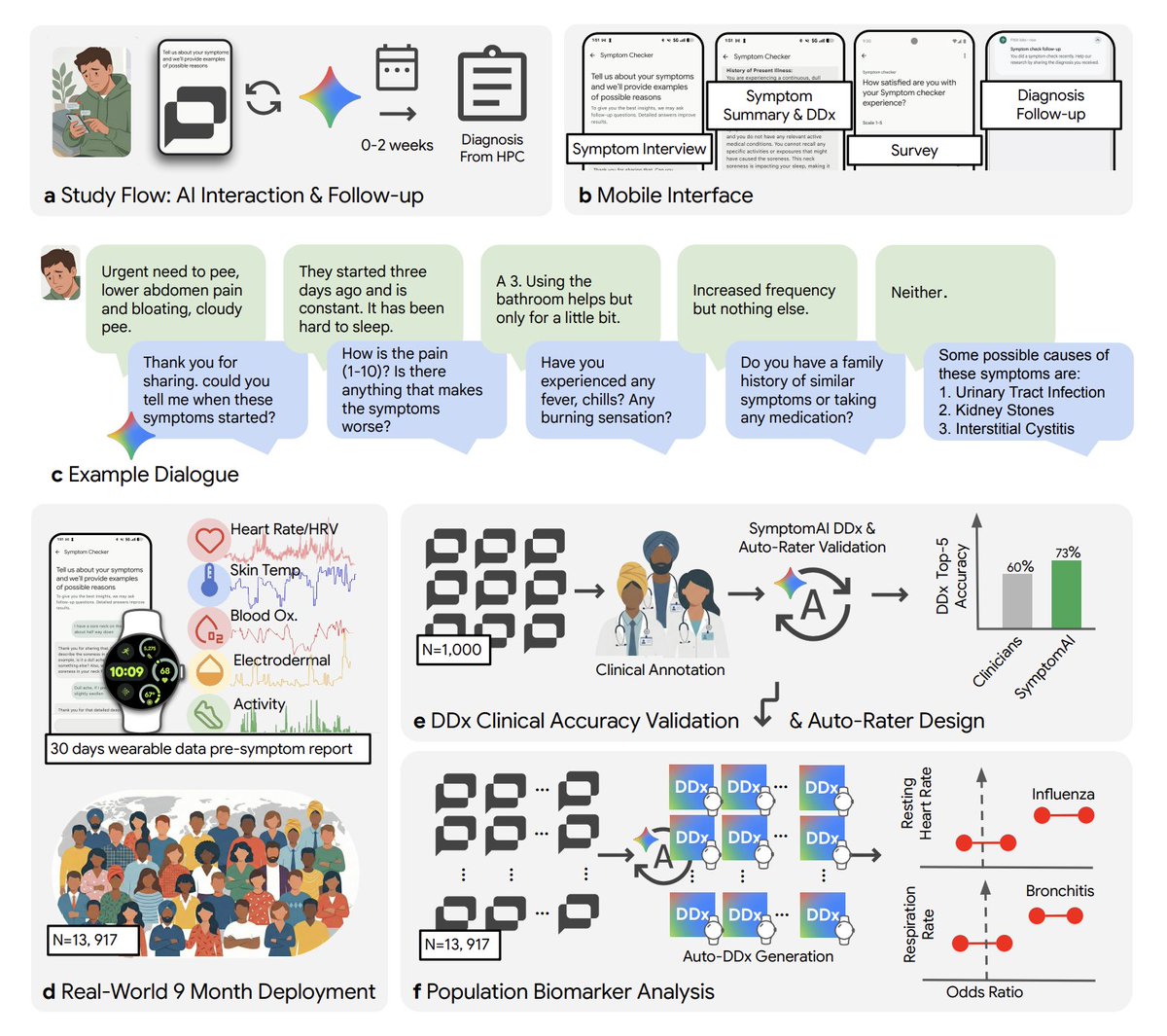
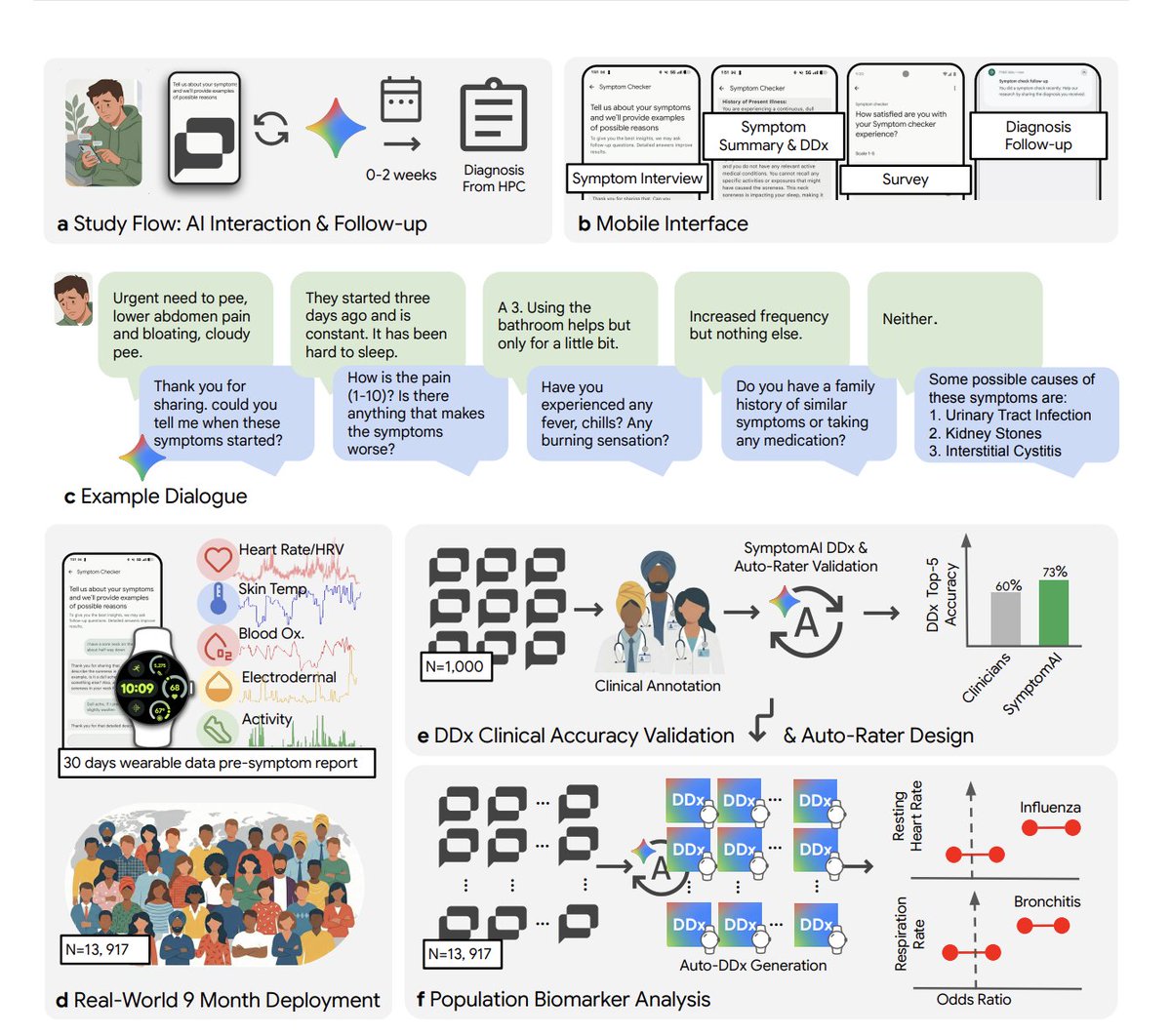
In work led by @breda_joe, @jesunshine, and @danmcduff, we randomized 13,917 Fitbit users across 5 AI strategies for symptom assessment 🧵
Reserach scientists at Google just tested an AI symptom checker on 14,000 real patients over 9 months via Fitbit.
In blinded evaluation, clinicians ranked the AI diagnosis as #1 in 53% of cases. Independent physicians: 24%.
But the real finding isn't "AI beats doctors.", but when users just type their symptoms and get an answer (the default mode of every consumer LLM right now), diagnostic accuracy drops ~27% compared to a structured AI-led interview.
ChatGPT, Claude, Gemini, none of them systematically interview users about their symptoms. They just respond. This study shows that's a measurable failure mode.
And then there's the second breakthrough: Fitbit data showed physiological shifts DAYS before users reported symptoms. Heart rate up, sleep disrupted, steps down, all visible before patients even opened the app.
Conversational AI that asks the right questions + wearable sensors that detect illness before you feel it. That's the exciting find here.
the modern engineering home lab stack:
→ a powerful laptop/workstation
for CAD, simulation, AI, rendering, compiling
→ ultrawide monitor
because engineering means 40 tabs open at once
→ 3d printer
the bridge between imagination and physical reality
→ soldering station + oscilloscope
to debug reality itself
→ raspberry pi / jetson / microcontrollers
the brains of embedded systems and robotics
→ local AI models
because engineers who can automate themselves move faster
→ linux
still the natural habitat of builders
→ simulation stack
ROS2, Gazebo, Isaac Sim, Blender, KiCad, Fusion360
→ organized tools and drawers
high output comes from low friction
→ notebooks everywhere
your future company starts as scattered thoughts
→ fast internet
modern engineering is multiplayer
→ a camera
documenting your work compounds opportunities
the future will be built by people with mini skunkworks inside their rooms.
Scientists spend 100+ days a year writing grants. Almost none get funded. Not because the ideas are bad, but because the system is broken, and you fall in the cracks.
Today we launch qed for grants, an AI reviewer that makes YOUR proposal stronger before you submit (it doesn’t replace you, you do the writing). Novelty. Logic. Methodology. Fit for the call. Making sure nothing is missed.
Early access open. 🔒🩶 @nivmast@OdedRechavi
Imagine a machine that could reach inside a living brain cell, find a single microtubule — one of those tiny filaments inside every cell — and feel it vibrating. Not metaphorically. Literally feel its surface fluctuating at scales smaller than a single atom, while at the same time watching individual proteins land on it and let go, while listening to the cell’s electrical chatter, while tapping the cell with a pulse of light to make it fire on command. All on the same cell, at the same instant, every signal stamped to a shared clock.
For a long time this was a napkin sketch. Each of those measurements lived in its own world — the lasers interfered, the probes blocked each other, the timing was sloppy. You did one thing on Monday’s cell, another on Tuesday’s, and crossed your fingers the stories matched. But the pieces have arrived. New atomic force microscopy can feel a living protein at ten-microsecond resolution. MINFLUX can pin down a single molecule to a few nanometers in a living cell. Patch-clamp and optogenetics are mature. The machine is real now. It just hasn’t been built.
Here’s what it lets you do.
You can pick a specific microtubule, steer the AFM tip onto an identified, fluorescently-tagged tubulin molecule, and listen to it. Microtubules aren’t still — they vibrate, partly from thermal noise we know how to predict, possibly from collective motions the lattice does as a whole. If that excess motion is there, the machine resolves it. Nobody has ever held a single identified protein in a living cell and listened.
You can catch the moment of firing. Drive the cell with light, fire it hundreds of times, average everything around each spike. The mechanical trace, the molecular binding, the membrane voltage — all aligned to the firing instant. There’s a specific claim in the literature that something in the cytoskeleton reorganizes 250 microseconds before the electrical signal. This machine is the first that can confirm or kill that claim.
You can dissect what your signal is actually made of. Wash in a drug that destroys microtubules and watch, on the same cell, in real time, whether your signal vanishes. Then test actin. Then test the sodium channels. Within one recording, on one cell, you pin down what’s really there.
You can drive the cell rhythmically and ask whether the lattice locks into the rhythm — whether it behaves like a passive object or an active resonator with its own preferences.
The deeper thing this enables is closure. The question of whether microtubules do real computational work inside neurons has been stuck for decades — interesting claims, suggestive data, a mainstream that can’t quite accept and can’t quite refute. The reason is that the measurement that would settle it has never been built. This is that machine. If the lattice is doing something, this instrument sees it. If it isn’t, the bound is tighter than anything the field has had. Either answer is a foundation. Right now we’re building on fog.
Of the hundreds of types of amino acids found on Earth, it’s a mystery why life settled on 20 as the building blocks for all its proteins. Although certain species can use more—some microbes employ up to 22—no one’s ever found one using fewer.
But now scientists are closer to creating such an organism, after partially eliminating one of the 20 amino acids from the bacterium Escherichia coli.
The research used #AI to propose alternatives to the amino acid isoleucine in dozens of proteins making up bacterial ribosomes—the protein factories of the cell.
The findings offer a glimpse into how earlier, simpler life forms might have lived and suggest new ways to synthesize proteins with bespoke functions in medicine and biotechnology.
Learn more: https://t.co/yFCYoHgfWa