Skip LinkedIn. Resources to find breakout startups hiring before everyone else:
• Ramp’s monthly vendor reports
• Harmonic’s quarterly Hot 25
• a16z Build newsletter
• Founders You Should Know
• Next Play newsletter
• YC startup directory
• Early Days Substack
Today, we’re launching @TownAI: the AI assistant that learns you.
We’re coming out of beta with a $55M Series A led by @ARampell at @a16z, with participation from @KirstenGreen at @forerunnervc and continued support from @firstround, @altcap, and @conviction.
Right now, getting real value from AI means prompting, configuring, building workflows, managing agents.
We think that’s backwards.
The future of AI is a companion that already knows you and how you work. Town connects across your inbox, calendar, Slack, docs, messages, and workflows to understand what you need, then starts doing the work with you.
Drafting. Scheduling. Project tracking. Follow-ups. Context gathering. Multi-step tasks. And it only acts when you say so.
All adapting to your voice, priorities, routines, and relationships over time.
Your Townie is the AI assistant you actually need.
Today, we’re launching @TownAI: the AI assistant that learns you.
We’re coming out of beta with a $55M Series A led by @ARampell at @a16z, with participation from @KirstenGreen at @forerunnervc and continued support from @firstround, @altcap, and @conviction.
Right now, getting real value from AI means prompting, configuring, building workflows, managing agents.
We think that’s backwards.
The future of AI is a companion that already knows you and how you work. Town connects across your inbox, calendar, Slack, docs, messages, and workflows to understand what you need, then starts doing the work with you.
Drafting. Scheduling. Project tracking. Follow-ups. Context gathering. Multi-step tasks. And it only acts when you say so.
All adapting to your voice, priorities, routines, and relationships over time.
Your Townie is the AI assistant you actually need.
talked to a YC company that scaled from $0 → $2m ARR in their first 6 months with their ENTIRE GTM built off going to conferences.
Here's the playbook they cracked (step by step):
~4 weeks before:
> Post abt the conference and tell attendees exactly how to reach you
> Send personal DMs to the right ppl on LinkedIn and X
> Reply within the hour & lock in 10 top targets to close.
> Send everyone else to your drip email campaign.
Then, set a meeting block of 1-3 days during the conference:
> make shared booking link for the team
> Reserve a quiet café / private dining room
> Pack in 12 meetings per day, 30 min each, with buffer time built in
While you're there:
>Hand every prospect a thoughtful small gift and a personal card
>Single out 5 standout customers whose pain ur product actually solves
>Pull them aside for a casual on-camera Q&A in a solid film spot
>Don't pitch hard.
>Let the conversation breathe and weave your product in naturally.
The 4 weeks after
>Hand the raw footage to a freelance editor + ask for ~15-20 punchy clips with captions.
>Drop a new clip every couple of days on LI / X
> use these clips when you post online about the next conference to keep the momentum
This is the formula, costs less than a few thousand dollars to execute.
They’re on track to end the Y1 at ~$6m ARR (B2B, targeting large enterprises) + STILL not using any other channels for customer acquisition
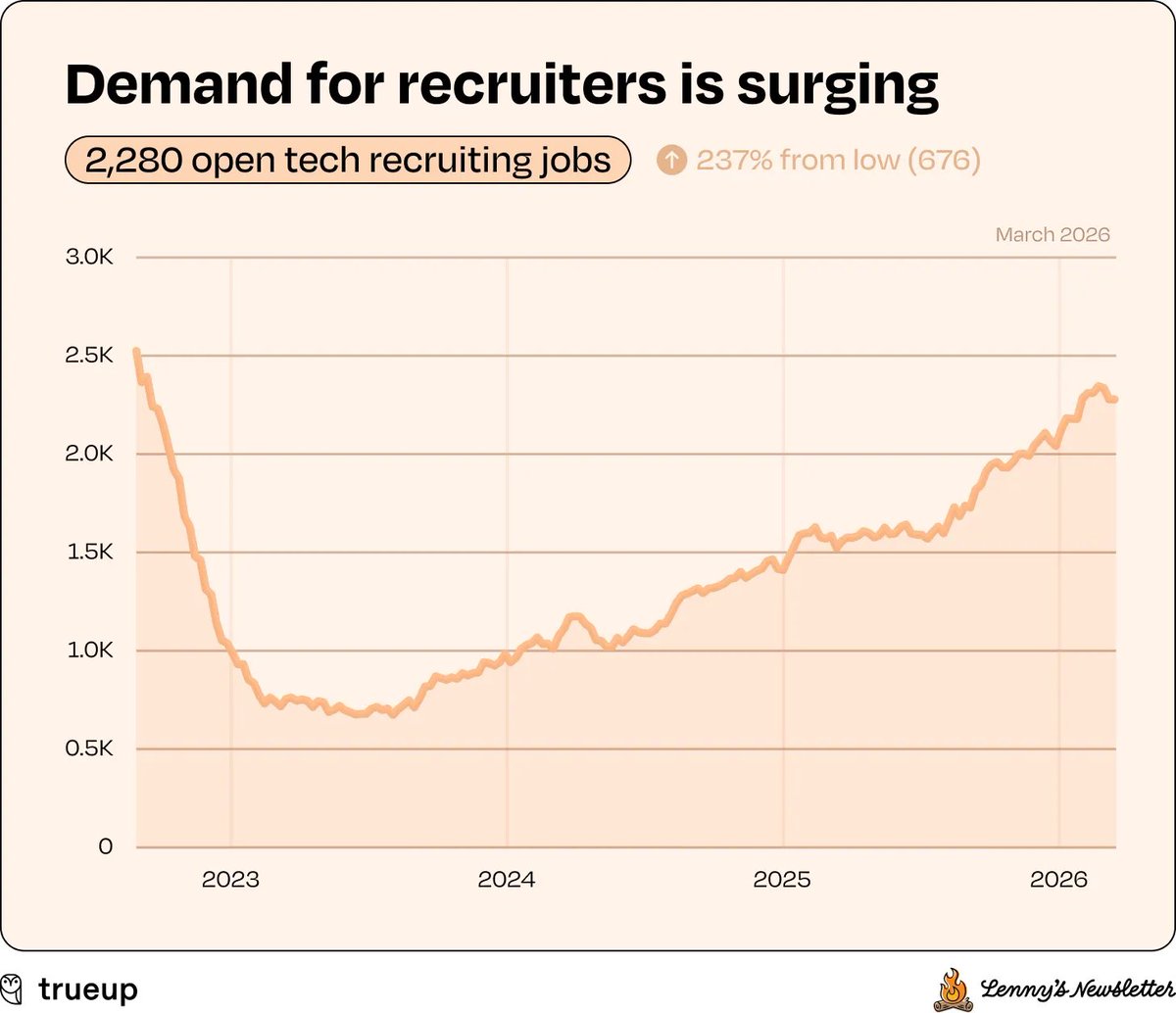
Demand for recruiters is surging
The number of open recruiter roles is almost back to 2022 peak levels. This role got hit the hardest post-Covid, and also recovered the quickest.
By definition, recruiting headcount expands and contracts with hiring demand, so it’s likely a leading indication that we’re tracking toward sustained highs in hiring demand in tech.
Box CEO @levie's defense of software over vibe-coded, n-of-1 internal tools:
"If you're Ford, and you're doing your supply chain on an ERP system, you want that to work the exact same way every single time."
"The billions of transactions going through that ERP system, you cannot take for granted. So the idea that you're going to go vibe-code that is not possible, or at least not likely."
"The other point is: your company has a fixed amount of IT resources. And you have to decide what you're going to spend your time on as an organization."
"Do you want to spend time on rebuilding something that the market can supply you, that's seen best practices thousands of times? Or do you want to go and build that out with your n-of-1 experience?"
"Or do you want to spend your limited, scarce resources on building software, and building experiences, that will make you more money, and that will actually be used by your customers?"
"I think on the margin the average enterprise is going to spend their time and energy on the latter."
"I'm 100% bullish on vibe-coding, 100% bullish that we're going to have 100x more software. But that still doesn't cross the threshold where I would want to go build our own CRM system."
For the first time in venture history, three distinct channels share the liquidity burden roughly equally.
A decade ago, secondaries barely registered. They accounted for roughly 3% of exit value in 2015. Today they claim 31% : nearly $95b in the trailing twelve months.
The shift accelerated after 2021’s IPO bonanza. When public markets closed their doors in 2022, investors found alternative routes. Secondaries absorbed demand that would have flowed to traditional exits. When Goldman Sachs acquired Industry Ventures, the transaction signaled secondaries have arrived. Morgan Stanley followed with EquityZen, then Charles Schwab announced its acquisition of Forge Global. Wall Street recognized the structural change before most of venture did.
This matters for founders & investors. When IPOs dominated exits, fund models assumed a small number of public offerings would generate the bulk of returns.
Now liquidity arrives through multiple doors. A founder might sell secondary shares to patient capital while the company remains private. A GP might move positions through continuation vehicles. An LP might trade fund stakes on an increasingly liquid secondary market.
The 830 unicorns holding $3.9t in aggregate post-money valuation cannot all exit through IPOs. The math doesn’t work. At 2025’s pace of 48 VC-backed IPOs, clearing the unicorn backlog would take seventeen years. Secondaries provide a release valve that traditional exits cannot.
Companies like OpenAI have embraced this reality, running employee tender offers while voiding unauthorized secondary transfers. The largest private companies now manage their own liquidity programs rather than waiting for public markets.
Today, secondary liquidity concentrates in the top 20 names. SpaceX, Stripe, OpenAI. For the founder of company #50, the secondary market remains largely theoretical. For secondaries to succeed as a broad asset class, buyers must underwrite positions in companies without household recognition. As the market grows, this coverage gap becomes opportunity.
For LPs starved of distributions since 2022, the expansion of secondary channels offers hope. The $169b in cumulative negative net cash flows needs somewhere to go. More exit paths mean more opportunities to return capital.
When a Series B employee asks about liquidity today, the answer isn’t “wait for the IPO.” It’s “we’re planning a tender offer next year.”
A decade ago, secondaries were a footnote. Now they’re infrastructure. Liquidity flows where it can, not where tradition suggests it should.
https://t.co/vzmd8Nv1Vb
@bhalligan@DarioAmodei This is where I’ve always believed the best HR leaders focus, aligning hiring, performance, comms, and comp around the company’s culture.
Taking a CEO or founder’s vision and actually embedding it into the systems people experience every day.
A quiet prediction for 2026, from someone who has spent a lot of time studying how humans behave at work:
I think we’re about to see an unprecedented quiet retirement of elder millennials from tech.
Not dramatic exits. Not mass layoffs. Just a steady, largely unannounced backing away.
Many elder millennials hit what was supposed to be the payoff phase of their careers—middle to senior roles, stable compensation, some accumulated growth—at the exact moment life got heavier. Kids entering adolescence. Parents aging or dying. Bodies changing. Energy changing. Perspective changing. (Read: perimenopause and midlife crises...)
At the same time, the last decade didn’t quite deliver what was promised. Most stock options didn’t meaningfully materialize. Homeownership was delayed or derailed. Many relocated during the pandemic “temporarily” for childcare or sanity and never fully returned—to cities, to offices, or to the pace they once sustained.
Then AI arrived. Not just as a new tool, but as a true platform shift.
What I’m watching isn’t resistance or denial so much as a widening gap in orientation. Some people are instinctively reorganizing how they think, work, and create around this new substrate. Others are using it incrementally; helpful, but not transformative. Neither is a moral failure. But the gap compounds quickly.
For a cohort already tired, already juggling more life outside of work, and already questioning the ROI of constant grinding, the incentive to retool themselves again—this time at platform speed—just isn’t there.
So many will choose something else.
They’ll frame it (honestly) as leaning into IRL, into human connection, into building tangible things. They’ll open coffee shops, take over family businesses, learn trades, consult selectively, or turn long-held hobbies into second careers. It will look intentional. And often, it will be.
What fascinates me is not the “exit,” but the alignment: a generational life stage colliding with a technological inflection point that dramatically raises the bar for cognitive and adaptive load at work.
From an HR lens, it’s one of the most interesting workforce transitions I’ve ever seen unfolding in real time... and I think we’re still underestimating how quietly, and how profoundly, it will reshape who stays, who leaves, and what “career success” even means next.