We recently obtained the highest-resolution 3D images of the human brain ever taken from outside the skull. This is the first look.
Introducing Aleph, a research lab building brain interfaces for the telepathic future. (1/n)
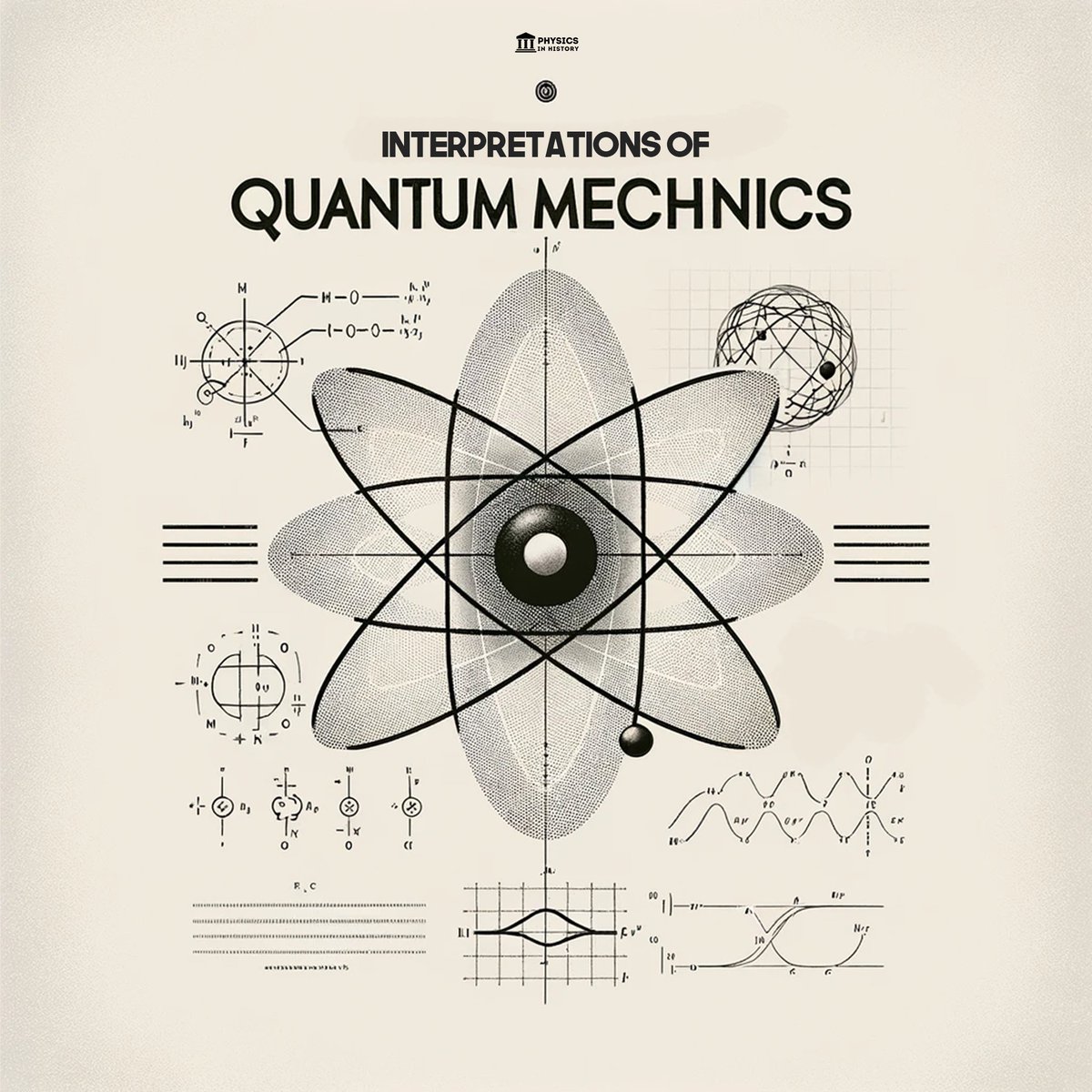
11 different interpretations of Quantum mechanics explained in brief ✍️
1. Copenhagen Interpretation: The "standard" interpretation where quantum systems exist in superpositions until measured, at which point they "collapse" to a definite state.
2. Many-Worlds Interpretation (MWI): Every quantum event spawns countless parallel universes, with each possible outcome actually occurring in a different universe.
3. De Broglie-Bohm (Pilot Wave) Theory: Quantum systems are guided by "pilot waves" that determine their behavior, implying that particles have definite positions at all times.
4. Objective Collapse Theories: Quantum systems spontaneously collapse to definite states over time, without requiring a measurement.
5. Quantum Bayesianism (QBism): Quantum states are subjective beliefs about the outcomes of experiments, emphasizing a Bayesian approach to probability.
6. Relational Quantum Mechanics: The properties of a quantum system are relative to the observer and do not exist absolutely.
7. Transactional Interpretation: Quantum events involve a time-symmetric exchange of "offer waves" and "confirmation waves" between source and detector.
8. Ensemble Interpretation: Quantum mechanics only applies to ensembles of systems, not individual systems, emphasizing statistical outcomes.
9. Consistent Histories: Focuses on establishing a consistent framework to discuss sequences or "histories" of quantum events over time.
10. Quantum Logic: Proposes a modification of classical logic to account for quantum phenomena.
11. Participatory Anthropic Principle (PAP): Observers play a role in bringing the universe into existence through quantum processes.
None of these interpretations alter the core mathematical formalism of quantum mechanics, but they provide different perspectives on what's "really" happening beneath the calculations. The debate over which interpretation, if any, correctly describes nature is ongoing and remains one of the central philosophical questions in the foundations of quantum theory.
50 pessoas. $2 bilhões de dólares em receita. Zero product managers.
A Cursor gera mais receita por funcionário do que Goldman Sachs, Google e Apple combinadas.
E o CEO acabou de entregar o playbook inteiro de graça.
Cada engenheiro da Cursor ganha entre $808 mil e $1,1 milhão por ano. E os engenheiros não escrevem mais código. Eles gerenciam dezenas de agentes de IA rodando em paralelo, cada um em sua própria VM na nuvem, 24 horas por dia. Enquanto o engenheiro dorme, os agentes continuam entregando.
Nesse vídeo o CEO explica em 9 minutos como eles fazem isso.
Salve este post antes que todos copiem o manual.
Os números:
1. 35% dos PRs mergeados na Cursor são criados por agentes autônomos
2. Em março de 2025, pra cada usuário de agente tinha 2,5 no autocomplete. Hoje inverteu: 2 de agente pra cada 1 de autocomplete
3. Uso de agentes cresceu 15x em 12 meses
4. Os engenheiros mais produtivos têm 100% do código escrito por agentes
O ciclo mudou. Humanos definem escopo e revisam. Agentes planejam, codam, testam e abrem o PR. Validação antes do código, não depois.
50 pessoas entregando o que empresas com 5.000 engenheiros não conseguem.
O que surgiu ali não é ganho de produtividade. É uma nova classe de trabalhador: o engenheiro que não programa.
Toda empresa que ainda avalia engenheiro por linhas de código ou horas na cadeira está rodando com o modelo mental de uma fábrica do século passado.
O novo indicador é quantos agentes autônomos você consegue orquestrar ao mesmo tempo.
Quem entender isso primeiro vai ter uma vantagem competitiva impossível de superar.
Peter Thiel, co-founder of Palantir and PayPal, is leading a $140mn investment in a US start-up that plans to use wave energy to fuel giant fleets of floating data centres. https://t.co/HAh1ijrEDw
One of the best intros of an era. One of the best games of all time. I often use the word "soul" when I compare old games to new ones - and this one is absolutely bursting at the seams with it
Graphics: 10/10
Music: 10/10
Gameplay: 10/10
In 1990, The Secret of Monkey Island was light-years ahead of anything that had come before it. It didn't just look a little better - it completely moved the goalposts.
Remember the first time you saw the intro? I thought I'd never see a better game. This one holds a very, very special place in my heart.
So, you want to be a pirate, eh? You look more like a flooring inspector.
SpaceXAI and @cursor_ai are now working closely together to create the world’s best coding and knowledge work AI.
The combination of Cursor’s leading product and distribution to expert software engineers with SpaceX’s million H100 equivalent Colossus training supercomputer will allow us to build the world’s most useful models.
Cursor has also given SpaceX the right to acquire Cursor later this year for $60 billion or pay $10 billion for our work together.
This 2 hour Stanford lecture shows exactly how Stanford trains it's engineers to build AI systems. It's more practical than every Claude tutorial & prompting threads you've seen.
Bookmark & give it 2 hours, no matter what. It'll be the most productive thing you do this weekend.
If you want your OpenClaw or Hermes Agent to be able to have perfect total recall of all 10,000+ markdown files, GBrain is here to help.
It's exactly my OpenClaw/Hermes Agent setup. MIT-licensed open source. Hope it helps you build your mini-AGI.
https://t.co/yFpFU4pn5b
Yes it's the tractable form of brain upload. There's a ton of scifi on brain uploads that requires way too exotic tech (scanning and simulating brains etc), when we're about to get a lossy and approximate version of that *a lot* sooner via LLM simulators. You can easily imagine a "brain upload" startup - you show up for a few days to carry out detailed video interviews, then they use all that data with an LLM finetuning process to "upload" you and give you an API endpoint of your simulation that you can talk to. Look at what's already possible with HeyGen as an example, but combine it with an LLM model that has deep knowledge and personality. Trippy and admittedly kind of dystopian but in principle quite possible around now.
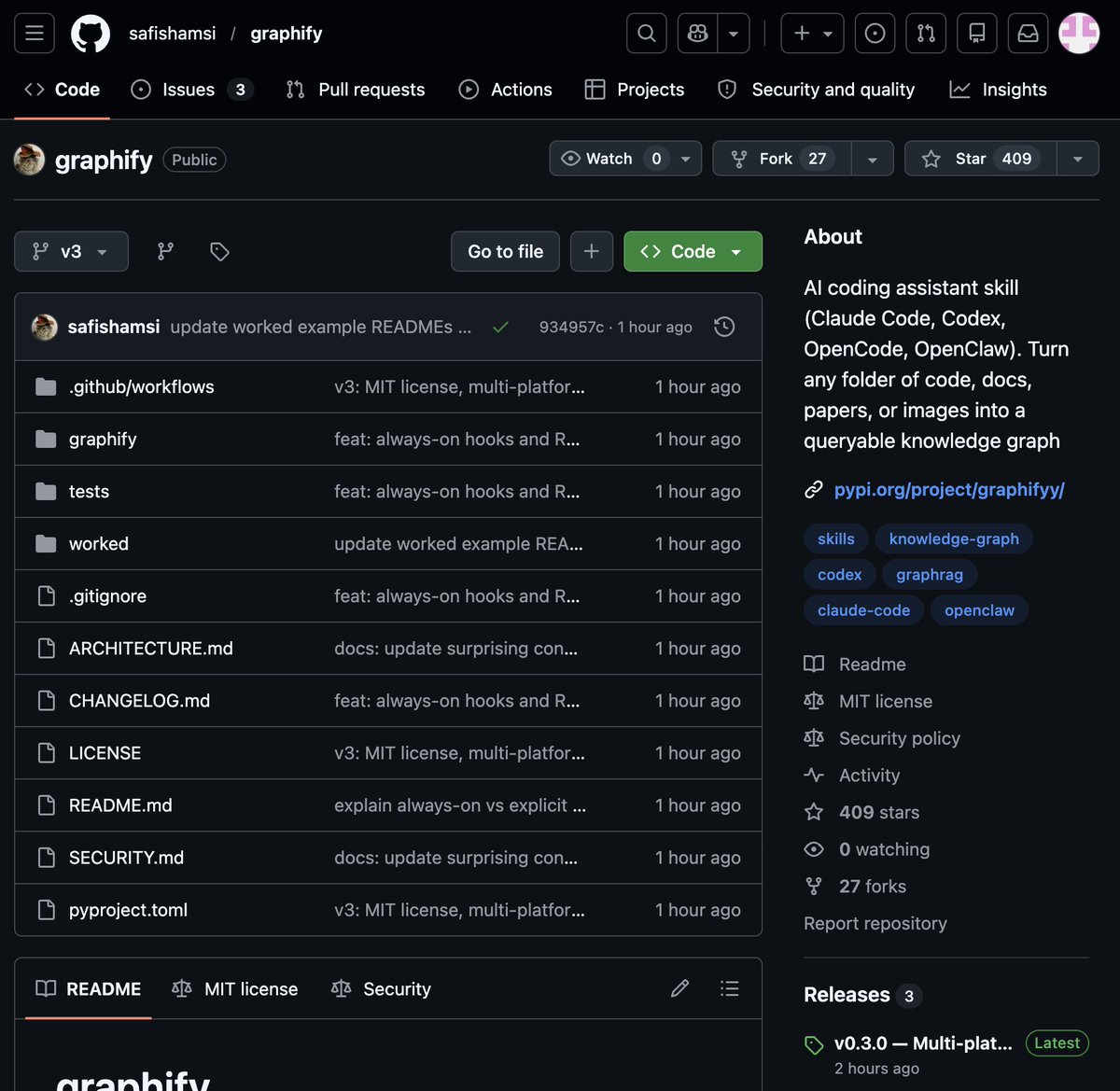
🚨 BREAKING: Someone just built the exact tool Andrej Karpathy said someone should build.
48 hours after Karpathy posted his LLM Knowledge Bases workflow, this showed up on GitHub.
It's called Graphify. One command. Any folder. Full knowledge graph.
Point it at any folder. Run /graphify inside Claude Code. Walk away.
Here is what comes out the other side:
-> A navigable knowledge graph of everything in that folder
-> An Obsidian vault with backlinked articles
-> A wiki that starts at index. md and maps every concept cluster
-> Plain English Q&A over your entire codebase or research folder
You can ask it things like:
"What calls this function?"
"What connects these two concepts?"
"What are the most important nodes in this project?"
No vector database. No setup. No config files.
The token efficiency number is what got me:
71.5x fewer tokens per query compared to reading raw files.
That is not a small improvement. That is a completely different paradigm for how AI agents reason over large codebases.
What it supports:
-> Code in 13 programming languages
-> PDFs
-> Images via Claude Vision
-> Markdown files
Install in one line:
pip install graphify && graphify install
Then type /graphify in Claude Code and point it at anything.
Karpathy asked. Someone delivered in 48 hours.
That is the pace of 2026.
Open Source. Free.
btw, that’s why we’re building https://t.co/xlLgQdLD0Z to give every person on earth the ability to create video content using their face, voice, and ideas. No barriers.
Powered by grok.