Kioxia Investor Day 2026 Key Incremental Information from Q&A
50% LTA coverage.
New fab K-3 is coming.
A lot more information from Q&A than from the investor day deck.
1. LTA Details
Around 50% of total business volume is currently expected to be covered by LTAs, with the company aiming to increase that over time.
LTAs cover price, timing, and volume, not just volume.
Customer interest extends into FY29 and beyond, reflecting strong hyperscaler and enterprise confidence in AI inference demand.
Not every customer will sign LTAs; some will remain on traditional procurement agreements.
Significant percentage of the entire business should be covered by LTA in year 2028 and beyond
2. Shareholder Return Policy
Kioxia is actively considering starting dividends from FY27, based on FY26 results.
A dividend in 2H FY26 is also being studied but not decided.
CFO used 50% of net FCF as an illustrative shareholder return ratio, while stressing this is not official policy.
Base return would be a progressive dividend.
Excess earnings could be returned through special dividends.
Buybacks would depend on the share price.
If no suitable M&A opportunities materialize, capital otherwise reserved for growth investment could be returned to shareholders; in principle, this could reach up to 100% of net FCF.
3. M&A Logic
M&A is explicitly part of the capital allocation framework.
Potential directions include:
Downstream / forward integration to deepen customer ties and solution capabilities.
Upstream / backward integration to strengthen supply chain stability.
Management said no specific transaction has been decided.
4. Capacity Discipline
FY28 output is expected to be roughly 2x FY25.
Output growth is calibrated to around 22% market CAGR, not designed to outgrow the market and create oversupply.
Roughly half of cleanroom space at Yokkaichi and Kitakami K-2 remains unoccupied.
Existing shell capacity should support expansion until around FY28-FY29, without immediate need for a new fab building.
5. K-3 New Fab Timing
Kitakami K-3 is still in early internal discussion.
Decision / construction timing may be around FY29, possibly early FY29.
The fab would likely need to come online around FY2030.
No new greenfield site outside Kitakami and Yokkaichi was mentioned.
6. Investment Discipline
Management pushed back against the idea of accelerating capex aggressively despite strong cash generation.
Projects must clear an internal hurdle rate above estimated WACC (around 10%).
Management explicitly noted that overinvestment would hurt the overall industry.
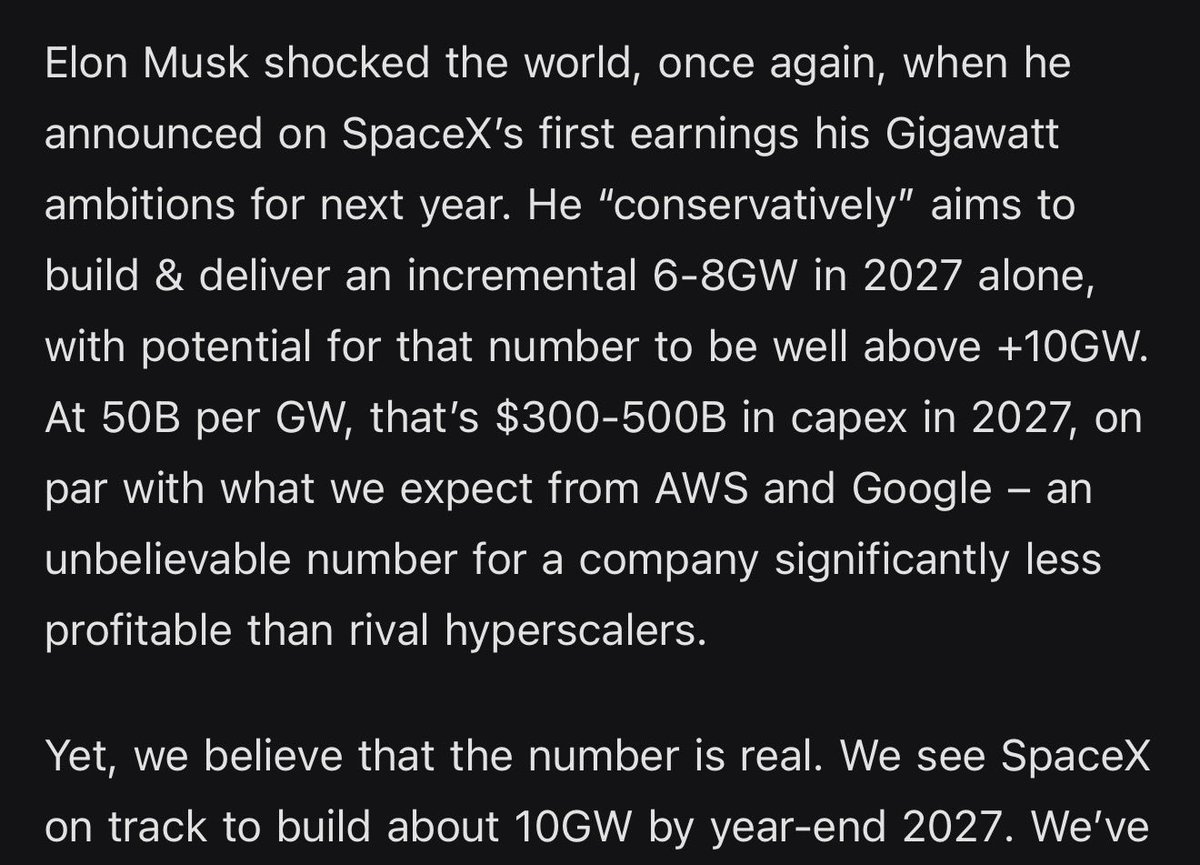
Holy crap. @SemiAnalysis_ says Elon Musk's 2027 gigawatt forecast for using Nvidia GPUs is real!
"Yet, we believe that the number is real. We see SpaceX on track to build about 10GW by year-end 2027."
"In a perfect world, we would have backed Anthropic many years ago" says Pat Grady, co-steward and partner at Sequoia. "We didn't. And so the best thing we can do now is to come in at the most scale that we can muster."
Listen to the full interview with @edludlow here: https://t.co/43SuhqZDfT
Narrative violation. Have been hearing for 18 months frontier models dead. Competition w open source is not zero sum. If you want American AI to win u should cheer for open & closed - we need these revenues to pay for the $1-2 T annual capex build out of American AI. 🇺🇸🚀💰
FULL INTERVIEW: @MartinShkreli breaks down the collapse of Leopold Aschenbrenner's Situational Awareness, and how Citadel capitalized on the liquidation.
01:00 Why Situational Awareness collapsed
03:00 SALP's 4x leverage, firms that were tapped to buy
08:00 Why Citadel did the deal
12:00 Where Leopold went wrong
14:30 Why AI funds could still be at risk
20:15 Why you can't just hit 'Sell' on a huge position as a hedge fund
26:15 Ken Griffin and Citadel
30:00 Can Leopold rebuild?
TFHK Commentary: How Should We Understand the Current Correction in AI Hardware?
The market is always right. Changes in stock prices inevitably reflect the new variables the market is currently pricing in. Even as long-term bulls on the AI industry, we need to understand the core concerns driving this correction in AI semiconductor stocks.
The current market bears a striking resemblance to last autumn and winter. Following OpenAI’s large fundraising round, industry conditions were very strong, yet stocks continued to trade sideways. Market participants spent every day debating CapEx, ROI, valuations, and financing—much like they are doing now.
The conclusions from this quarter’s earnings reports remain overwhelmingly positive. GCP grew by 80%, the ROI of cloud investment was validated, Intel delivered a significant beat, and ASML, TSMC, and Intel raised their order or CapEx outlooks. Presumably, these companies also saw extremely strong downstream forecasts, giving even the most conservative players in the supply chain the confidence to make aggressive bets. Had this information emerged in May or June, semiconductor stocks would almost certainly have surged.
Now, however, every earnings release has instead become an opportunity for bears to reassess valuations and the long-term investment thesis. What we may be seeing is that the AI market is no longer in the “AI Summer” of May and June. The same positive developments now provide less support to share prices. Take GCP’s 80% growth as an example. Previously, the market’s first reaction would have been: “AI demand has exceeded expectations—the catalyst has arrived.” Now, the first response is: “So what? What about 2028? Can OpenAI become profitable? For how many more years can GPU prices keep rising? Margins are rising again, financing costs are increasing, and the entire CapEx thesis needs to be repriced.” In essence, the market has shifted from trading the growth of AI CapEx to trading its sustainability and ROI.
Market sentiment, as we perceive it, has already become extremely bearish. Even long-term bulls are beginning to question whether AI semiconductor stocks can continue to rise, and we are hearing almost no calls for new highs. When the market shifts from looking for further upside to searching for additional downside risks, it usually means that pessimistic expectations have already been largely priced in.
Nevertheless, we have no doubts about the fundamentals. We also believe that, ultimately, facts determine stock prices. So what would send these stocks higher again? Under the framework outlined above, additional capital-spending plans alone will no longer be enough to convince the bears. What is needed is validation of a new demand curve. The most powerful and direct catalyst would be the emergence of a blockbuster product. If “Coding 1.0” proved that AI can improve developer productivity, then “Coding 2.0” must demonstrate that AI agents can genuinely replace part of the software development process. Once new productivity use cases are validated, the market’s concerns about AI ROI may be redefined, and AI infrastructure spending will once again be viewed as “productivity investment” rather than a “cost.”
@Zaug72@thsottiaux Is it crime to be a Chinese user? They paid fucking $10 extra just for VPN and paid for ChatGPT in full to use Codex. What’s wrong with that? How much of OpenAI and Anthropic’s revenue are actually coming from Chinese users?
At least we get to learn which stocks the podbros are shorting.
President Trump, please stop bombing Iran. We need the Iran War to truly end. Thank you.
Your constituents, American growth investors.
Gavin Baker @GavinSBaker: HBM DRAM will be 30-40% of all hyperscaler capex in 2027.
Baker manages Atreides - his 2025 Micron call is now 14x. This is his next call.
HBM requires stacking 12-16 DRAM dies in a single package. Only three companies can do it: Micron, SK Hynix, Samsung. No fourth supplier arrives in 2027. Hundreds of billions annually to three firms.
Micron's new supply chain agreements lock in floor pricing above prior cycle gross margin peaks.
If you still hold $MU at a commodity discount to $ASML and $LRCX, Baker says that discount is no longer earned.
Baker's full case at @theallinpod:
https://t.co/sH8c5iozAo
Source: All-In Podcast - https://t.co/31lFFUPJgJ
Retail, Substack, Reddit and most of all @X accounts are increasingly the most important forces in the stock market and yet there is no way for them to connect directly with the management teams of the companies they are writing about and investing in. And they have almost no visibility into the late-stage private companies that are ever more important.
The @TomorrowXSummit aims to change this. Hosted by @antoniogracias and Valor Equity Partners, @iconnections_io and @rbiscardi and @atreidesmgmt, we are going to have our own version of the superb Morgan Stanley or Goldman Sachs TMT conference with an epic line-up of both public and private companies. Instead of having sell-side analysts interview management teams, we are going to have X accounts like @citrini and buysiders do the fireside chats. We expect thousands of attendees at the Moody Center in Austin, November 17-18 and please note that security will be extremely tight given some of the CEOs that are going to speak.
Attendance will be free for X accounts that contribute positively to the discourse and affordable for retail accounts. Happy that this means friends like @DanielSLoeb1 , @altcap , @plaffont , @patrick_oshag and the @theallinpod crew will be able to afford the price of admittance should their schedules permit. And perhaps we can even get them on a panel or have them interview some management teams. I am sad to say there will be a different price for institutional investors who are not on X unless they are willing to reveal their anonymous handle, but I think this is going to be awesome for all. And everything will eventually be posted here on X for all to see. Open source for the win.
Link to the website to sign up in the next post:
At a very hi level, free cashflow = operating cash flow - capex.
The hyperscalers are deep into an investment cycle so they are consuming their operating cash flow. It is incorrect to look at this and assume their FCF has collapsed because operating cash flow has collapsed.
It hasn't. Capex has exploded.
This cycle should be eerily reminiscent of Amazon's approach over the past 20 years when they did the same thing related to e-commerce and AWS buildout. The question should be what moat did Amazon create at the end of that cycle and what kind of moat could the hyperscalers build now related to AI after this cycle?
HOLY CRAP $MU
Micron: “Fourteen of the 16 SCAs that we have signed have a cumulative revenue at minimum price per our contracts of approximately $100 billion over the remaining agreement term”
“We are excited to announce that we have now signed 16 strategic customer agreements, or SCAs, which we expect will fundamentally transform our business model.”
“We are pleased to announce that we have completed 16 SCAs with customers across the data center, consumer and auto market segments. These SCAs accelerate the transformation of our business model, enhance partnership in technology and innovation, and provide customers with contracted supply assurance.”
“Typically, these agreements have a five-year term, from calendar 2026 through the end of calendar 2030. Automotive agreements generally have a three-year term. The 16 signed agreements represent roughly 20% of our DRAM volume and a third of our NAND volume over this period. These SCAs include four very large customers and three medium-sized customers. The remaining agreements relate to smaller customers from the automotive industry and represent our commitment to this important sector.”
“When completed, we expect approximately half or more of our company revenue to be under these SCAs with customers across end markets. Our customers value our U.S. supply plans, and this is reflected in our SCAs.”
“These SCAs are structured as take-or-pay agreements, with binding commitments to purchase specific volumes over this multi-year term.”