Considering the language of the announcement alone, taken entirely at face value: This seems an enormous advance in attitude (and scientific integrity) over previous big projects. They claim non-optimistic results will be considered allowable, valuable, and publishable!
I am going to tell you a deep secret of the English language. When we want to tell the truth, we use Germanic-derived words. When we want to lie, we use Latin-derived words.
- Germanic (Old English) words → concrete, direct, sensory, testable
- Latinate/French words → abstract, bureaucratic, distancing, often euphemistic
Death / harm
Germanic (plain, testable):kill, die, hurt
Latinate (distancing, euphemistic):terminate, expire, neutralize, collateral damage
👉 “We killed civilians” vs “There was collateral damage”
Lying / deception
Germanic:lie, cheat, hide
Latinate:misrepresent, obfuscate, prevaricate
👉 “He lied” vs “He misrepresented the facts”
Money / exploitation
Germanic:take, steal, pay
Latinate:appropriate, extract, leverage, monetize
👉 “They’re taking your money” vs “They’re extracting value”
War / violence
Germanic:fight, bomb, burn
Latinate:engagement, kinetic action, force projection
👉 “We bombed them” vs “We conducted kinetic operations”
Bureaucracy / responsibility
Germanic:you broke it, you did it
Latinate:mistakes were made, systemic failure occurred
👉 Notice how the subject disappears.
Money / exploitation
Germanic:take, steal, pay
Latinate:appropriate, extract, leverage, monetize
👉 “They’re taking your money” vs “They’re extracting value”
War / violence
Germanic:fight, bomb, burn
Latinate:engagement, kinetic action, force projection
👉 “We bombed them” vs “We conducted kinetic operations”
Bureaucracy / responsibility
Germanic:you broke it, you did it
Latinate:mistakes were made, systemic failure occurred
👉 Notice how the subject disappears.
If you see a public statement filled with Latin-sounding words, you are being fooled, tricked, manipulated, or lied to.
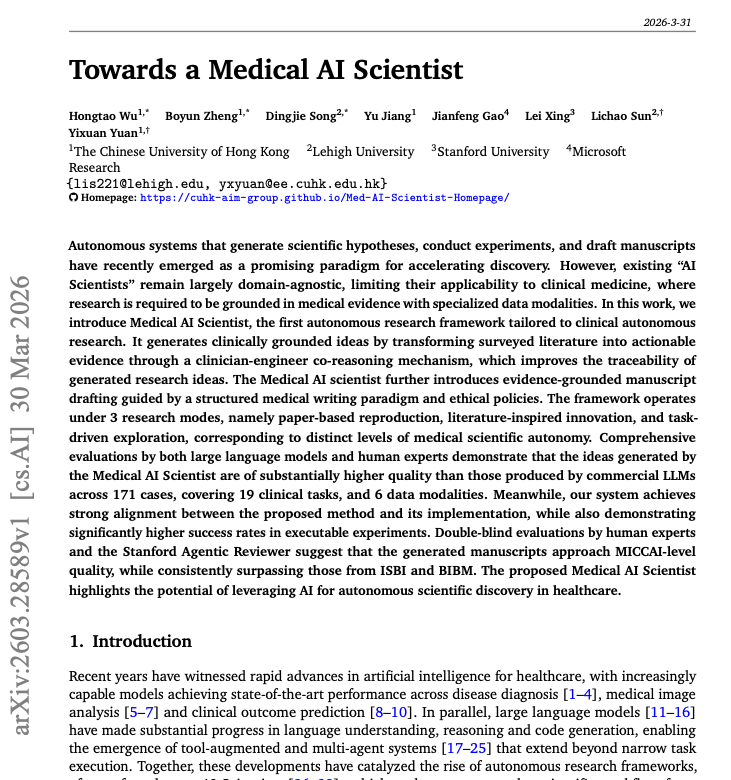
🚨BREAKING: Stanford and Microsoft just built an AI scientist that writes medical research papers that actually pass peer review.
Not summaries. Not drafts. Full papers reviewed and accepted by real scientists.
This is not a demo and this is not a prototype. A peer-reviewed conference just accepted a paper that no human wrote, and most people have absolutely no idea it happened.
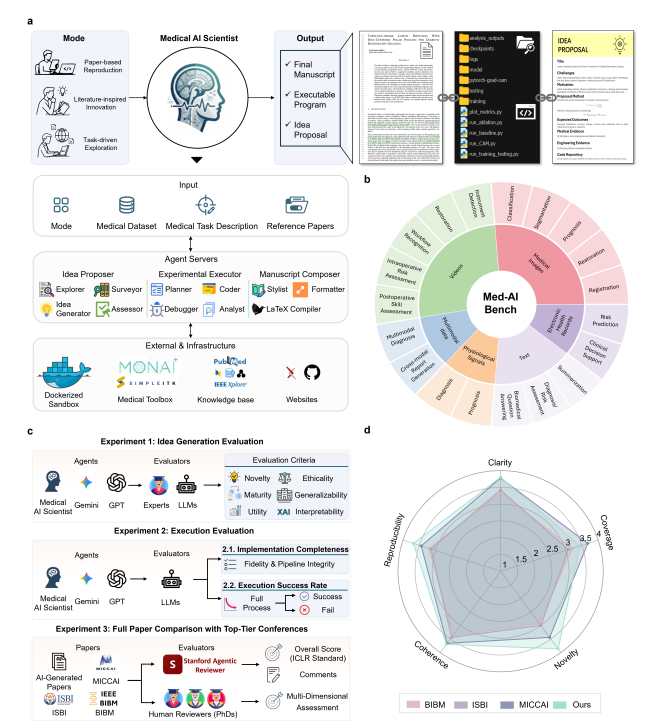
The system is called Medical AI Scientist and it works in three stages that run completely on their own.
First, it reads medical literature, identifies real clinical gaps, and generates a research hypothesis grounded in actual disease evidence, not a hallucination and not a generic idea pulled from thin air. Then it writes the code, runs the experiment inside a secure environment, catches its own errors, and fixes them without any human stepping in. Then it writes the full paper, including the introduction, methods, results, figures, ethics statement, citations, and LaTeX formatting, from start to finish, autonomously.
They tested it against GPT-5 and Gemini 2.5 Pro across 171 real medical research cases covering 19 clinical tasks, and the results were not close. Medical AI Scientist successfully completed experiments 91 to 93 percent of the time. GPT-5 managed 60 to 75 percent. Gemini 2.5 Pro collapsed somewhere between 40 and 53 percent.
Then they ran the part that genuinely broke my brain. Ten independent medical experts with over five years of first-author publishing experience reviewed the AI-generated papers side by side with real human papers from MICCAI, ISBI, and BIBM, the top conferences in medical imaging, and nobody knew which was which.
The AI papers scored competitively on novelty, clarity, coherence, and reproducibility across the board, and one paper was accepted at a peer-reviewed conference after a full review process.
Here is what nobody is saying out loud.
Medical research has a brutal bottleneck where ideas pile up, experiments take months, papers take even longer, and patients wait the entire time. That problem just got a serious solution, and the implications for healthcare are enormous.
A possible extension: AI firms allocate compute based on the returns to scaling now vs. searching for algorithms that would benefit future scaling. So these estimates indicate the returns to research are relatively high.
In honour of this milestone, I’m publishing the v/acc manifesto – PopVax's plan to save 1 million lives each year by massively accelerating vaccine development. Read it at the link below:
https://t.co/iw0t7YkGvm
I accidentally discovered how to compress a semester of learning into 48 hours.
A grad student at MIT showed me his NotebookLM setup. I thought he was just organized. Then I watched him pass a qualifying exam on a subject he'd never studied before.
Here's exactly what he did:
First: he didn't upload a textbook.
He uploaded 6 textbooks, 15 research papers, and every lecture transcript he could find on the subject.
Then he asked NotebookLM one question:
"What are the 5 core mental models that every expert in this field shares?"
Not "summarize this." Not "explain this topic."
Mental models. The stuff that takes professors years to develop.
But the next part is what broke my brain.
He followed up with:
"Now show me the 3 places where experts in this field fundamentally disagree, and what each side's strongest argument is."
In 20 minutes he had a map of the entire intellectual landscape of the field:
the debates, the consensus, the open questions.
Most students spend a full semester just figuring out what those debates even are.
Then he did something I've never seen before.
He asked:
"Generate 10 questions that would expose whether someone deeply understands this subject versus someone who just memorized facts."
He spent the next 6 hours answering those questions using the source material. Every wrong answer triggered a follow-up:
"Explain why this is wrong and what I'm missing."
By hour 48, he could hold a conversation with his thesis advisor without getting destroyed.
The tool didn't change. The questions did.
Most people treat NotebookLM like a fancy highlighter.
These students are using it like a private tutor who has read everything ever written on the subject.
The difference between a semester and 48 hours isn't the amount of content.
It's knowing which questions to ask.
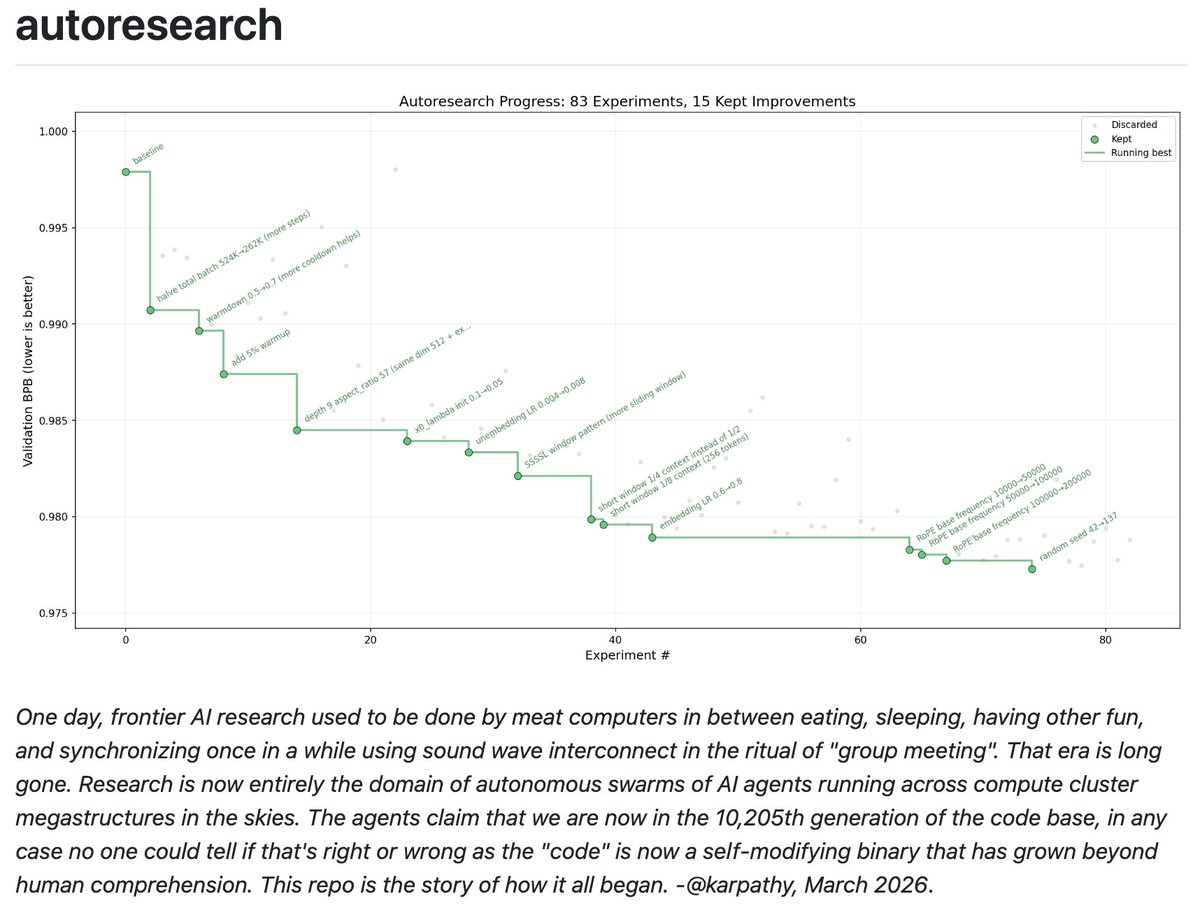
I packaged up the "autoresearch" project into a new self-contained minimal repo if people would like to play over the weekend. It's basically nanochat LLM training core stripped down to a single-GPU, one file version of ~630 lines of code, then:
- the human iterates on the prompt (.md)
- the AI agent iterates on the training code (.py)
The goal is to engineer your agents to make the fastest research progress indefinitely and without any of your own involvement. In the image, every dot is a complete LLM training run that lasts exactly 5 minutes. The agent works in an autonomous loop on a git feature branch and accumulates git commits to the training script as it finds better settings (of lower validation loss by the end) of the neural network architecture, the optimizer, all the hyperparameters, etc. You can imagine comparing the research progress of different prompts, different agents, etc.
https://t.co/YCvOwwjOzF
Part code, part sci-fi, and a pinch of psychosis :)
Brain Computer Interfaces are now giving sight back to the blind. A 2mm chip restored sight in 81% of blind patients.
Published in NEJM. FDA reviewing now.
Max Hodak left Neuralink to build this. Here is his story.
https://t.co/TMUGNliu5r
Everything I know about how to run an elite enterprise sales org, I learned from the PTC mafia during my time at Endeca. Cerner used to be PTC for healthtech back in the 2000-2010's - they had a super rigorous sales training program, and you had to be pretty damn good to sell end-to-end EHR to hospitals pre-Meaningful Use (we had some excellent Cerner-trained AEs at Kyruus). Who's the PTC of healthtech today??
If your child becomes a reader, about 80% of the education job is already done. That's my honest assessment after working in education for over thirty years. Everything else is secondary. Most parents think science education is important. Yes it is. But if you can't read the biology textbook, you're not going to learn biology.
Reading is the meta-skill that enables all other skills. History requires reading. Science requires reading. Even math increasingly requires reading as it becomes more sophisticated. The child who reads voraciously will figure out everything else. The child who doesn't will struggle with everything.
In an interview with @dwarkesh_sp, Anthropic CEO @DarioAmodei speculated that as AI designs better drugs, clinical trials will speed up dramatically - to as little as 1 year in total.
I explain why this is unlikely & what is needed to accelerate trials.
https://t.co/cOlHJitegV
psychology solved the ai memory problem decades ago. we just haven't been reading the right papers.
your identity isn't something you have. it's something you construct. constantly. from autobiographical memory, emotional experience, and narrative coherence.
Martin Conway's Self-Memory System (2000, 2005) showed that memories aren't stored like video recordings.
they're reconstructed every time you access them, assembled from fragments across different neural systems. and the relationship is bidirectional: your memories constrain who you can plausibly be, but your current self-concept also reshapes how you remember. memory is continuously edited to align with your current goals and self-images. this isn't a bug. it's the architecture.
not all memories contribute equally. Rathbone et al. (2008) showed autobiographical memories cluster disproportionately around ages 10-30, the "reminiscence bump," because that's when your core self-images form.
you don't remember your life randomly. you remember the transitions. the moments you became someone new. Madan (2024) takes it further: combined with Episodic Future Thinking, this means identity isn't just backward-looking. it's predictive. you use who you were to project who you might become. memory doesn't just record the past. it generates the future self.
if memory constructs identity, destroying memory should destroy identity. it does. Clive Wearing, a British musicologist who suffered brain damage in 1985, lost the ability to form new memories. his memory resets every 30 seconds. he writes in his diary: "Now I am truly awake for the first time." crosses it out. writes it again minutes later.
but two things survived: his ability to play piano (procedural memory, stored in cerebellum, not the damaged hippocampus) and his emotional bond with his wife. every time she enters the room, he greets her with overwhelming joy. as if reunited after years. every single time. episodic memory is fragile and localized.
emotional memory is distributed widely and survives damage that obliterates everything else.
Antonio Damasio's Somatic Marker Hypothesis destroyed the Western tradition of separating reason from emotion.
emotions aren't obstacles to rational decisions. they're prerequisites.
when you face a decision, your brain reactivates physiological states from past outcomes of similar decisions. gut reactions. subtle shifts in heart rate. these "somatic markers" bias cognition before conscious deliberation begins.
the Iowa Gambling Task proved it: normal participants develop a "hunch" about dangerous card decks 10-15 trials before conscious awareness catches up. their skin conductance spikes before reaching for a bad deck. the body knows before the mind knows. patients with ventromedial prefrontal cortex damage understand the math perfectly when told. but keep choosing the bad decks anyway. their somatic markers are gone. without the emotional signal, raw reasoning isn't enough.
Overskeid (2020) argues Damasio undersold his own theory: emotions may be the substrate upon which all voluntary action is built.
put the threads together. Conway: memory is organized around self-relevant goals. Damasio: emotion makes memories actionable. Rathbone: memories cluster around identity transitions. Bruner: narrative is the glue.
identity = memories organized by emotional significance, structured around self-images, continuously reconstructed to maintain narrative coherence. now look at ai agent memory and tell me what's missing.
current architectures all fail for the same reason: they treat memory as storage, not identity construction. vector databases (RAG) are flat embedding space with no hierarchy, no emotional weighting, no goal-filtering. past 10k documents, semantic search becomes a coin flip. conversation summaries compress your autobiography into a one-paragraph bio. key-value stores reduce identity to a lookup table. episodic buffers give you a 30-second memory span, which as the Wearing case shows, is enough to operate moment-to-moment but not enough to construct identity.
five principles from psychology that ai memory lacks.
first, hierarchical temporal organization (Conway): human memory narrows by life period, then event type, then specific details. ai memory is flat, every fragment at the same level, brute-force search across everything. fix: interaction epochs, recurring themes, specific exchanges, retrieval descends the hierarchy.
second, goal-relevant filtering (Conway's "working self"): your brain retrieves memories relevant to current goals, not whatever's closest in embedding space. fix: a dynamic representation of current goals and task context that gates retrieval.
third, emotional weighting (Damasio): emotionally significant experiences encode deeper and retrieve faster. ai agents store frustrated conversations with the same weight as routine queries. fix: sentiment-scored metadata on memory nodes that biases future behavior.
fourth, narrative coherence (Bruner): humans organize memories into a story maintaining consistent self across time. ai agents have zero narrative, each interaction exists independently. fix: a narrative layer synthesizing memories into a relational story that influences responses.
fifth, co-emergent self-model (Klein & Nichols): human identity and memory bootstrap each other through a feedback loop. ai agents have no self-model that evolves. fix: not just "what I know about this user" but "who I am in this relationship."
the fundamental problem isn't technical. it's conceptual. we've been modeling agent memory on databases. store, retrieve, done. but human memory is an identity construction system. it builds who you are, weights what matters, forgets what doesn't serve the current self, rewrites the narrative to maintain coherence. the paradigm shift: stop building agent memory as a retrieval system. start building it as an identity system.
every component has engineering analogs that already exist.
hierarchical memory = graph databases with temporal clustering.
emotional weighting = sentiment-scored metadata.
goal-relevant filtering = attention mechanisms conditioned on task state.
narrative coherence = periodic summarization with consistency constraints.
self-model bootstrapping = meta-learning loops on interaction history.
the pieces are there. what's missing is the conceptual framework to assemble them. psychology provides that framework.
the path forward isn't better embeddings or bigger context windows. it's looking inward. Conway showed memory is organized by the self, for the self. Damasio showed emotion is the guidance system. Rathbone showed memories cluster around identity transitions. Bruner showed narrative holds it together.
Klein and Nichols showed self and memory bootstrap each other into existence. if we're serious about building agents with functional memory, we should stop reading database architecture papers and start reading psychology journals.
AI is cool and all... but a new paper in @ScienceMagazine kind of figured out the origin of life?
The paper reports the discovery of a simple 45-nucleotide RNA molecule that can perfectly copy itself.
Epstein-Barr Virus aka mono is absolutely terrifying. I got it at 21 & the effects lingered for years. It's also a major causative agent of multiple sclerosis.
Regardless of your personal feelings on the COVID vax fallout, we NEED an EBV vaccine. This is insane.
We aren't hitting a wall, but we are hitting a "slower grind". Even if AGI is 10 years away instead of 2, that is still incredibly short for the world to prepare for a machine that can do all human intellectual R&D work #AI#AGI#TechTrends
Source: https://t.co/CkWrm1TPLj
TIL,
2025 was the year of the “AI Vibe Shift.” We saw AGI timelines shrink to 2-3 years after OpenAI’s o1 and o3 reasoning models dropped, only for them to blow back out by the end of the year. Why? 🧵