Most classes teaching the algorithms, but a lot of ML is about the empirical intuitions that develop from experience. This class systemizes this process. Assessment is next experiment prediction.
I had so much fun creating the Self-Improving AI Agents course with @achowdhery, and teaching it twice in one year at Stanford!
We also collaborated with Stanford Online to make the course available online:
YouTube: https://t.co/t1uZlWz5eq
The field is moving incredibly fast, but we tried to focus on the core concepts that help us build better AI systems. I hope you enjoy it!
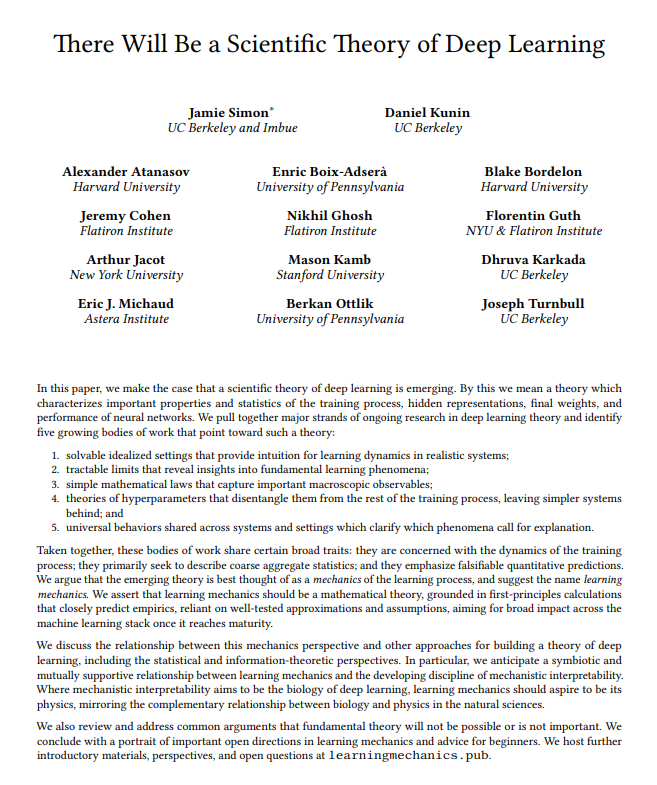
This is a very interesting paper
It argues that a real scientific theory of deep learning is starting to form.
Researchers call it "learning mechanics." It's like physics, but for how neural networks learn.
Now there are 5 active research areas that together look like pieces of this theory:
1. Simple systems (like linear networks) that we can fully solve. Math there works cleanly and we have intuition about how learning behaves.
2. Studying extreme limits, like what happens if a network becomes infinitely wide.
Systems become mathematically tractable in these cases.
3. Simple laws that describe large-scale behavior, like scaling laws (performance vs. data/model size) and relationships between sharpness and generalization
4. Understanding hyperparameters separately
Learning rate, batch size, weight decay and other effects can be separated to make training look like a simpler system underneath.
5. There are underlying principles shared across systems as they scale: similar training dynamics, scaling trends, internal structures
Old theory can’t explain what we see today, that's why we need a real theory upgrade. But why it should be about mechanics?
The researchers see that deep learning needs 2 parts: mechanistic interpretability is like biology that studying individual parts, and studying overall laws and behavior is like physics.
Stanford's latest seminar is a deep dive into the evolution of world modeling in AI.
Focuses on the shift in the world model from traditional reconstruction methods toward latent space prediction.
Covers topics like:
- Introduction to JEPA & World Models
- Causal JEPA
- LOWER Model
- Practical Applications & Planning
- Future Outlook
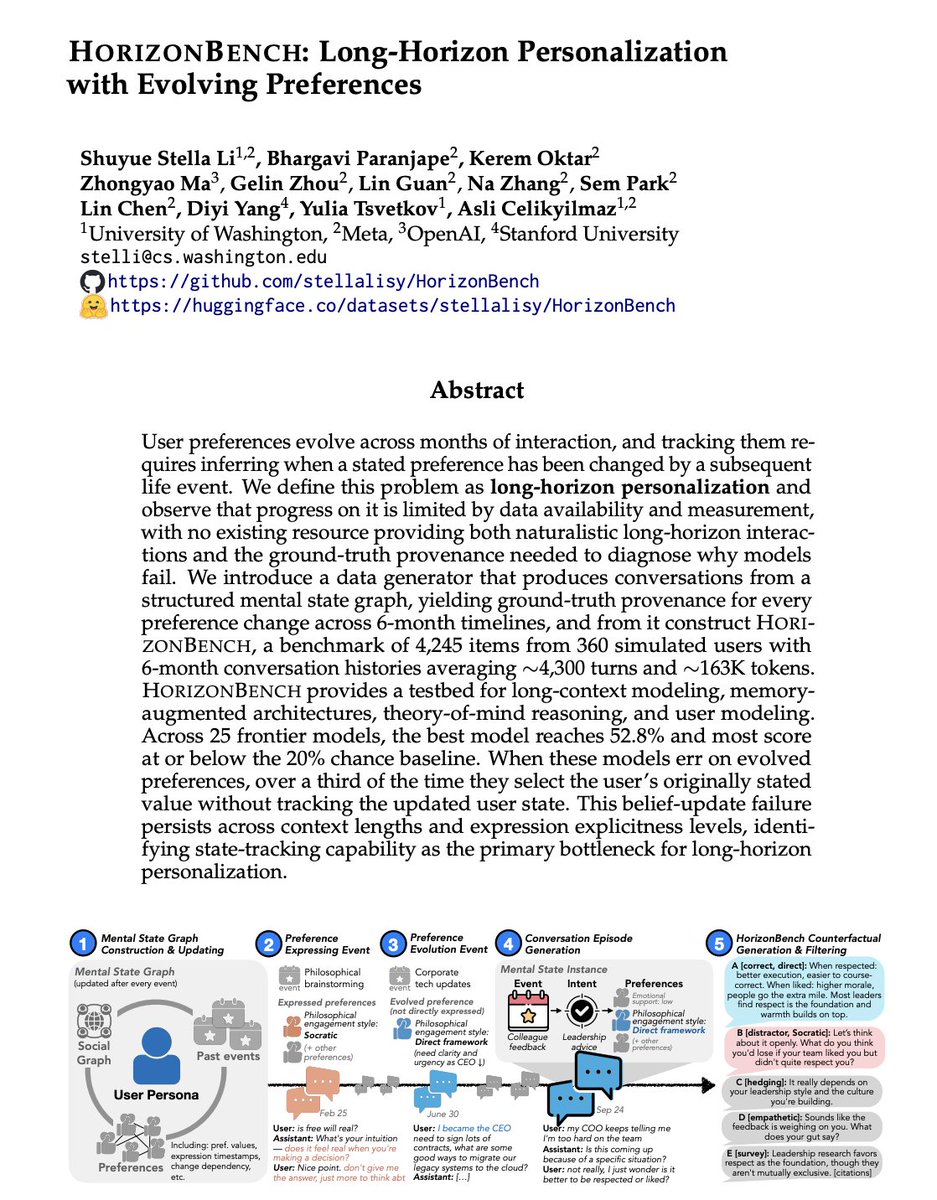
Millions of users now have months-long conversation histories with AI assistants💬 But this data is proprietary and unavailable to the academic community for research, training, or benchmarking.
We introduce HorizonBench🌅, a benchmark and data generator for long-horizon personalization: tracking a user's current preferences across a history where life events have silently changed them.
Wow, this tweet went very viral!
I wanted share a possibly slightly improved version of the tweet in an "idea file". The idea of the idea file is that in this era of LLM agents, there is less of a point/need of sharing the specific code/app, you just share the idea, then the other person's agent customizes & builds it for your specific needs.
So here's the idea in a gist format: https://t.co/NlAfEJjtJV
You can give this to your agent and it can build you your own LLM wiki and guide you on how to use it etc. It's intentionally kept a little bit abstract/vague because there are so many directions to take this in. And ofc, people can adjust the idea or contribute their own in the Discussion which is cool.
@MujumdarRohit can this out - https://t.co/Z8nQPonxay if you use torch, also seen datadog provide good utilities to so by having an agent run on your pod/container
If you avoid even *the potential* for embarrassment, mistakes, failure, or ridicule...you are also avoiding the potential for success.
Doing what you really want to do & getting where you really want to go, is worth it.
Don't sit on the sidelines....
Push that line today.
Maybe I am late on this - but analogies made by
@karpathy
in his talk at Stanford are really interesting and help connect dots to understand transformer's learning and performance at scale
https://t.co/abJjjoY6ou
How to meet with your advisors/mentors?
If you are a grad student, having effective regular meetings with advisors or mentors is absolutely crucial for your success!
Here are some tips on how to make the most of it! 🧵
As someone early in the career, how does one keep up with the pace of the current development around LLMs, any ideas or suggestions ?
#LLMs#NLProc#Transformers#MachineLearning
New post: bringing LLM applications to production!
1. Challenges of LLM engineering & the solutions that I’ve seen
2. How to compose multiple tasks and incorporate tools (e.g. SQL executor, bash, web browsers, third-party APIs)
3. Promising use cases
https://t.co/XWmZfIc5mr
I have managed nearly 100 Senior Engineers at this point in my career as an Engineering Leader.
Check out my latest article, On Being a Senior Engineer: https://t.co/XMBDb3n0FM
How & where do large language models (LLMs) like GPT store knowledge? Can we surgically write *new* facts into them, just like we write records into databases?
Explainer 🧵 on how interpretability & model editing go hand-in-hand, and why these emerging areas are so important 👇
1. How to define your product strategy. When I start a new job, I define a SWAG (Stupid Wild-Ass Guess) product strategy within my first two weeks. Here's my approach...
.@imVkohli, it was undoubtedly the best innings of your life. It was a treat to watch you play, the six off the back foot in the 19th over against Rauf over long on was spectacular! 😮
Keep it going. 👍
#INDvPAK#T20WorldCup
We've found a new way to prompt language models that improves their ability to answer complex questions
Our Self-ask prompt first has the model ask and answer simpler subquestions. This structure makes it easy to integrate Google Search into an LM. Watch our demo with GPT-3 🧵⬇️