Excited to support founders Spencer Seiler & Kateryna Voitiuk by participating in their $1 Million #PreSeed round! 🏆
#OpenCultureScience develops technology for automatically collecting data from delicate cell cultures. Their hardware/software platform, #HABITAT, lets researchers revive, passage, aggregate, and run cell biology experiments in one place — miniaturized, cloud-connected, and monitored from a phone or laptop.
Congrats to @ucsc on the spinout!👏
“Warm temperature quantum gel quantum computers based on Orch OR are on their way.” 👀
A debate on biological/computational consciousness between two greats.
Worth reading! 🤓
Thanks Anil, and you are correct. I do not know what you think.
I do generally know what you write, that you are an authority in brain and consciousness studies, speak very well (you should do Shakespeare), straddle fences nimbly, and don’t commit to conscious AI through neuronal computation. You do favor ‘biological naturalism’ to explain consciousness, but don’t say what that is.
Here’s the thing. Though you’ve never mentioned Orch OR, it is the only biologically natural theory of consciousness. Put forth by Sir Roger Penrose and myself in mid 90s, it was one of 5 ‘major’ theories of consciousness (GNW, IIT, HOT, PC/RP, Orch OR) in the TWCF program beginning around 2018. It was selected despite being consistently criticized because quantum effects seemingly need extreme cold to avoid decoherence, loss of quantum states before quantum processes necessary for consciousness to occur. How long is that? We claim 10^-12 to 10^-6 secs would suffice (with interference beats getting down to, and BEING the EEG).
In the TWCF program we could not agree with proponents of other theories for an adversarial collaboration. They are all at levels of complex computation of simple neurons. We focused on microtubules inside neurons where anesthetics are known to organize activities, process information and mediate anesthesia.
For TWCF we predicted
1) room temperature quantum states in microtubules which could be functional
2) those quantum states would be inhibited by anesthetics.
Both were shown. Aarat Kalra working in Greg Scholes lab at Princeton used UV fluorescence at ambient temperature to trigger propagating excitons in microtubules 6.6 nm over 8 nanoseconds, both requiring quantum states. They were dampened by two types of anesthetic.
We ‘called our shots’.
https://t.co/YxIL56pB72
Correct me if I’m wrong but overall the TWCF program over 8 years spent $30 million dollars and produced only this one significant positive result for Orch OR for a measley $100k.
You do hold yourself up as an authority.
In 2022 you and Tim Bayne wrote a review of theories of consciousness for Nature Neuroscience Reviews with extensive discussion of the other 4 original TWCF theories, mentioning Orch OR only in a list of 20 others.
I asked you about it and sent this paper
https://t.co/eGxdWy25jQ
You said you would read it and comment but never did. You Tweeted you’d do so for the new Theories of Consciousness -The Grand Tour book in which I have a chapter. But you didn’t.
And what biological naturalism theory is there other than Orch OR? I probably sound whiney but you’re dodging Orch OR.
Maybe I’m paranoid but you and other neuro-influencers like Dave and Christof suppress and ignore Orch OR, and have for years.
Why? Is it funding from conscious Al proponents? Or… you just don’t like me? (I have been a bit obnoxious with pushback). Are you ‘quanta-phobic’?
The evidence is on our side https://t.co/BLRNhgrsjL
Quantum biology is booming,
neurocomputational approaches are flailing. Warm temperature quantum gel quantum computers based on Orch OR are on their way https://t.co/pIjKc1kZBB
So that’s what’s going on. You’ve been obstructing progress in my view. Depriving the public of important knowledge. There’s a whole new world inside the neuron. The tide has turned. I thought you’d want to know.
Competition with China might be the best thing to happen to America since the cold war.
We’ve been leading the world for so long, but we got a bit complacent. Competition breeds excellence.
Following breakthrough results, we’re bringing longevity medicine to human trials.
We’ve raised a $435M Series C led by @foundersfund to make it happen.
Reprogramming cell age has the potential to create more healthy years for everyone. We're closer than ever to realizing it.
Aging is arguably the root cause of most major diseases (loss of function in our cells). Four years ago, we made a bet that aging was treatable, and NewLimit was born.
NewLimit now has a prototype drug that reverses the age of some human cells (restores function they had when they were younger), and a clinical trial scheduled for next year (with more drug candidates in the pipeline).
Grateful to Founders Fund, Thrive, Greenoaks, and the rest of the investors for this latest round. @jacobkimmel and the team are just getting started.
It’s one domain, however, where system change is ridiculously hard. That is why I, at 44, have accepted an offer from Oxford to spend a year researching- & contributing to - Translational Health Sciences. Knowing how bio/life science innovation currently gets to the people will allow me to be an effective orchestrator of the paradigm shift to prevention & disease eradication, rather than ‘merely’ a disruptive innovator/founder with limited impact…
Deep inner suffering inevitably arises when the human person is reduced to performance, consumption, or a statistical datum. Many young people today live under the yoke of expectations to perform, immersed in an exasperated competitiveness that generates anxiety, fear of not measuring up, and disorientation.
Google is fighting every final boss at once:
OpenAI & Anthropic in models, Nvidia in chips, AWS & Microsoft in cloud, Meta in ads, Tesla in self-driving, Apple in phones and OS.
At $4.6T, it feels weirdly undervalued.
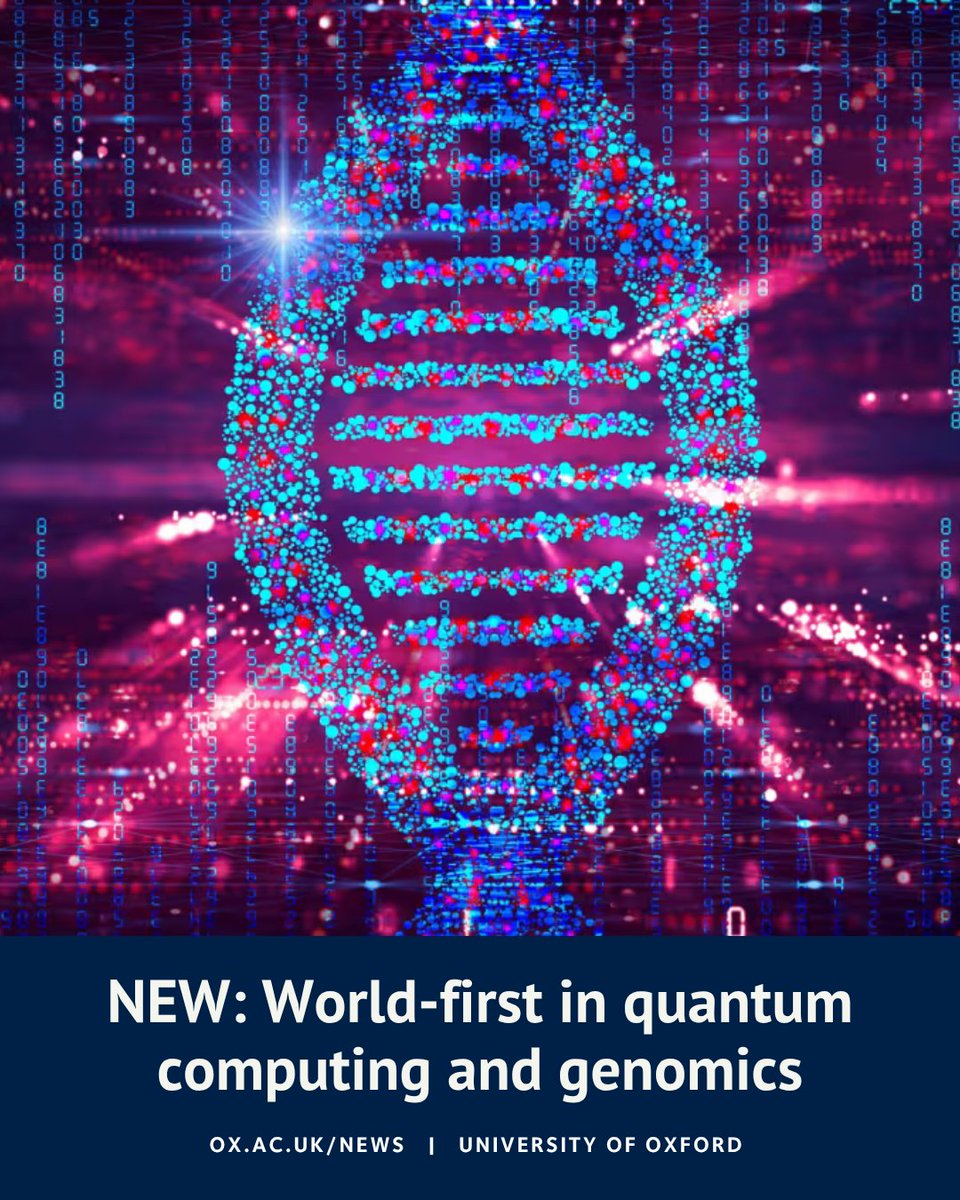
NEW: Oxford researchers have helped to achieve a world first: loading a complete genome onto a quantum computer. This makes an important step towards a future where quantum computing accelerates biological discovery.
Find out more ⬇️
https://t.co/5DROjxivgr
A day in the life of a VC in 2026:
9am: Board meeting. My main value-add is aggressively pushing for Anthropic/OpenAI usage in non-engineering functions. Briefly ponder how I became an SDR for foundation model companies.
1pm: Lunch with another VC. We discuss how startups can find "blue ocean" away Anthropic/OpenAI. We conclude we should probably just invest the rest of our funds directly into Anthropic/OpenAI.
3pm: Pitch meeting. Me: "Do you run on Anthropic or OpenAI?" Founder: "Both." Debating internally whether a company reselling Anthropic/OpenAI with a 10% gross margin is a good investment but hey, at least they're in the "token flow".
4:30pm: Deep due diligence. I ask Claude if it plans to build this exact startup natively in its next release. Same to ChatGPT. They both say yes. I pass on the deal.
6pm: Urgent call from a portco CTO: "We need an intro to upgrade our Anthropic tier!" I immediately agree to help them spend more of the venture dollars we just invested in them, on Anthropic.
8pm: Brainstorming next guests for the podcast. Thinking I should probably just try to get some folks from Anthropic and OpenAI.
All personnel are accounted for and safe. It’s too early to know the root cause but we’re already working to find it. Very rough day, but we’ll rebuild whatever needs rebuilding and get back to flying. It’s worth it.
We've raised $65 billion in Series H funding at a $965 billion post-money valuation, led by @AltimeterCap, Dragoneer, @Greenoaks, and @sequoia.
This investment will help us advance our research and expand our capacity to meet growing demand for Claude.